Q1.
The decimal expansion of \( \frac{33}{8} \) is
Q2.
Express 0.\(\overline6 \) in the form of \( \frac{p}{q} \), where p and q are integers and q \(\not=0\).
\( \frac{2}{3} \)
Show Answer
Q3.
Who were the mathematicians that established the correspondence between real numbers and points on the number line?
Q4.
The value of 1.999…. in the form \( \frac{p}{q} \), where p and q are integers and q \(\not=0\). is:
Q5.
Simplify the expression: (3 - \( \sqrt{3} \))(3 + \( \sqrt{3} \))
6
Show Answer
Q6.
Find the value of x, if \( 3^x \) = 81.
4
Show Answer
Q7.
What is the value of : 15\( \sqrt{15} \) ÷ 3\( \sqrt{3} \) ?
5 \( \sqrt{5} \)
Show Answer
Q8.
If x = \( \sqrt{7} \) - \( \sqrt{6} \), then find the value of \( \frac{1}{x} \).
\( \sqrt{7} \) + \( \sqrt{6} \)
Show Answer
Q9.
Find the least rationalizing factor of \( \sqrt{63} \) .
\( \sqrt{7} \)
Show Answer
Q10.
The number pi (π) has a never-ending decimal expansion. what is the value of π to 10 decimal places?

3.1415926535
Show Answer
Q11.
The product of (8 + 3\(\sqrt{2} \) ) and (8 ⎼ 3\(\sqrt{2} \) ) is
Q12.
An irrational number between 0ꞏ3101 and 0ꞏ333… is
Q13.
The irrational number between 2 and 2.5 is
Q14.
Archimedes showed that 3.140845 < π < 3.142857. Find the difference between the upper and lower bounds of his approximation.
0.002012
Show Answer
Q15.
Express 3\(\frac{1}{8} \) in decimal form and state what kind of decimal expansion it has.
3.125 Terminating
Show Answer
Q16.
Given that \( \frac{1}{7} \)= \( 0.\overline{142857} \). Find the decimal expansion of \( \frac{2}{7} \) without actually performing the long division.
\( 0.\overline{285714} \)
Show Answer
Q17.
Find the value of (\(1^3 + 2^3 + 3^3)^{3/2} \)
216
Show Answer
Q18.
The irrational number \(\sqrt{2} \) , discovered by Hippasus, has a never-ending decimal expansion. What is its value up to 10 decimal places?
1.4142135623
Show Answer
Q19.
If x = 2 + \(\sqrt{3} \) , then find the value of x + \( \frac{1}{x} \)
4
Show Answer
Q20.
Find the value of \( 125^ \frac{1}{3} \)
5
Show Answer
Q21.
If \( 10000^x \) = 10, then find the value of x.
\( \frac{1}{4} \)
Show Answer
Q22.
Find the value of \( 4^ \frac{3}{2} \)
Q23.
If x = 9 + 4\(\text{}\sqrt{5} \), then what is the value of x + \( \frac{1}{x} \)
18
Show Answer
Q24.
What is the rationalizing factor of \(\text{}\sqrt{5} \) +\(\text{} \sqrt{3} \) ?
Q25.
Simplify the expression:
(\(\text{} \sqrt{3} \) + \(\text{} \sqrt{7} )\ ^2 \)
10 + 2\(\text{} \sqrt{21} \)
Show Answer
Q26.
1.\(\overline{54} \) when expressed in the form of \( \frac{p}{q} \), where p and q are integers and q \(\not=0\) is
Q27.
0 .\(\overline{72} \) when expressed in the form of \( \frac{p}{q} \), where p and q are integers and q \(\not=0\) is
Q28.
Observe the given figure of a square. Which theorem can be used to find the length of the diagonal?

Q29.
The value of 0ꞏ55555… in the form \( \frac{p}{q} \), where p and q are integers and q \(\not=0\) is
Q30.
The square roots of positive integers are
Q31.
π is
Q32.
After rationalising the denominator of \( \frac{1}{(\text{} \sqrt {5 } \ ) - (\text{} \sqrt{3 } \ )} \), the denominator obtained is
Q33.
What is the value of (\( 2^ \frac{2}{3} \) x \( 2^ \frac{1}{3} \))?
2
Show Answer
Q34.
Which fraction is equivalent to \( \frac{1}{2} \)?
Q35.
Which of the following is equal to \( \frac{1}{\sqrt{7}\ - 2}\) after rationalising its denominator?
Q36.
If \(x\sqrt{8} + 5\sqrt{8} = 12\sqrt{8}\), then which of the following is the value of x?
Q37.
Which of the following is an irrational number?
Q38.
The decimal expansion of the number \(\sqrt{2} \) is
Q39.
Find the repeating block in the decimal expansion of \( \frac{1}{27} \).
0370
Show Answer
Q40.
Simplify the expression: (5 + \(\sqrt{5} \) )(5 ⎼ \(\sqrt{5} \) )
20
Show Answer
Q41.
Without performing long division, what is the maximum number of digits in the repeating block of the decimal expansion of \(\frac{1}{17} \)?
16
Show Answer
Q42.
To how many decimal places did Aryabhata correctly compute the value of π, and what value did he obtain?
Four decimal places; π=3.1416
Show Answer
Q43.
Observe the numbers 169, 250, 343, and 256. Identify the numbers whose square roots are rational.
169 and 256
Show Answer
Q44.
Which mathematician showed that \(\sqrt{3} \) is irrational. Mention the approximate year as well.
Theodorus of Cyrene, around 425 BC.
Show Answer
Q45.
Simplify \(\frac{6}{8} \) so that numerator and denominator become co-prime.
\(\frac{3}{4} \)
Show Answer
Q46.
What do the fractions \(\frac{1}{2} \) = \(\frac{2}{4} \) = \(\frac{10}{20} \) represents?
Equivalent fractions
Show Answer
Q47.
Which of these numbers can be written as \(\frac{p}{q} \) with q = 1?
Q48.
The product of a non-zero rational number and an irrational number is
Q49.
What is the value of \(\sqrt{32} \) ÷ \(\sqrt{2} \)?
4
Show Answer
Q50.
Find the value of \(( 343)^ \frac{-1}{3} \)?
\(\frac{1}{7} \)
Show Answer
Q51.
Observe the numbers 9, 27, 125, and 36. Identify the numbers whose square roots are irrational.
27 and 125
Show Answer
Q52.
Which of the following is irrational?
Q53.
What is the set of numbers {…, –3, –2, –1, 0, 1, 2, 3, …} called?
Q54.
A rational number is expressed in the form of \(\frac{p}{q} \), where p and q are integers. Which of the following cannot be the value of q?
Q55.
Which fraction is not in the simplest form?
Q56.
Which of these fractions is in the simplest form?
Q57.
Which number is both an integer and a rational number?
Q58.
How many rational numbers are there between − 5 and − 4?
infinite
Show Answer
Q59.
Which of the following is a whole number but not a natural number?
Q60.
The decimal representation of the rational number is
Q61.
If the decimal representation of a number is non-terminating and non-repeating, what type of number is it?
An irrational number
Show Answer
Q62.
Which of the following is a terminating decimal?
Q63.
The decimal expansion of \(\frac{329}{400} \) is
Q64.
What is the decimal representation of \(\frac{10}{3}\)?
3.333...
Show Answer
Q65.
Which of the following is an irrational number?
Q66.
Rationalise the denominator of \( \frac{2}{(\text{} \sqrt {5 } \ ) - (\text{} \sqrt{3 } \ )} \)ꞏ
\(\sqrt{5} \) +\(\sqrt{3} \)
Show Answer
Q67.
Which of the following variables represent a rational number?
Q68.
.Which of the following is equal to 0.66666...?
Q69.
If x = 3 + \(\sqrt{8} \) , then find the value of x + \( \frac{1}{x} \)
6
Show Answer
Q70.
A rational number between \(\frac{1}{9} \) and \(\frac{4}{9} \) is
Q71.
Which of the following is an irrational number between 2.11243... and 2.12243?
Q72.
Every rational number is
Q73.
The rational number \( 0.\overline{3} \) can also be written
Q74.
The product of (\(\sqrt{5} \) +\(\sqrt{7} \) ) and (\(\sqrt{5} \) - \(\sqrt{7} \) ) is
Q75.
Which of the following statements is true?
Q76.
Find the decimal form of 3\(\frac{3}{8} \)
3.375
Show Answer
Q77.
Which of the following is a rational number between 4 and 5?
Q78.
Out of the following, the irrational number is
Q79.
Find the rationalizing factor of 7 - 2\(\sqrt{3} \).
7 + 2\(\sqrt{3} \)
Show Answer
Q80.
Which of the following can be written in the form \( \frac{p}{q} \)?
Q81.
Which of the following numbers is irrational?
Q82.
Which of the following statements is true?
Q83.
A number whose decimal expansion neither terminates nor repeats is called:
Q84.
Peter draws the spiral of irrational numbers on a paper. What is the length of OE in the spiral?
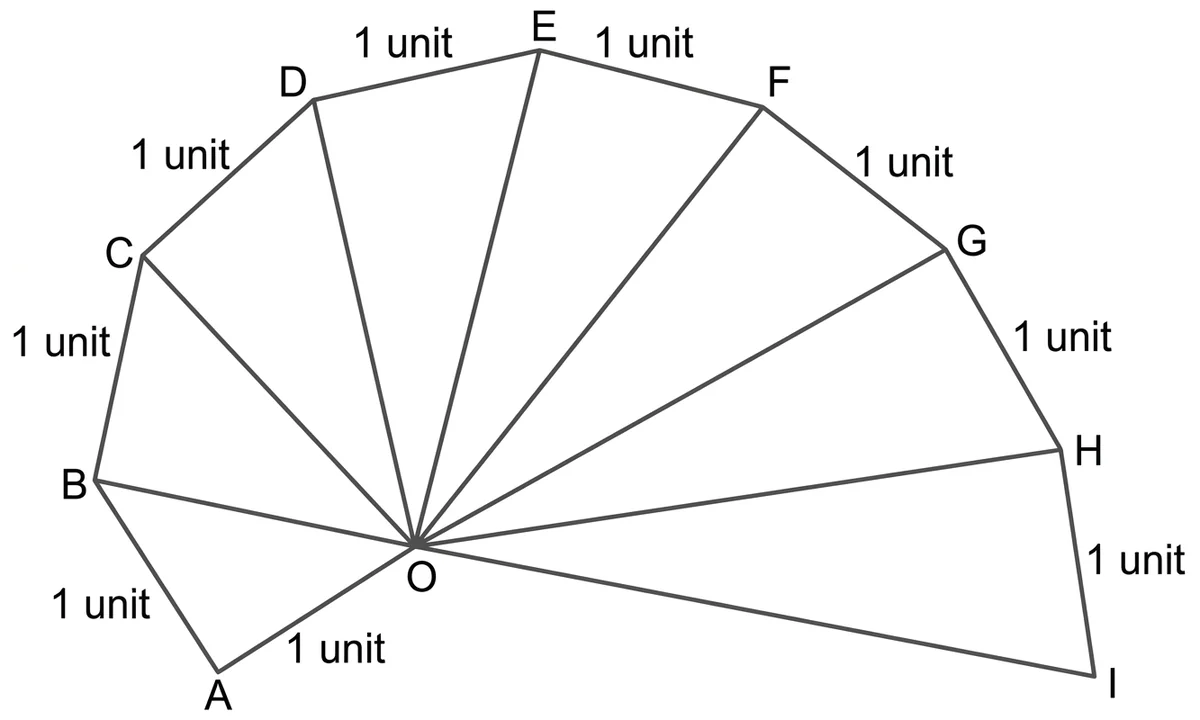
\(\sqrt{5} \)
Show Answer
Q85.
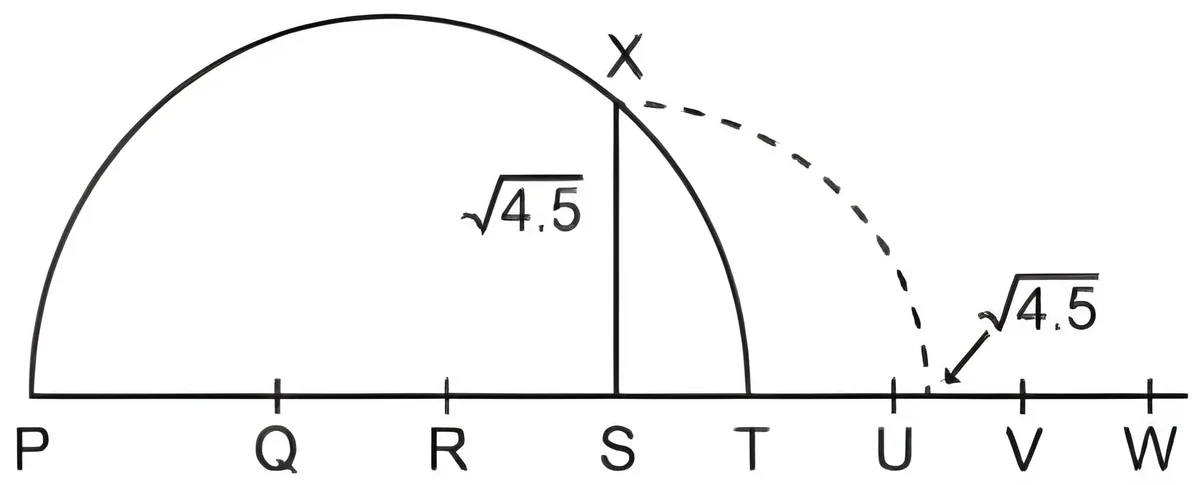
Vasu represents \(\sqrt{4.5} \) on the number line PW. The length of TS = 1 unit. His representation is shown below. Which letter represent the number 0 of the number line?
Q86.
Which of the following is an equivalent fraction to \( \frac{3}{5} \)?
Q87.
Which number has a non-terminating, repeating decimal expansion?
Q88.
The product of two irrational numbers is:
Q89.
12 \(\sqrt{12} \) divided by 3 \(\sqrt{3} \) is equal to
Q90.
In the given figure, OABC is a square with each side of length 1 unit, and ∠OAB = 90°. Using the Pythagorean theorem, find the length of the diagonal OB.
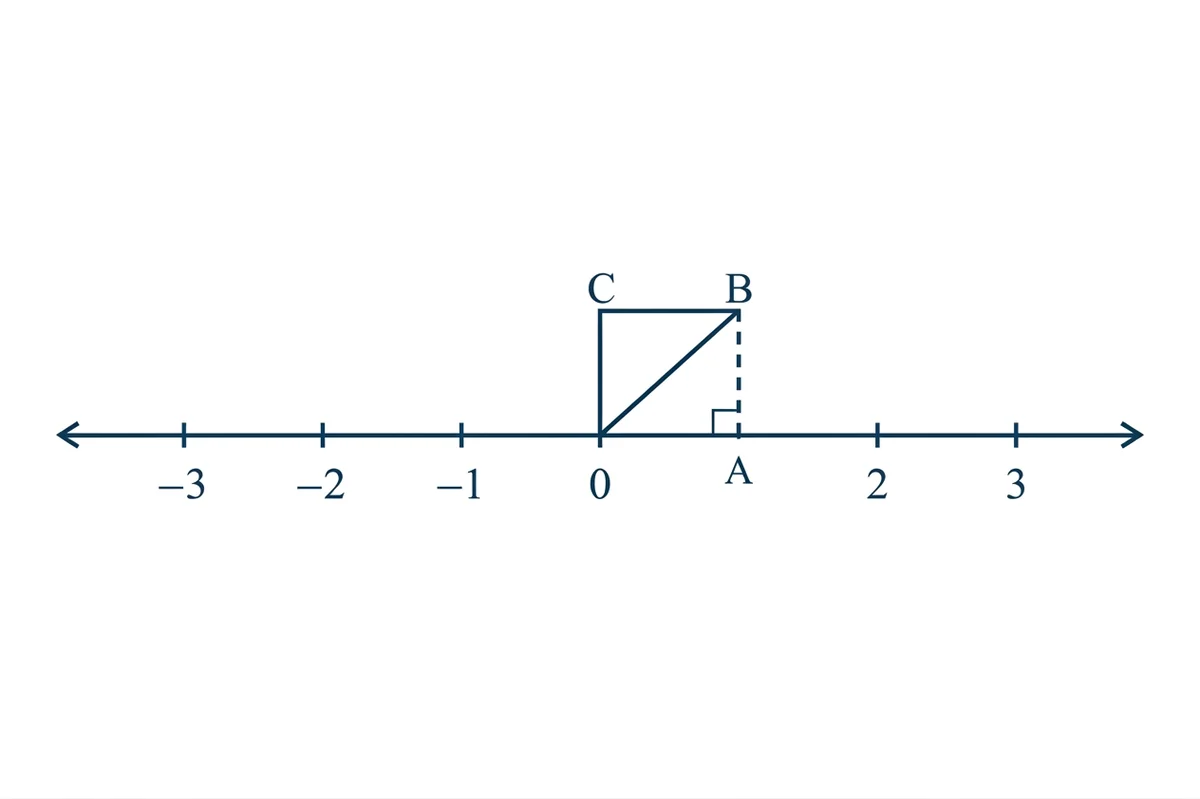
\(\sqrt{2} \)
Show Answer
Q91.
Who was the first mathematician to prove that π is an irrational number, and in which year was this proof established?
Johann Heinrich Lambert in 1761
Show Answer
Q92.
Which of the following is an irrational number between 2 and 3?
Q93.
In 1761, Lambert proved that π is irrational. His work was further refined by another mathematician in 1794. What was the name of that mathematician?
Adrien-Marie Legendre
Show Answer
Q94.
Starting with a unit square whose diagonal OB=√2, a perpendicular line segment BD of length 1 unit is drawn from B. What irrational number is represented by the hypotenuse OD?
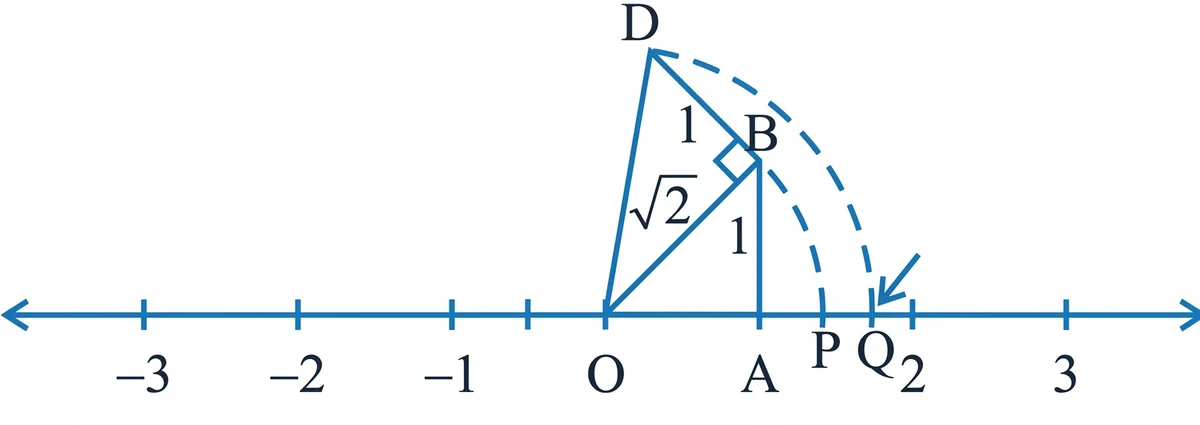
\(\sqrt{3} \)
Show Answer
Q95.
If \(\sqrt{2} \) and \(\sqrt{3} \) are constructed successively on the number line using perpendicular unit segments, which number will be obtained in the next step?
2
Show Answer
Q96.
Without constructing \(\sqrt{2} \), \(\sqrt{3} \), and \(\sqrt{4} \) successively, determine the lengths of the two perpendicular sides of a right triangle that can be used to construct √5 directly on the number line.
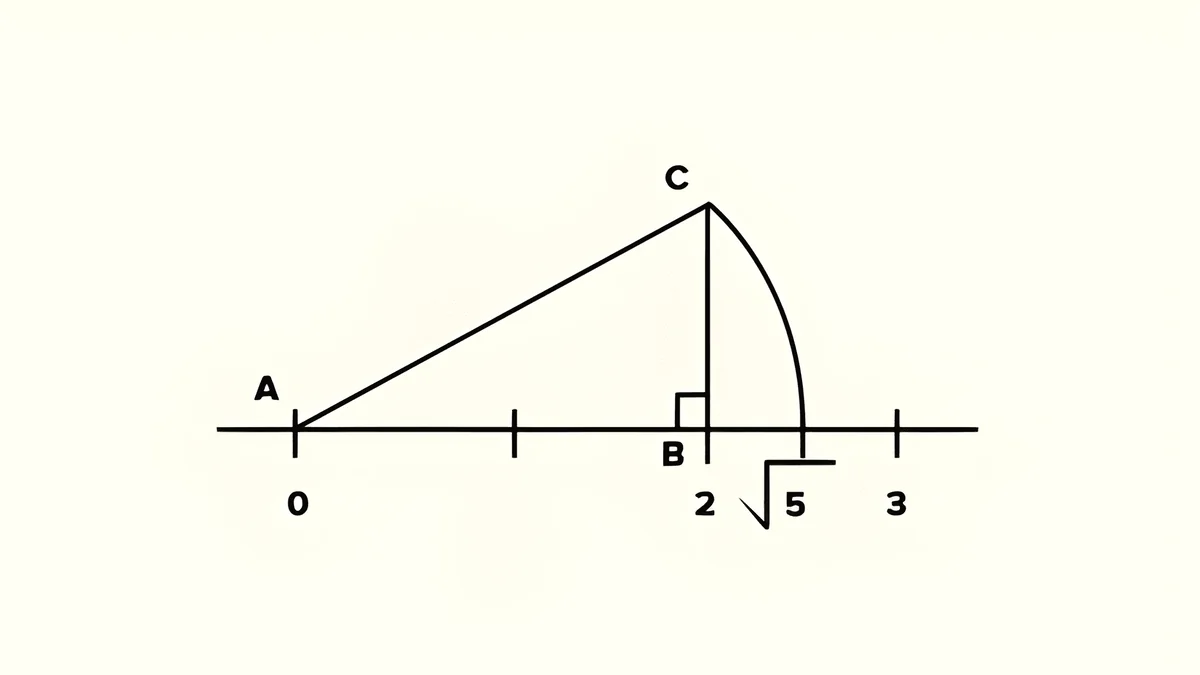
1 unit and 2 units
Show Answer
Q97.
Observe the following rational numbers: \( \frac{1}{2} \) = 0.5, \( \frac{11}{25} \) = 0ꞏ44, \( \frac{9}{20} \) = 0ꞏ45. All of these have terminating decimals. What special property must the denominators satisfy?
The denominators must have only power of 2 or powers of 5 or both as prime factors.
Show Answer
Q98.
If \( \frac { 2 + \sqrt{3}}{2 - \sqrt{3}} \) = a + b\(\sqrt{3} \), find the values of ‘a’ and ‘b’.
a = 7, b = 4
Show Answer
Q99.
Which of the following is a rational number between \(\sqrt{2} \) and \(\sqrt{3} \) ?
Q100.
Express \( 0.\overline{001} \) in the form of \(\frac{p}{q} \), where p and q are integers and q≠0.
\( \frac{1}{999} \)
Show Answer
Q101.
If a=2 - \(\sqrt{3} \) ,then find the value of a + \( \frac{1}{a} \)
4
Show Answer
Q102.
Which of the following is an irrational number?
Q103.
Assertion (A): The sum of two irrational numbers is always irrational.
Reason (R): Irrational numbers cannot be expressed in the form \( \frac{p}{q} \), where p and q are integers and q≠0.
Q104.
Which of the following pairs has a rational product but an irrational sum?
Q105.
Express 0.6 + \( 0.\overline{7} \) in the form of \(\frac{p}{q} \), where p and q are integers and q≠0.
\( \frac{62}{45} \)
Show Answer
Q106.
What is the simplest form of the expression \(\frac{\sqrt {2} + 1}{\sqrt{2} - 1 } \)?
3 + 2\(\sqrt{2} \)
Show Answer
Q107.
If \( x^{-2} \) = \(\frac{1}{9} \), then what is the value of x?
3
Show Answer
Q108.
Which of the following is equal to x?
Q109.
Simplify: \(\sqrt[4]{81} \) - 8 \(\sqrt[3]{216} \) + 15 \(\sqrt[5]{32} \) + \(\sqrt{225} \)
0
Show Answer
Q110.
What is the value of \( 16^{-\frac{1}{4}} \) x \(\sqrt[4]{16} \)?
1
Show Answer
Q111.
Simplify the following expression:
\( 3(243)^{-\frac{1}{5}} \) + \( 6^2 \)\( (216)^{-\frac{2}{3}} \) + \( 4^3 \)\( (256)^{-\frac{3}{4}} \)
3
Show Answer
Q112.
Find the value of \( 27^{\frac{1}{3}} \) - \( 27^{\frac{2}{3}} \)
-6
Show Answer
Q113.
Simplify the expression: \( 27^{-\frac{1}{3}} \) x \( 27^{-\frac{1}{3}} \)
\(\frac{1}{9} \)
Show Answer
Q114.
Simplify the expression: \(\frac{\left(x^{a-b}\right)\times\left(x^{b-c}\right)}{x^{c-a}} \)
\( x^{2(a-c)} \)
Show Answer
Q115.
Find the value of the expression \( \left\{7\left(64^{\frac{1}{3}}+27^{\frac{1}{3}}\right)\right\}^{\frac{1}{2}}\)
7
Show Answer
Q116.
If the \(\frac{p}{q} \) form of 0.72 is \(\frac{m}{n} \), then find the value of (m + n).
43
Show Answer
Q117.
Which of the following is a rational number between - 2 and - 5?
Q118.
\( \text{If } a = 2^{\frac{1}{3}} \text{ and } b = 2^{\frac{2}{3}}, \text{ find the value of } a^3 b^3. \)
8
Show Answer
Q119.
\( \text{If } a = 2+\sqrt{3} \text{ and } b = 2-\sqrt{3}, \text{ find } a^2+b^2. \)
14
Show Answer
Q120.
Find the value of x, if
3 + \( 2^x \) = \( \left(64\right)^{\frac{1}{2}} + \left(27\right)^{\frac{1}{3}} \)
3
Show Answer
Q121.
In the figure, OA=1 unit and AB=1 unit, with ∠OAB=90∘. Find the length of OB.
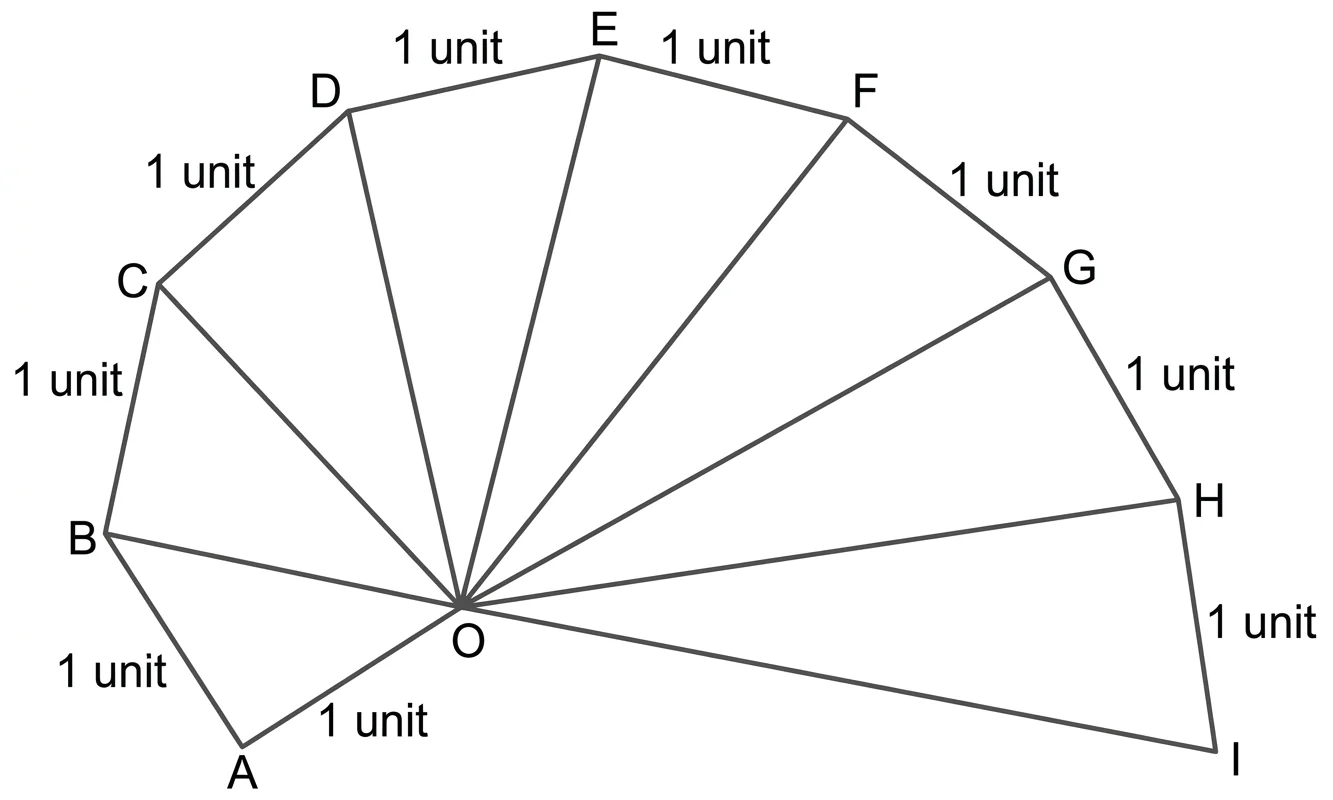
\(\sqrt{2} \)
Show Answer
Q122.
Which of the following are the three rational numbers between 3 and 4?
Q123.
What is the simplest form of the decimal 0.272727...?
\(\frac{3}{11} \)
Show Answer
Q124.
A rational number between \( \frac{1}{4} \) and \( \frac{1}{2} \) is
Q125.
Assertion (A): The decimal expansion of \( \frac{1}{8} \) is terminating.
Reason (R): The denominator 8= \( 2^3 \) has only 2 as its prime factor.
Q126.
Using the successive square-root construction method, \(\sqrt{7} \) can be located on the number line after locating:
Q127.
Find the product of the following:
\( \left(\frac{ \sqrt{3} - 1}{2}\right)\times\left(\frac{\sqrt{3} + 1}{3}\right) \)
\( \frac{1}{3} \)
Show Answer
Q128.
Simplify: \( \left(\sqrt{2}+\frac{1}{\sqrt{2}}\right)^2 \)
\( \frac{9}{2} \)
Show Answer
Q129.
If \( \frac{\sqrt{3}-1}{\sqrt{3}+1}=a + b\sqrt{3} \), then find the values of a and b.
a = 2, b = -1
Show Answer
Q130.
Assertion (A): Every integer is a rational number.
Reason (R): Any integer 'n' can be written as \(\frac{n}{1} \) where 1 ≠ 0