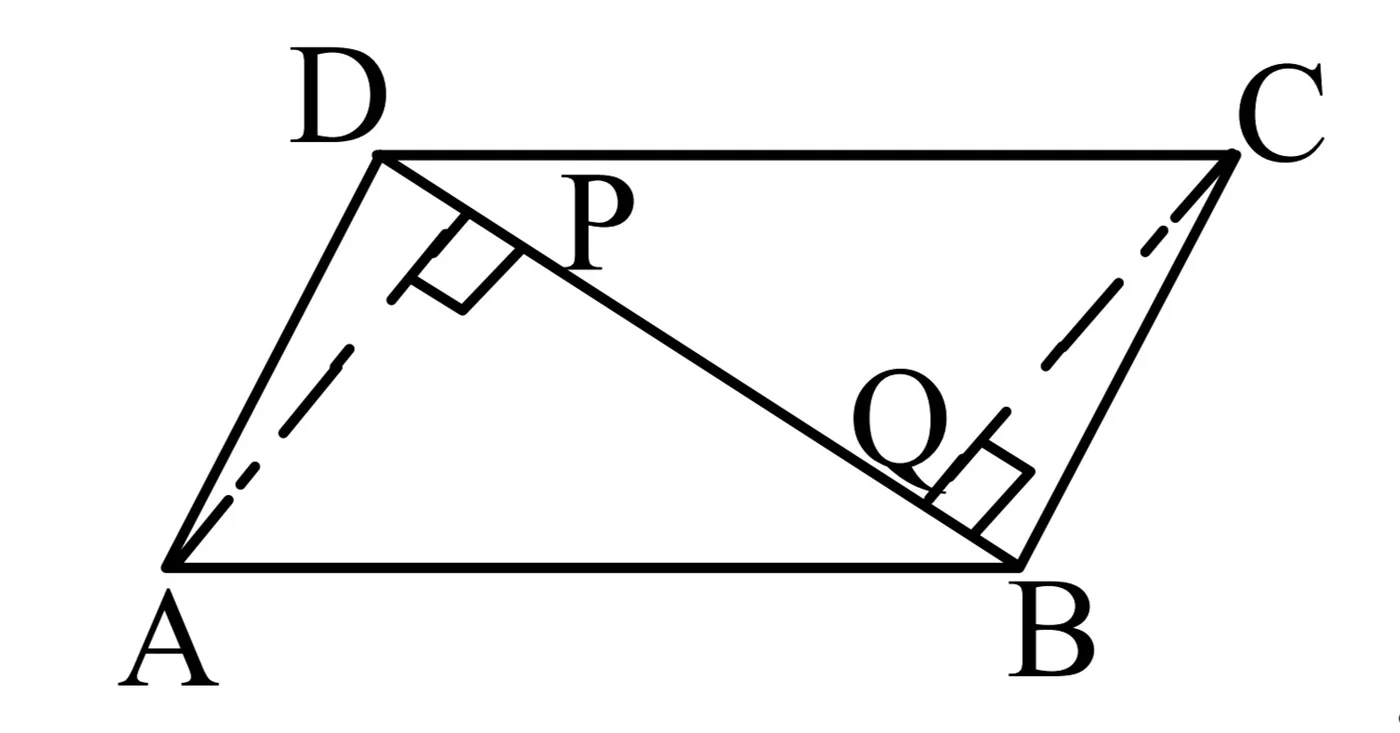
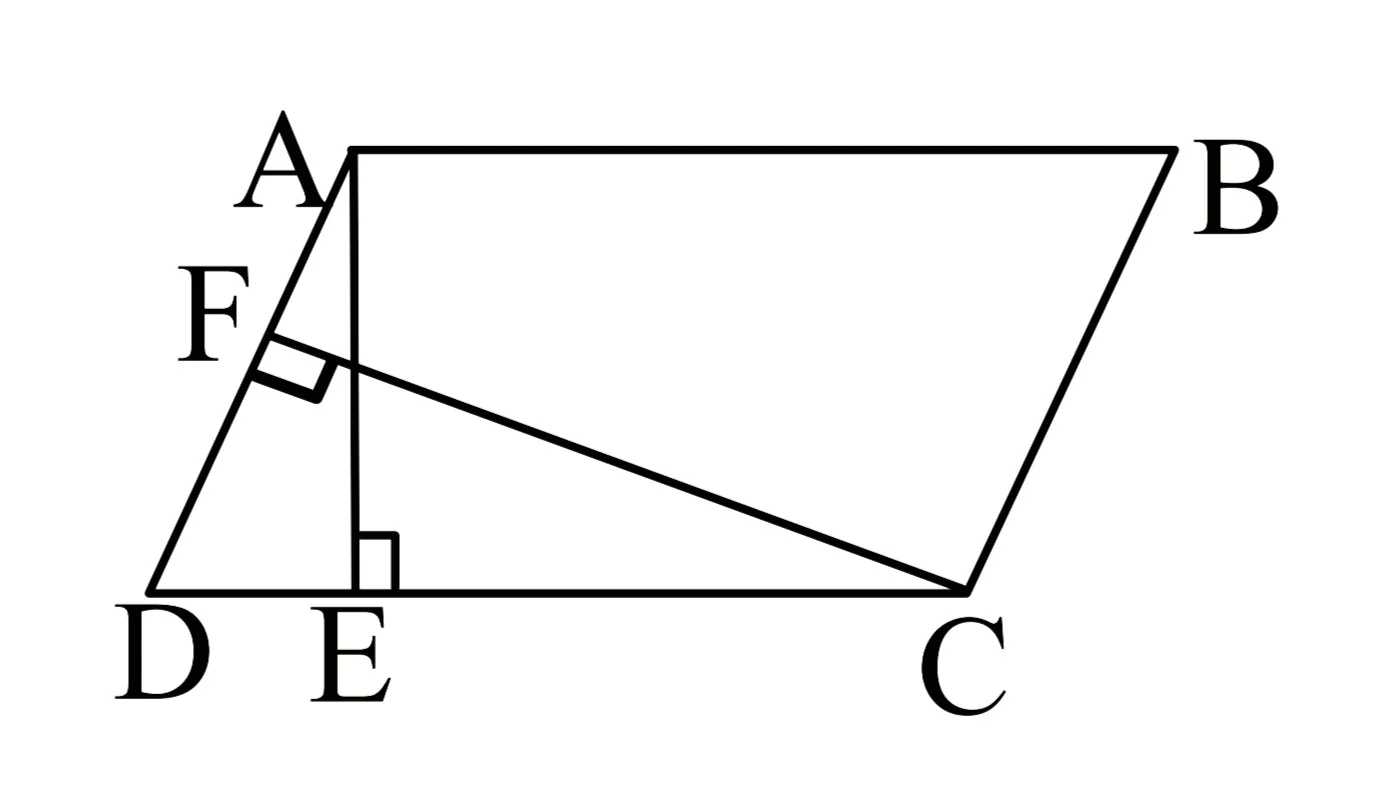
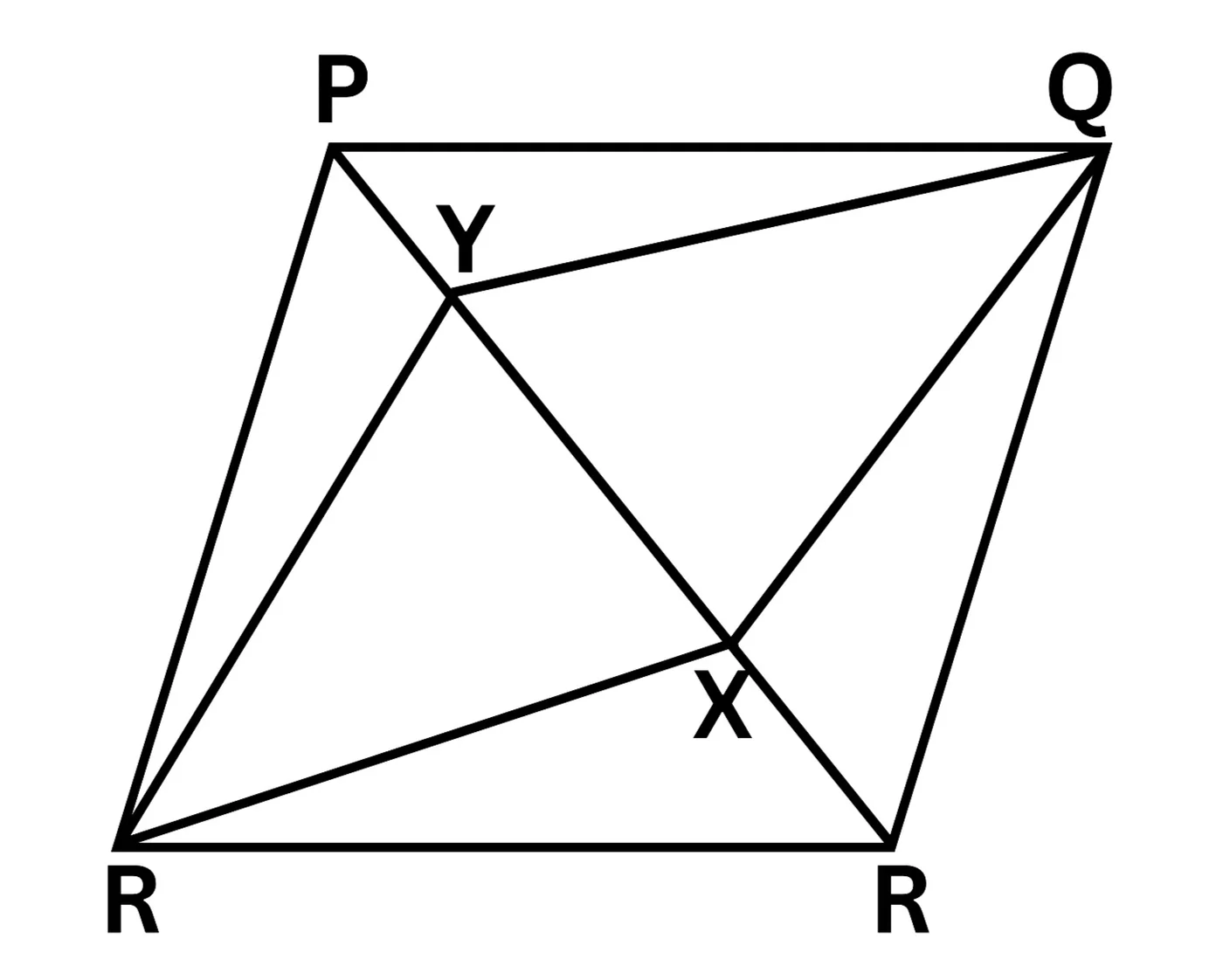
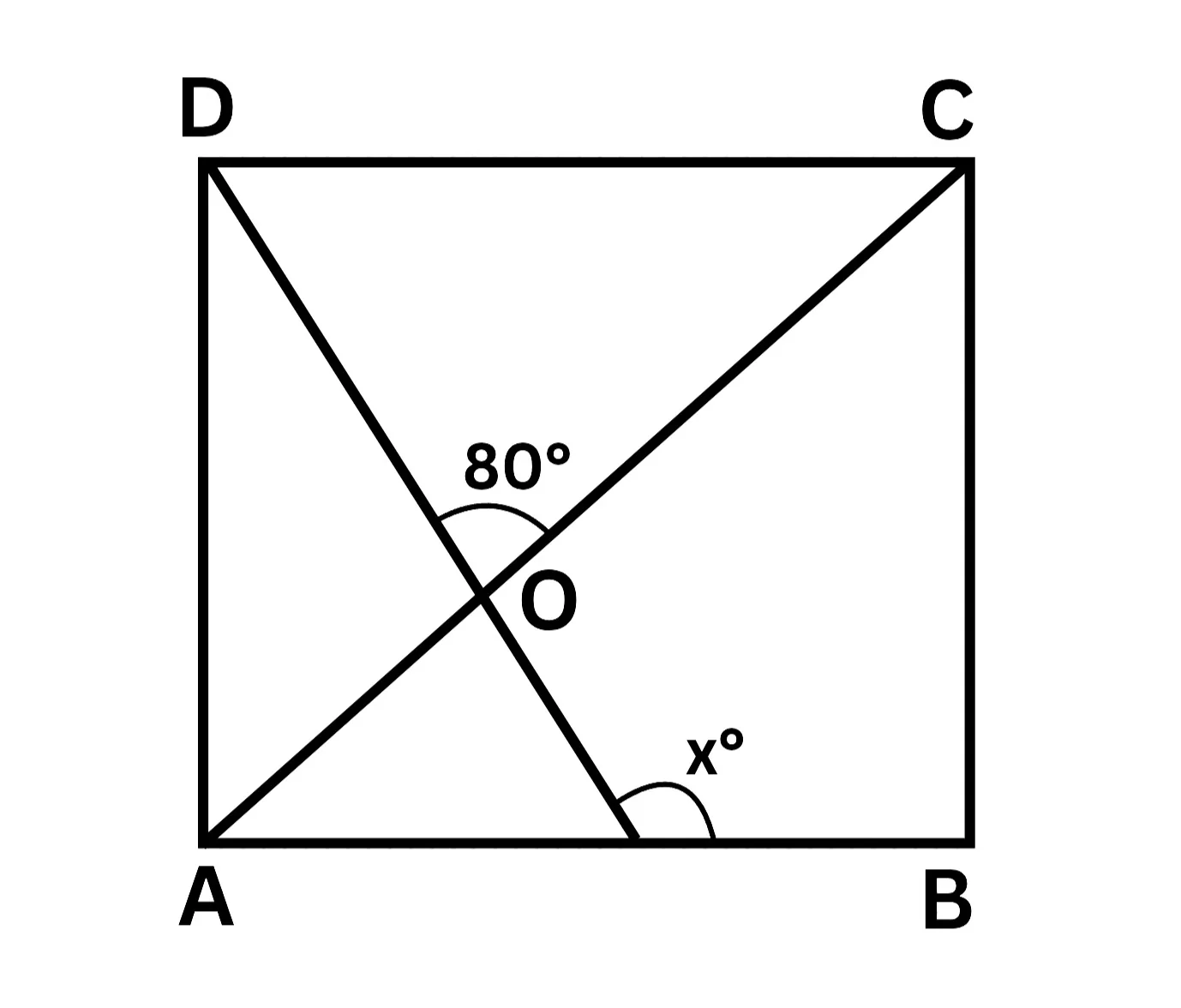
Q14.In a parallelogram ABCD, if AB = 6 cm, BC = 8 cm, then the perimeter is:
A14 cm
B28 cm
C24 cm
D20 cm
Q15.If diagonals of a quadrilateral are equal but do not bisect each other, then it is:
ARectangle
BIsosceles trapezium
CSquare
DParallelogram
Q16.If a parallelogram has all sides equal but diagonals are not equal, then it is a:
ARectangle
BSquare
CRhombus
DKite
Q17.In which of the following quadrilateral, the pairs opposite sides are parallel but diagonals are not equal?
ASquare
BRectangle
CKite
DParallelogram
Q18.What is the the relationship between the angle formed by the bisectors of any two adjacent angles of a parallelogram to the sum of the pair of adjacent angles?
AThey are equal.
BThe angle between bisectors is twice the sum.
CThe angle between bisectors is half the sum.
DThe angle between bisectors is one-fourth the sum.
Q19.In a rhombus ABCD, if \(\angle ACB = 40^\circ\), then the measure of \(\angle BCD\) is:
A\(40^\circ\)
B\(45^\circ\)
C\(80^\circ\)
D\(100^\circ\)
Q20.In quadrilateral ABCD, diagonals AC and BD bisect each other at right angle. if \(\angle ADB = 40^\circ\), then the measure of \(\angle DCB\) is:
A\(50^\circ\)
B\(100^\circ\)
C\(40^\circ\)
D\(80^\circ\)
Q21.In rectangle PQRS, if \(\angle PRS = 50^\circ \), then what will be the measure of \(\angle PSQ\)?
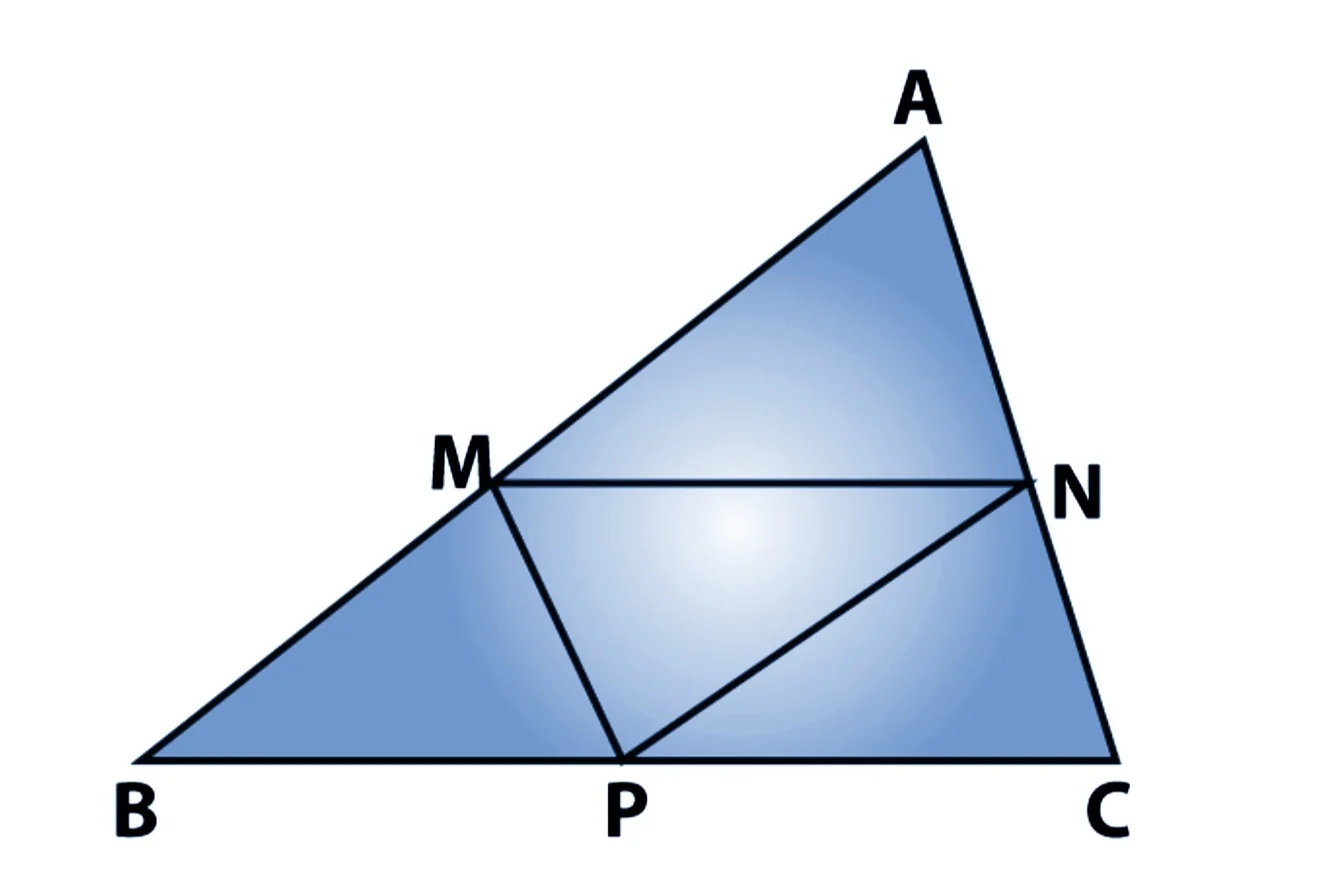
Q37.In the given figure, M, N and P are mid-points of AB, AC and BC respectively. If MN = 3 cm, NP = 3.5 cm and MP = 2.5 cm, then the perimeter of \(\triangle ABC\) is:
A15 cm
B9 cm
C18 cm
D10 cm
Q38.The ratio of the perimeter of the triangle formed by joining the midpoints of the sides of a given triangle to the perimeter of the given triangle is:
A1:2
B2:1
C1:1
D1:3
Q39.In quadrilateral ABCD, the bisectors of \(∠A \) and \(∠B \) intersect at O such that \(∠AOB = 75^\circ\). Find the value of \(∠C + ∠D\).
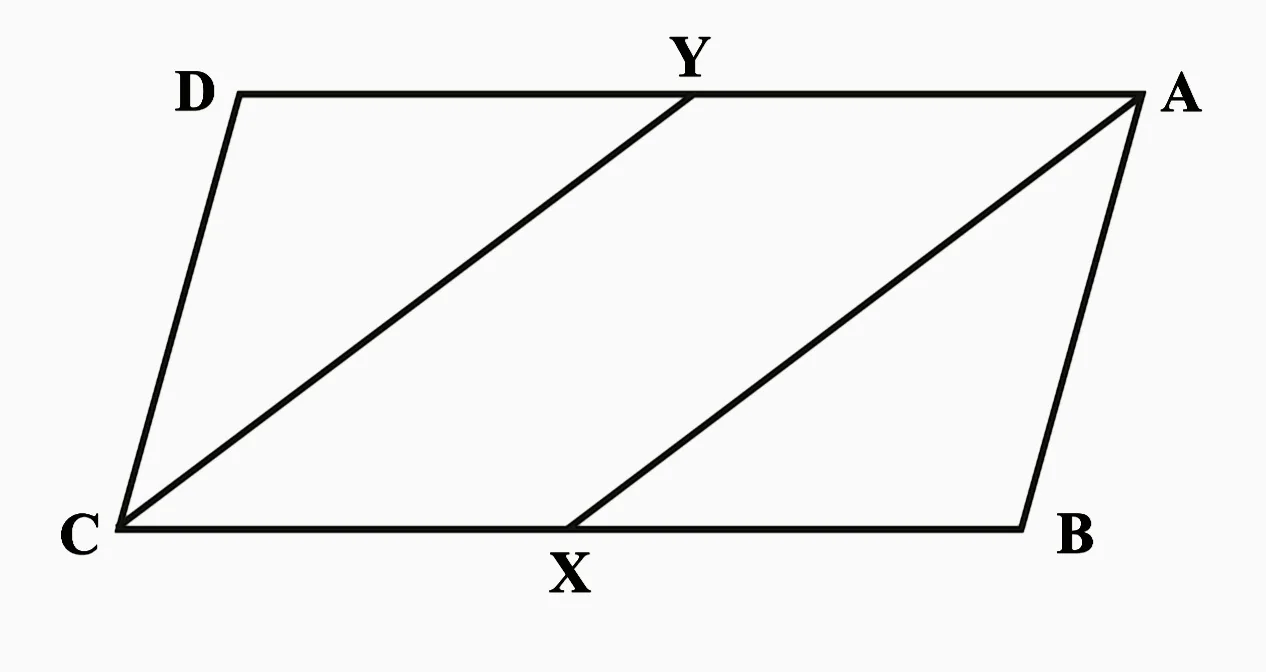
Q64.In the adjoining figure, AX and CY are respectively the bisectors of the opposite angles A and C of a parallelogramABCD. Then:
AAXCY is a Rhombus.
BAXCY is a parallelogram.
CBoth A and B
DNeither A nor B
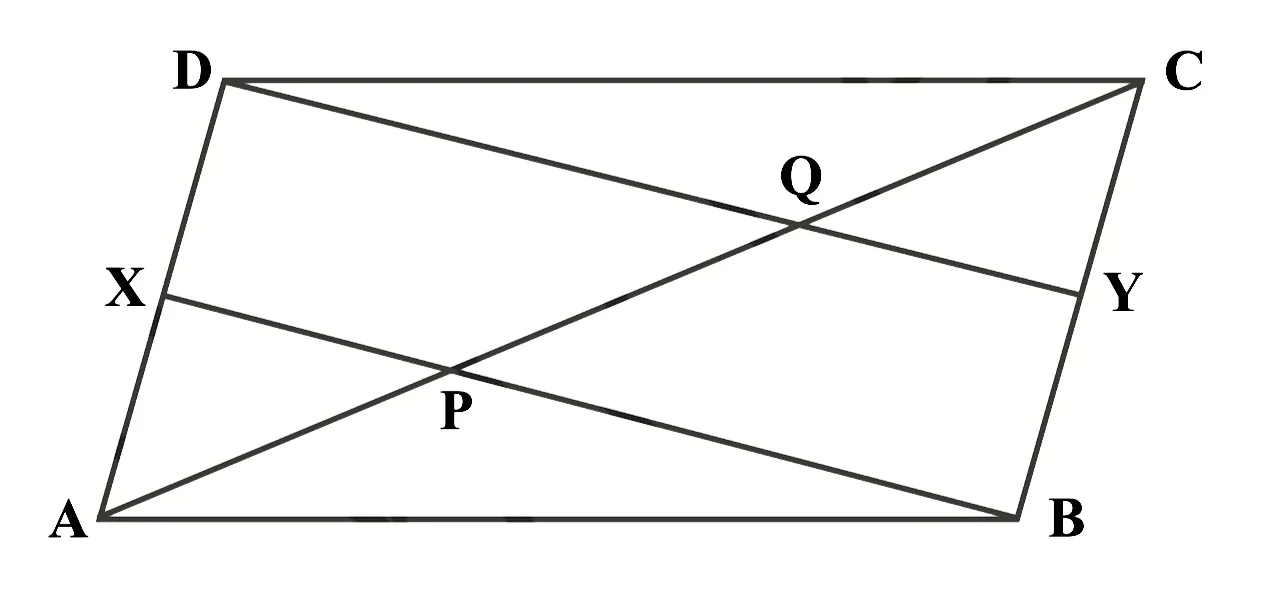
Q65.X and Y are respectively the mid-points of the opposite sides AD and BC of a parallelogram ABCD. Also, BX and DY intersect AC at P and Q, respectively. Which of the following is incorrect?
APoint P trisects AC
BPoint Q trisects AC
CPoint P bisects AQ
DPoint P bisects AC
Q66.If a diagonal of a parallelogram bisects one of its interior angles, then the parallelogram is necessarily a:
ARhombus
BSquare
CRectangle
DTrapezium
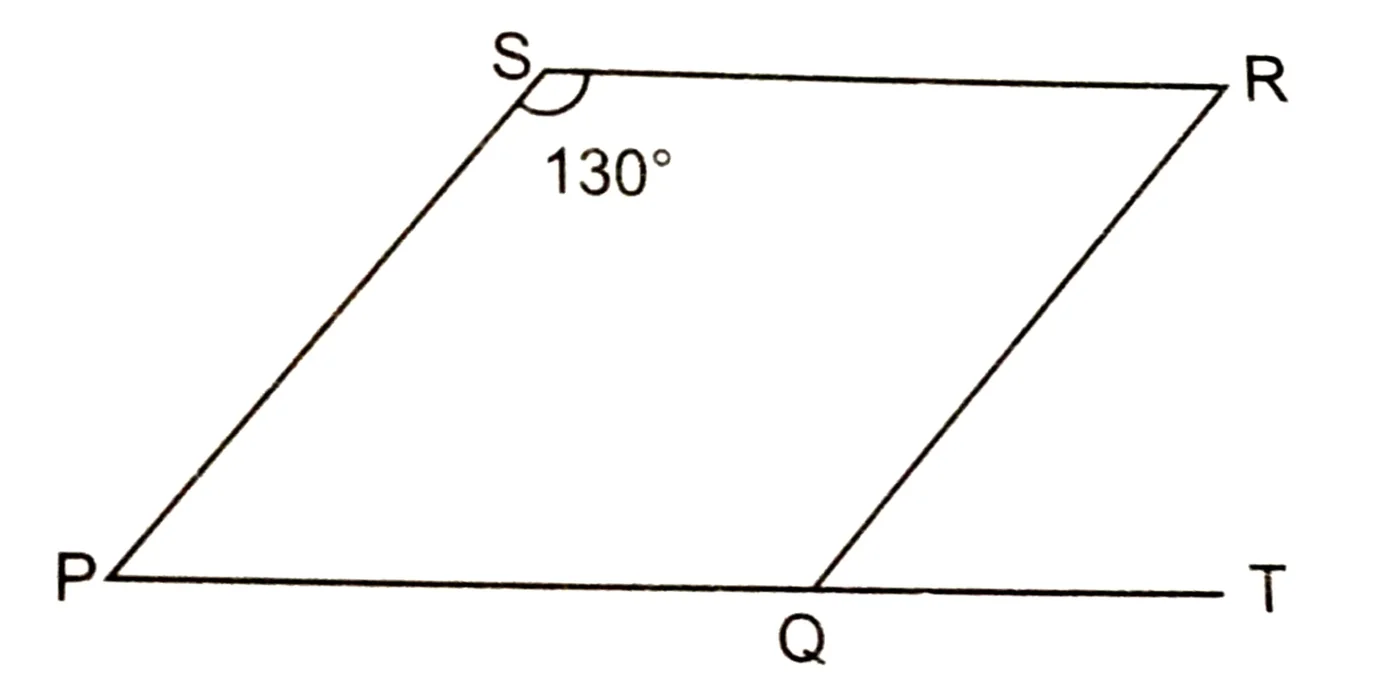
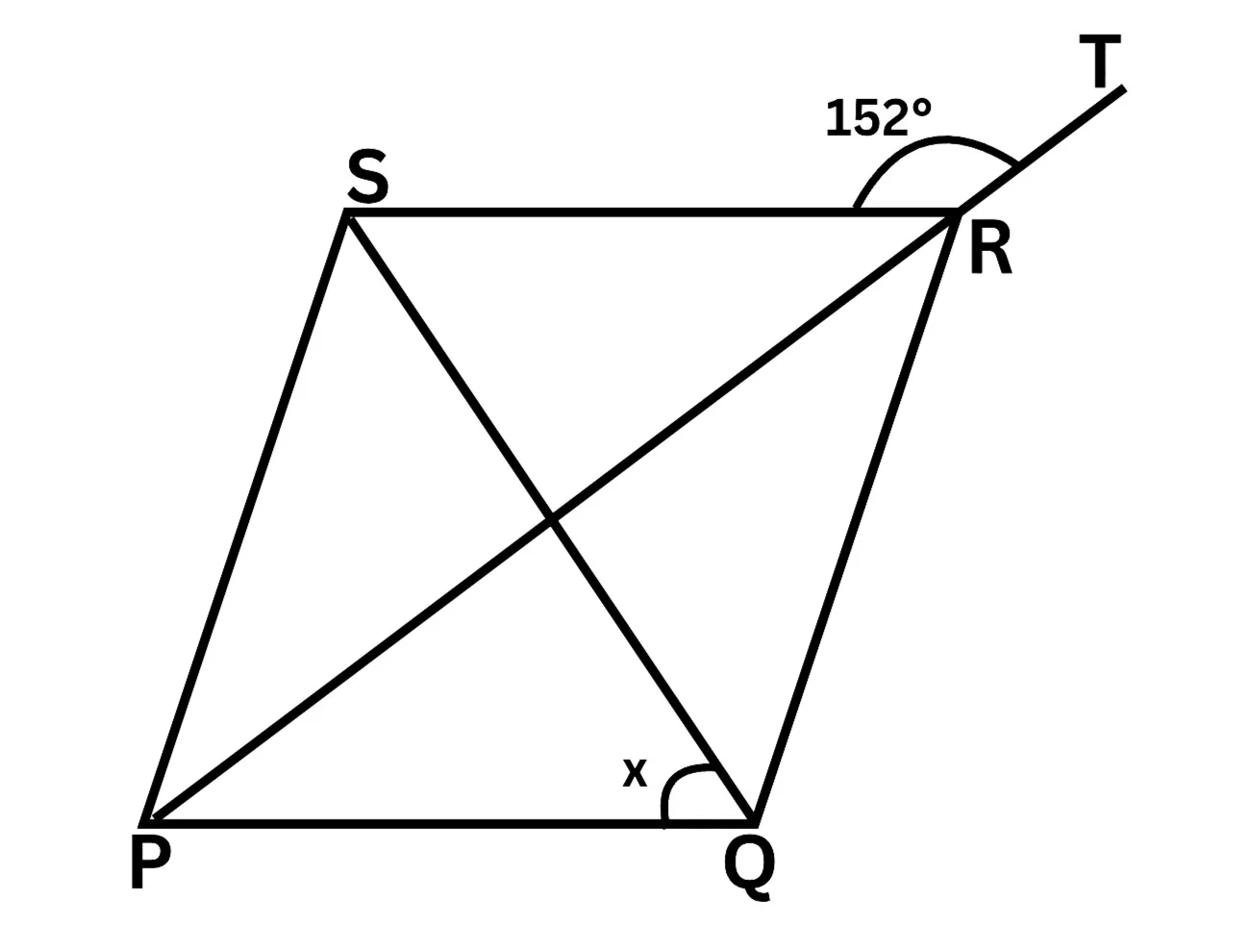
Q67.In the adjoining figure, the diagonal PR of a rhombus PQRS is produced to T. If \(\angle SRT = 152^\circ\), then the value of x is:
A\(28^\circ\)
B\(56^\circ\)
C\(62^\circ\)
D\(124^\circ\)
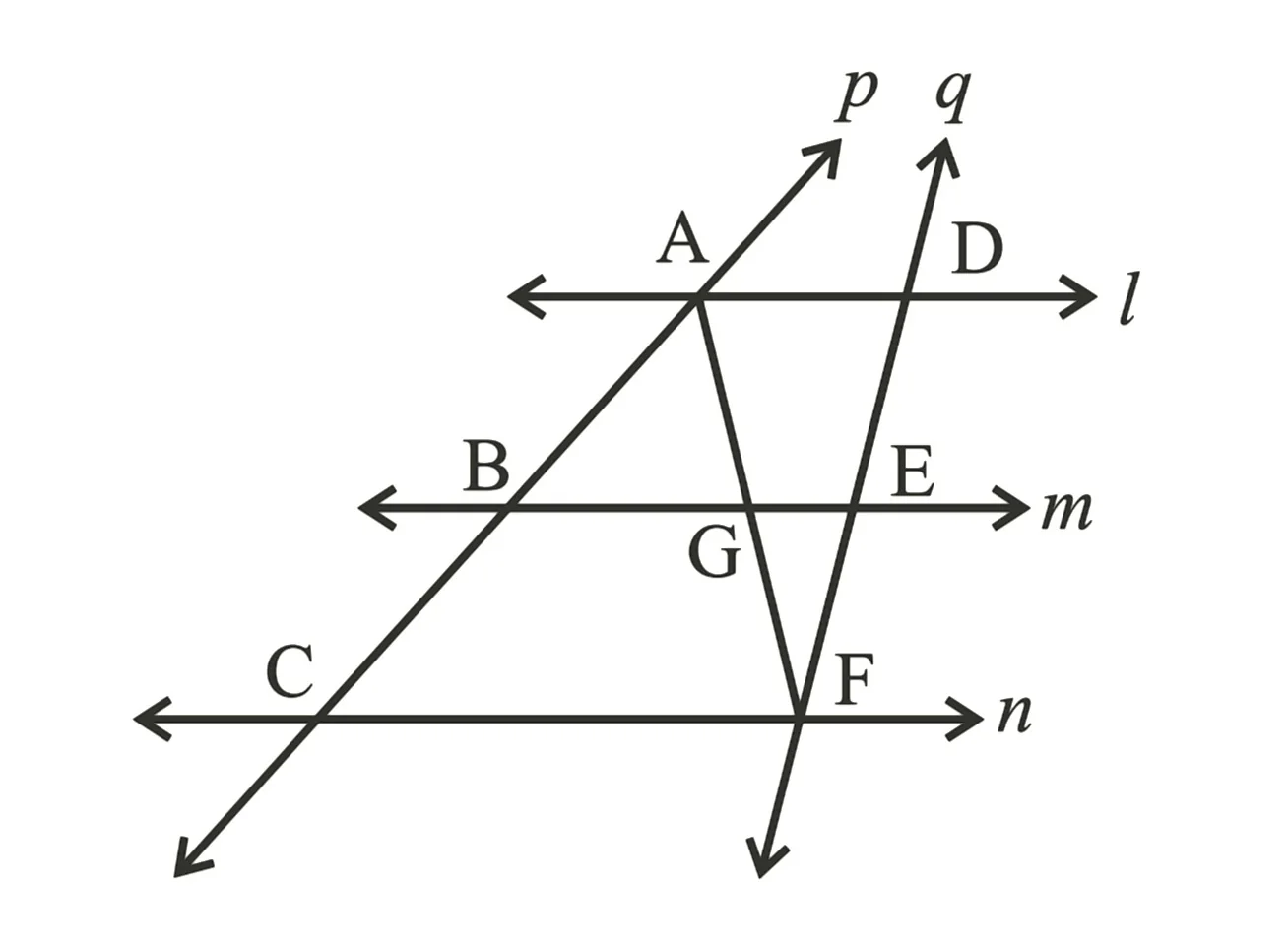
Q68.In the given figure, l, m and n are three parallel lines intersected by transversals p and q such that l, m and n cut off equal intercepts AB and BC on p. Which theorem proves that G is a midpoint of AF?
AMidpoint theorem
BConverse of midpoint theorem
CPythagoras theorem
DLines pair theorem.
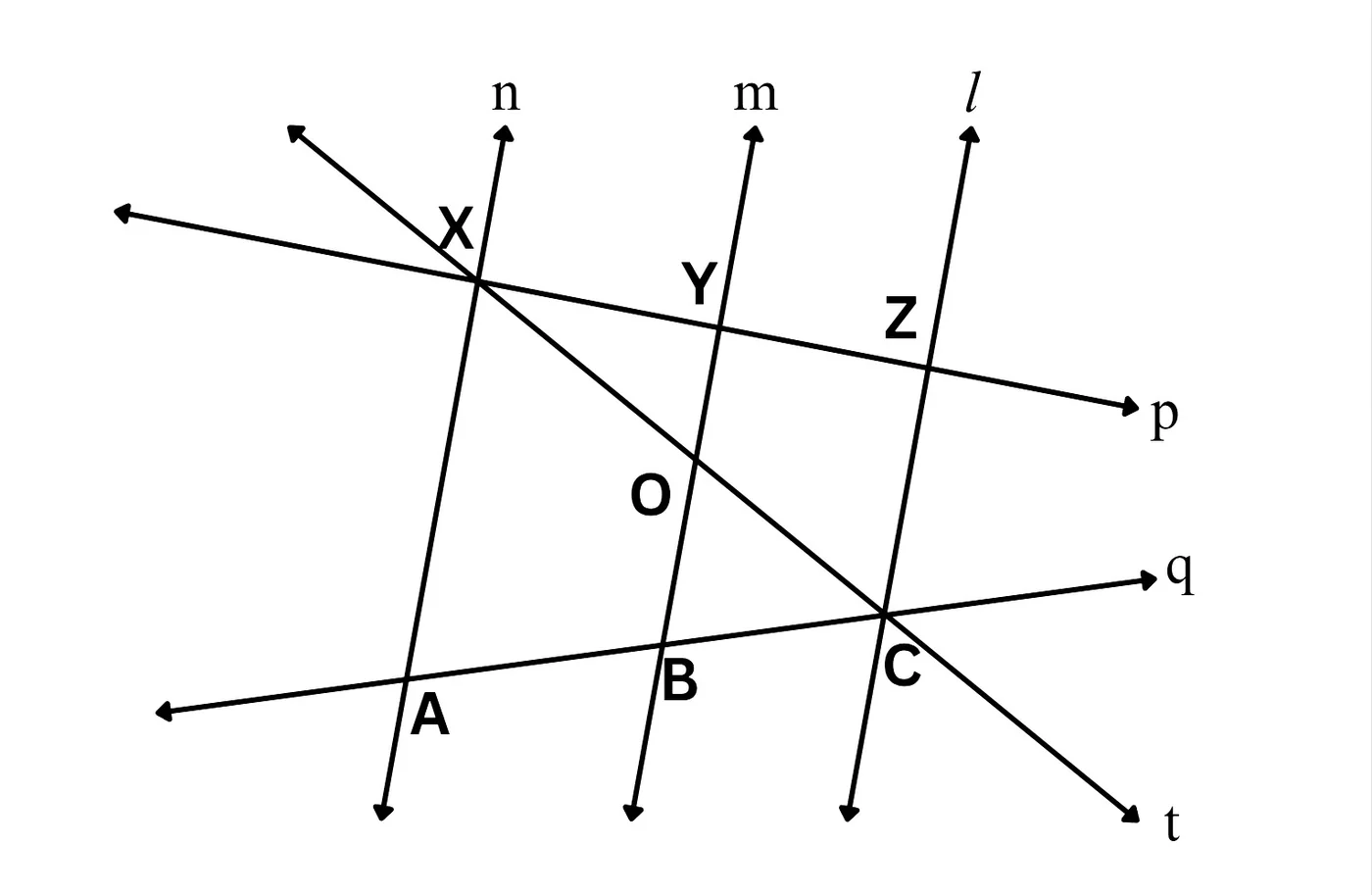
Q69.In the given figure, l, m, and n are parallel lines cut by transversals t, p, and q. If B is equidistant from A and C, which of the following is false?
A\( BO = \frac{1}{2}AX \)
B\( OY = \frac{1}{2}ZC \)
C\( CO = \frac{1}{2}CX \)
D\( BO = \frac{1}{2}CZ \)
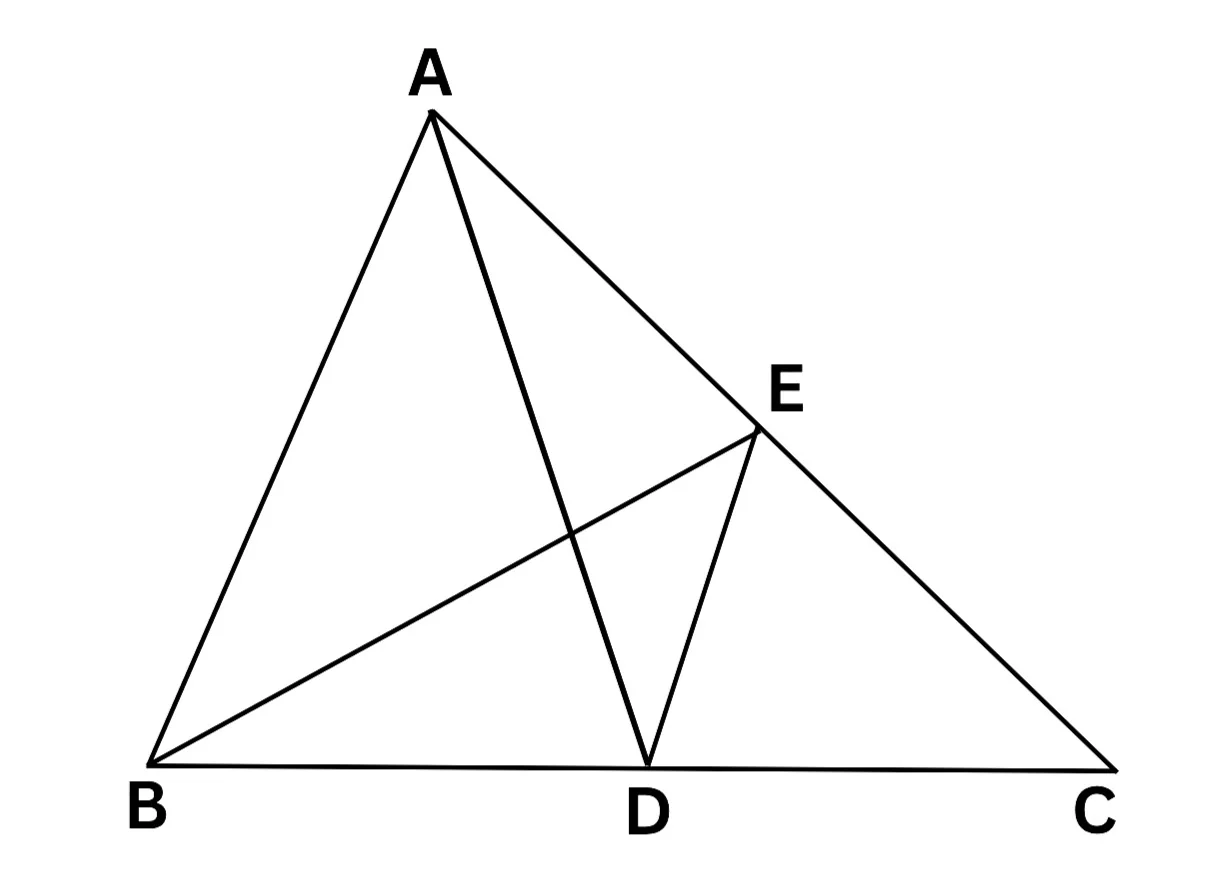
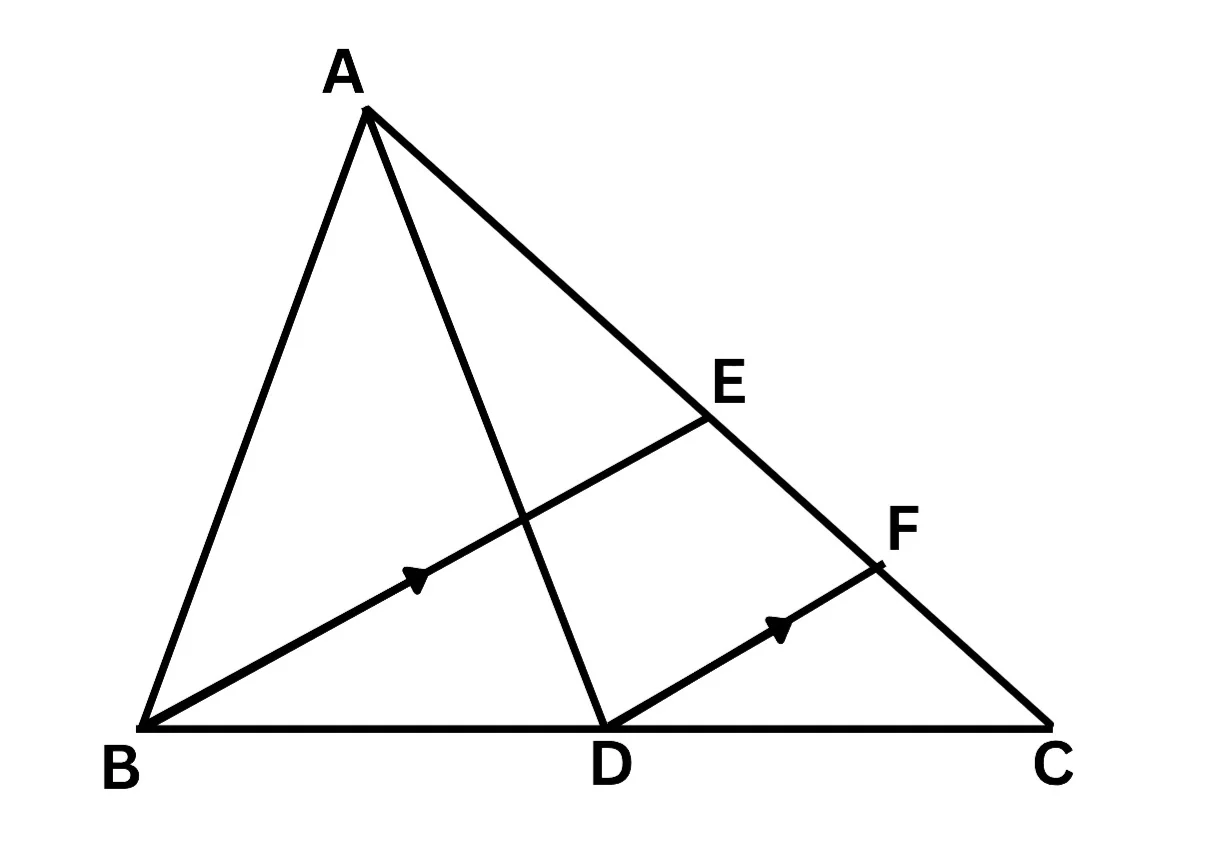
Q70.In the given figure, AD is the median and \(DE \parallel AB\). Which of the following statement is valid?
ABE bisects \(\angle ABC\).
BAD bisects \(\angle ABC\).
CE is a midpoint of AC.
DBE equals AD.
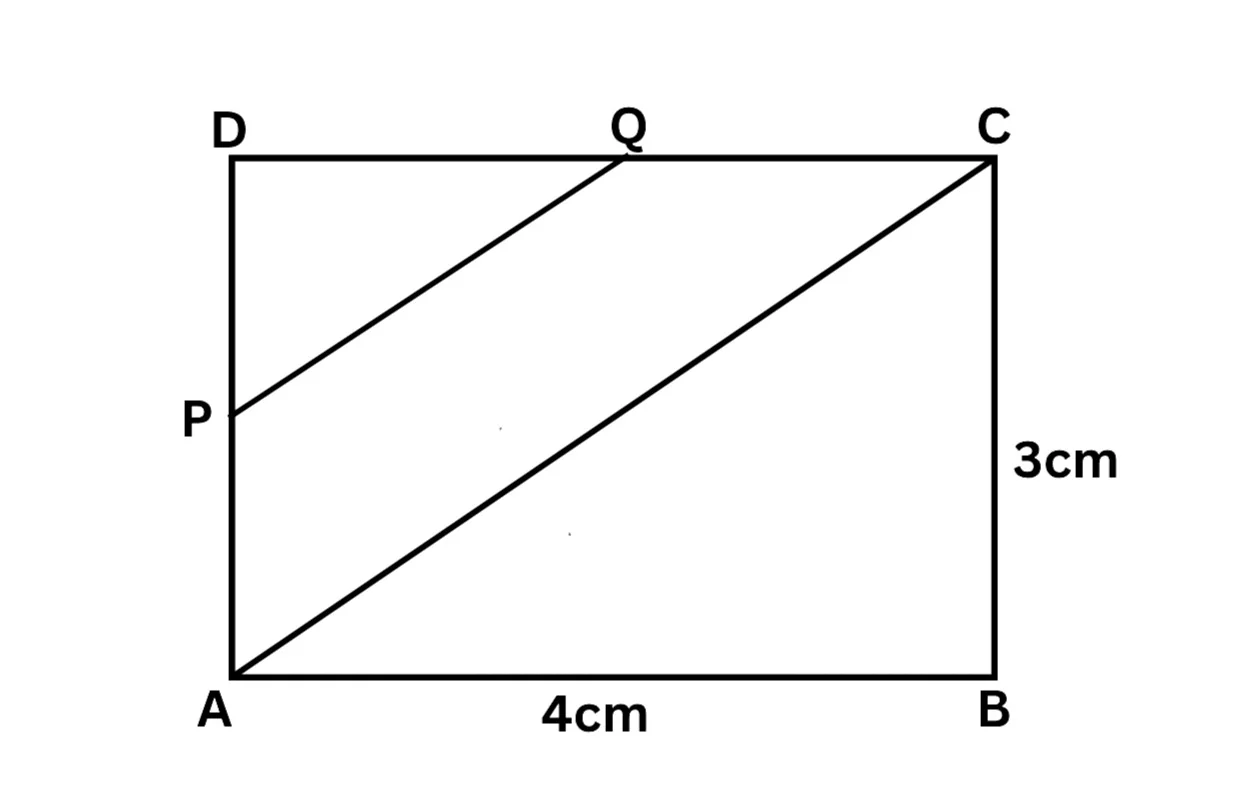
Q71.In the given figure, ABCD is a rectangle. P and Q are mid - points of AD and DC respectively. The length of PQ is:
A5 cm
B4 cm
C2.5 cm
D2 cm
Q72.Two diagonals are equal in a:
AParallelogram
BRhoumbus
CRectangle
DTrapezium
Q73.Diagonals necessarily bisect opposite angles in a:
ARectangle
BParallelogram
CIsosceles trapezium
DSquare
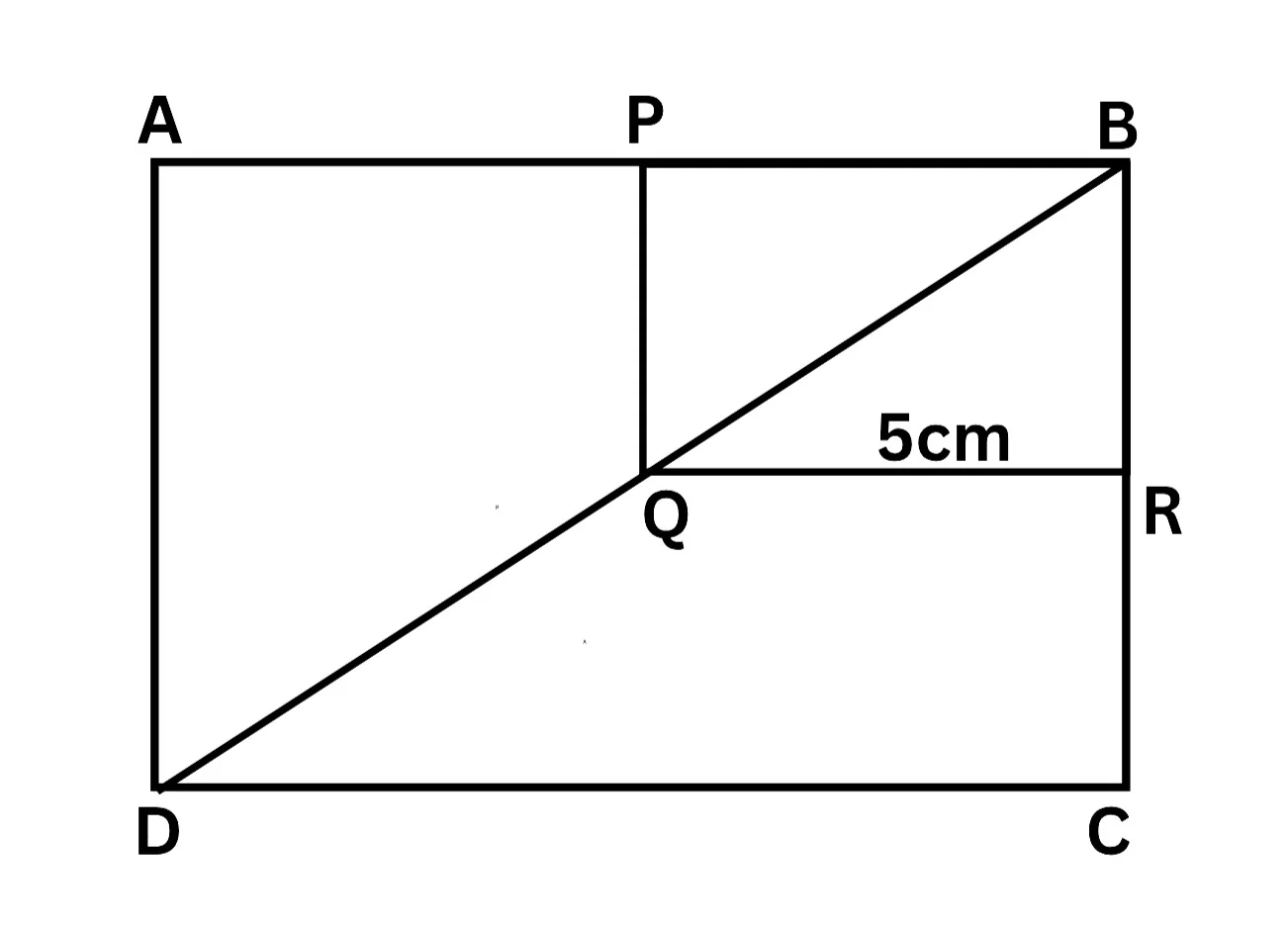
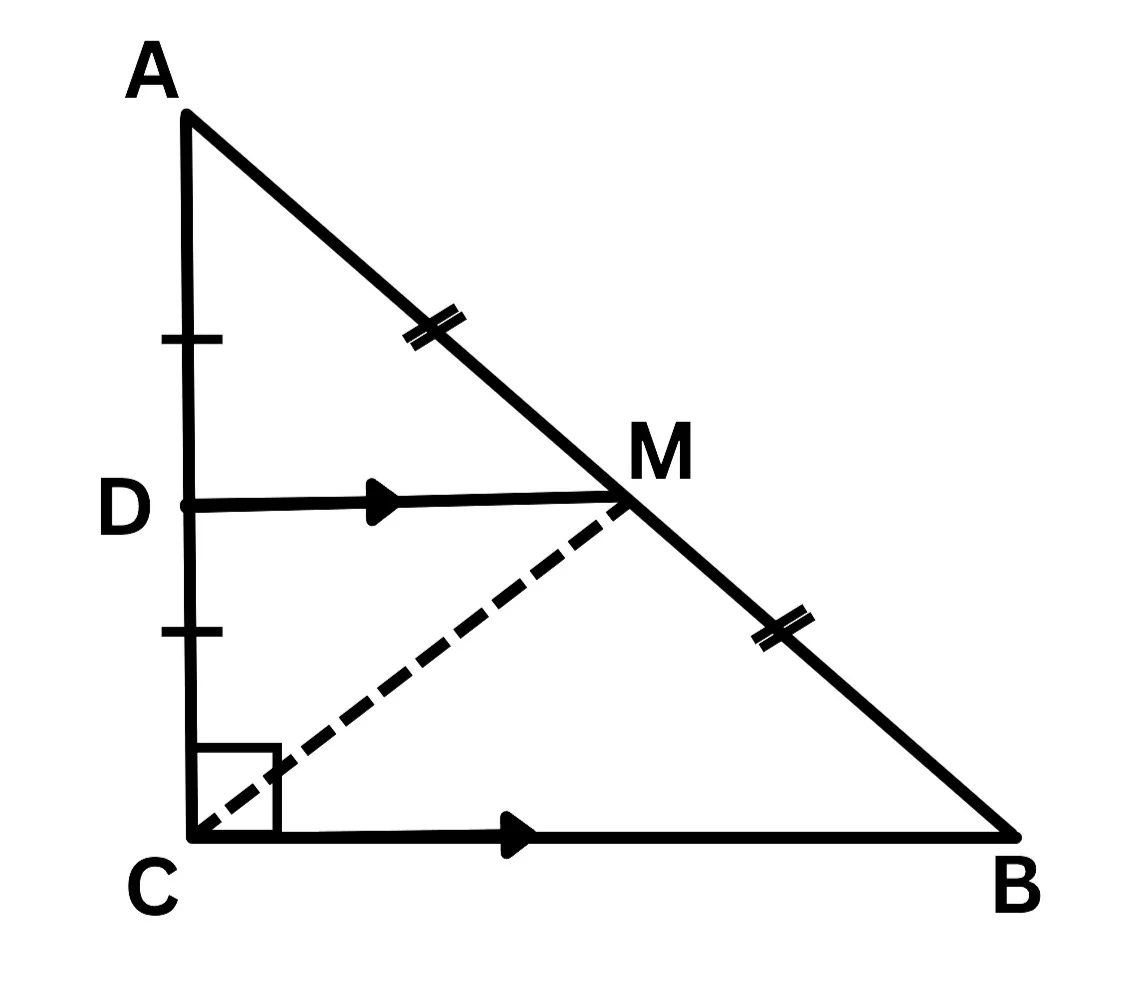
Q74.ABCD and PQRS are rectangle where Q is the mid-point of BD. If QR = 5 cm, then the length of the side AB is:
A2.5 cm
B5 cm
C10 cm
D20 cm
Q75.In \(∆PQR\), if QR = 10 cm and \(EF\parallel QR\) where E and F are mid-points of sides PQ and QR respectively. Then the length of EF is equal to:
A5 cm
B10 cm
C15 cm
D20 cm
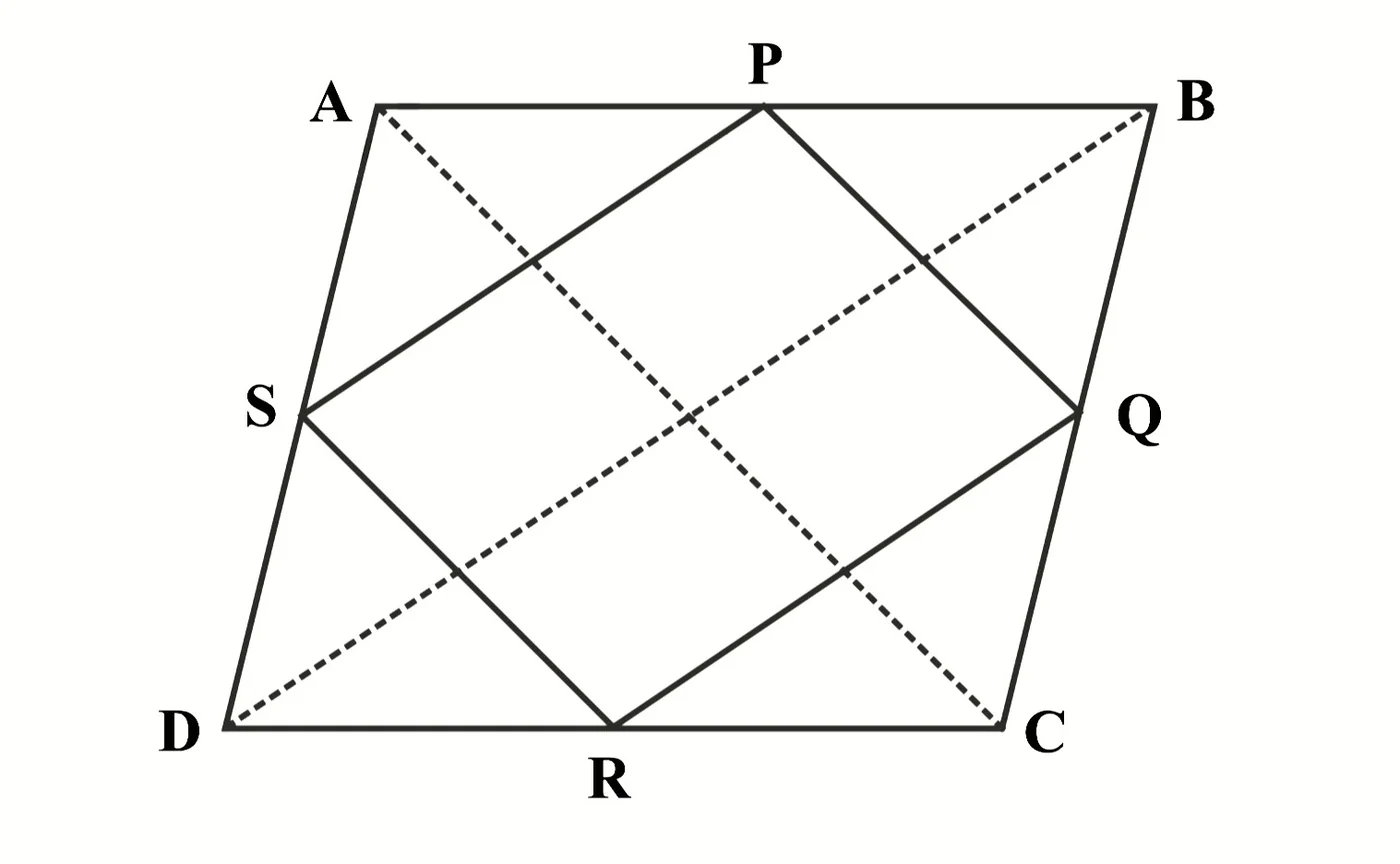
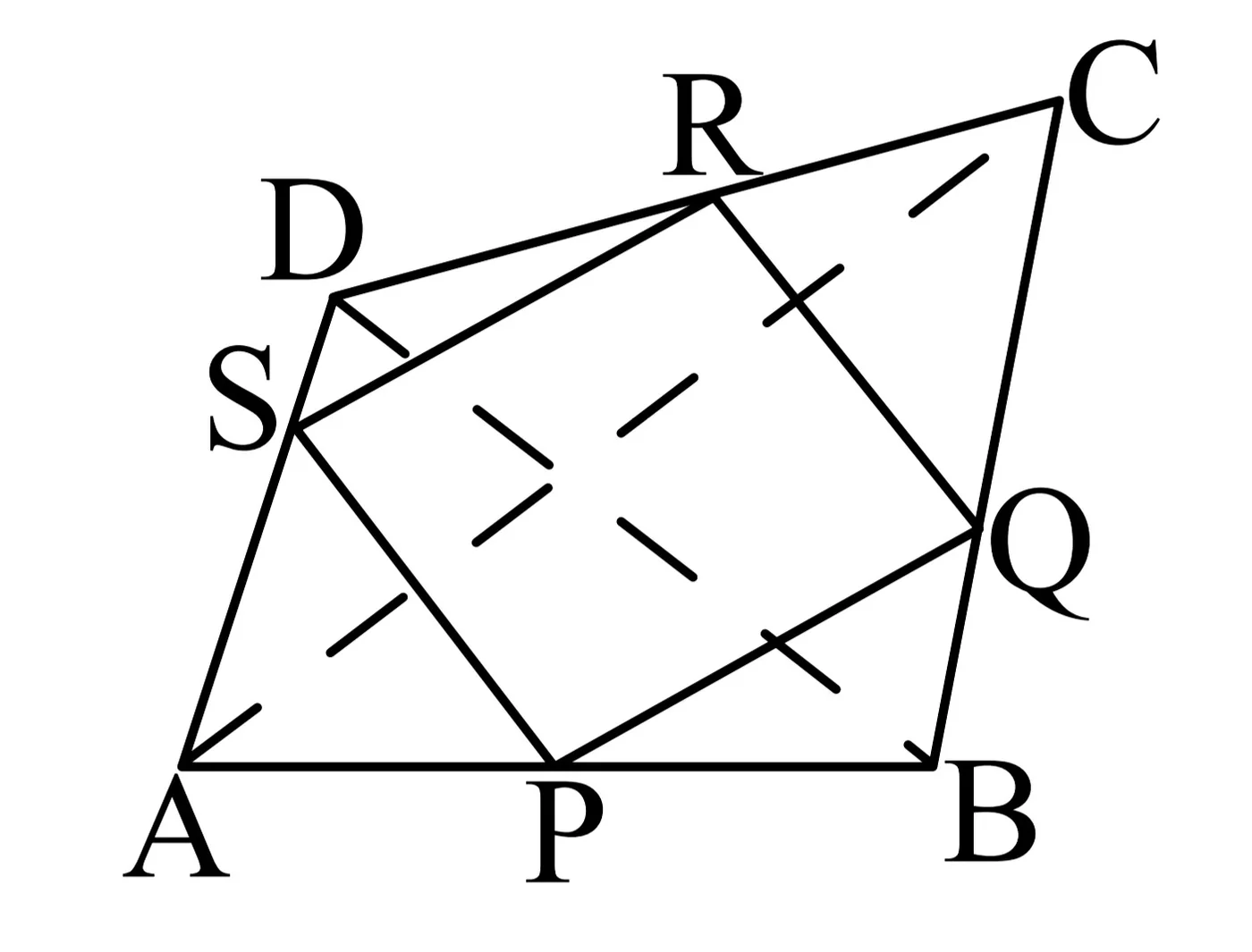
Q76.ABCD is a quadrilateral in which P, Q, R and S are the midpoints of the sides AB, BC, CD and DA respectively. AC is a diagonal. Then:
APQ= QR
BPS= RS
C\( PQ = \frac{1}{2}AC\)
D\( PQ = \frac{1}{2}BD\)
Q77.In a parallelogram, sum of its two adjacent angles is:
A\(90^\circ\)
B\(180^\circ\)
C\(360^\circ\)
D\(270^\circ\)
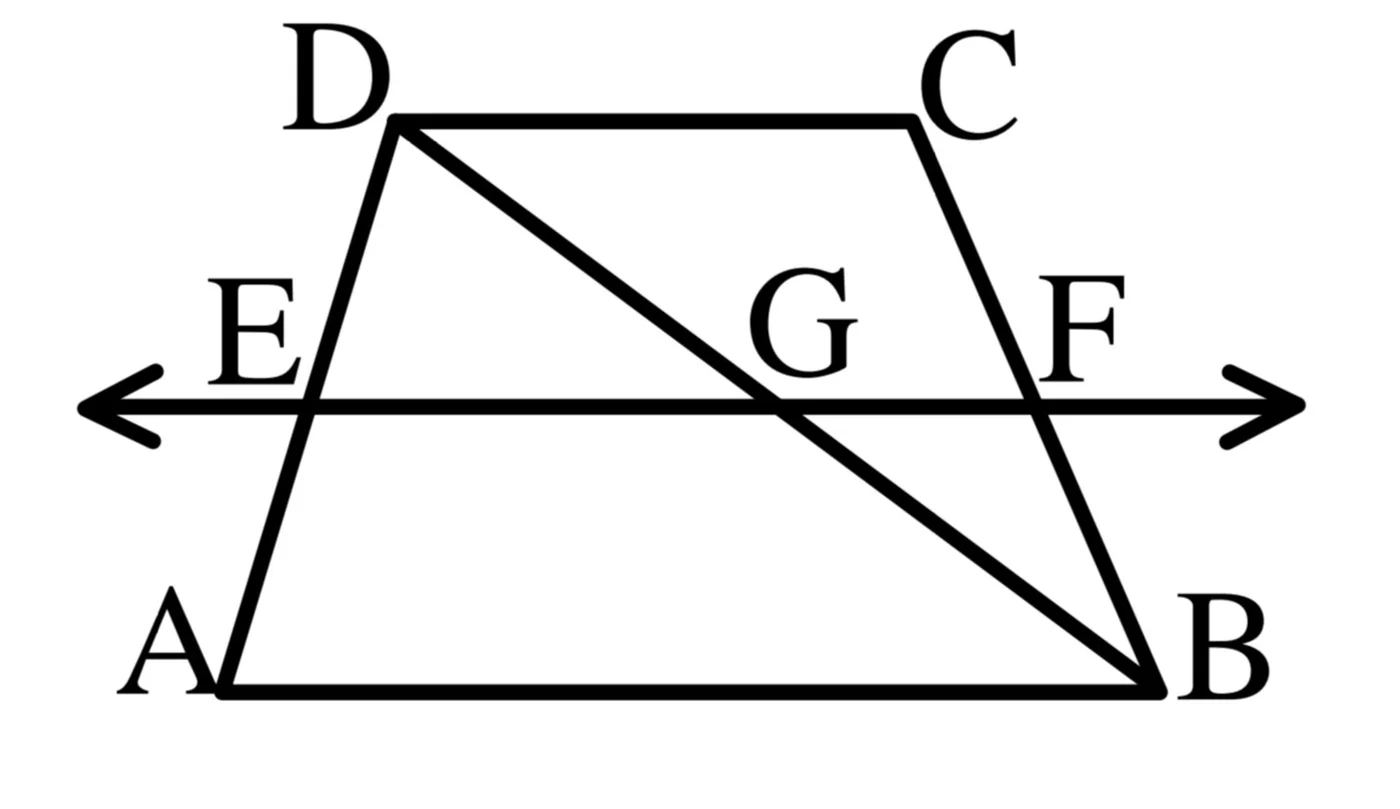
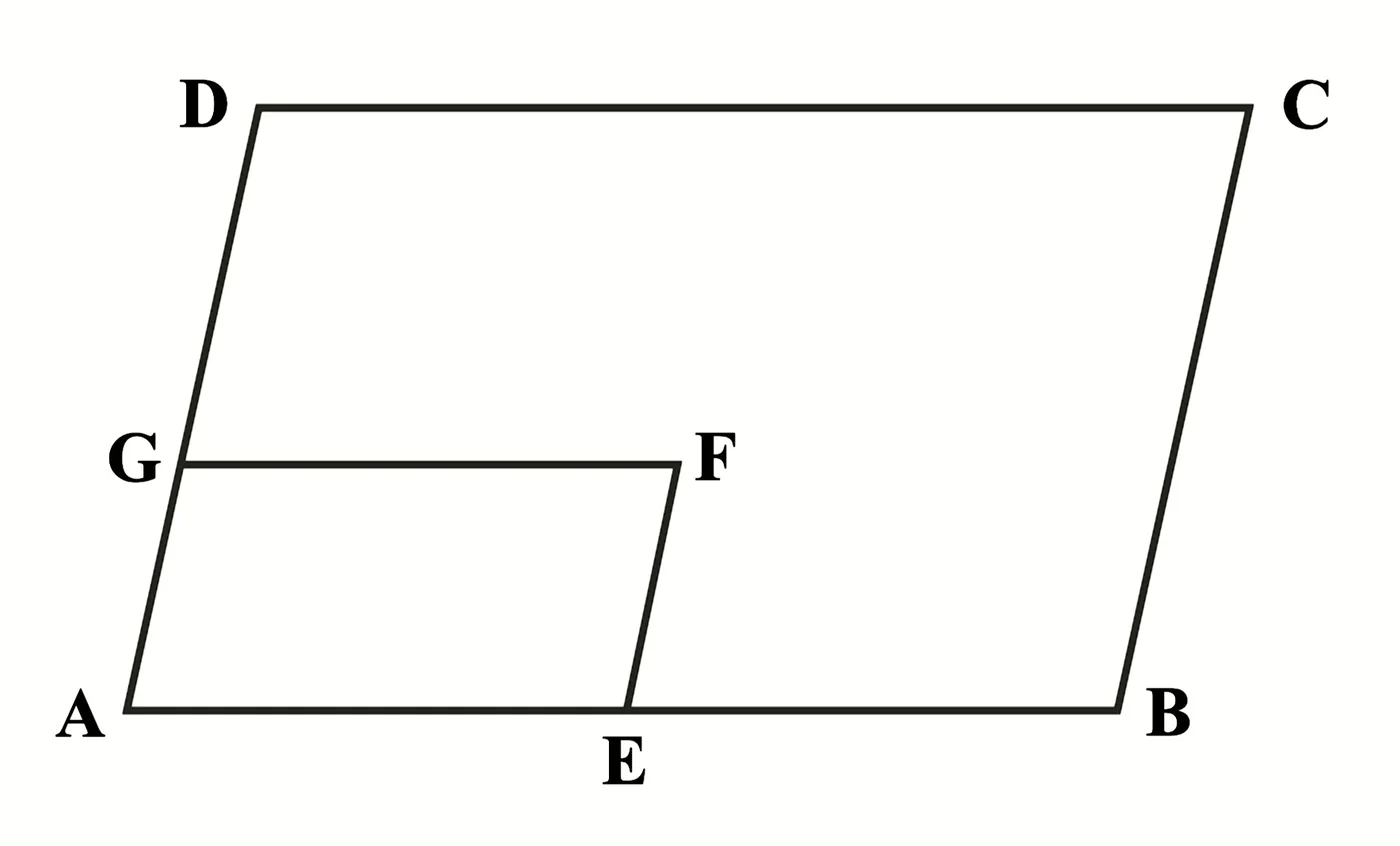
Q78.ABC is a trapezium in which \(AB || DC\), BD is a diagonal and E is the mid-point of AD. A line is drawn through E parallel to AB intersecting BC at F. Then:
APoint G bisects EF
BEG is the half of DC
CGF is the half of AB
DPoint F bisects CB.
Q79.In a quadrilateral ABCD, \(\angle D = 150^\circ\) and \(\angle A = \angle B = \angle C\). Find the measures of \(\angle A\).
Q88.If P, Q, R and S are respectively the mid-points of the sides AB, BC, CD and DA of a quadrilateral ABCD in which AC = BD and \(AC ⊥ BD\), then PQRS is precisely a ______.
Q90.The sum of two opposite angles of a quadrilateral is \(220°\). The other two angles of the quadrilateral are equal. Find the measure of each equal angles.
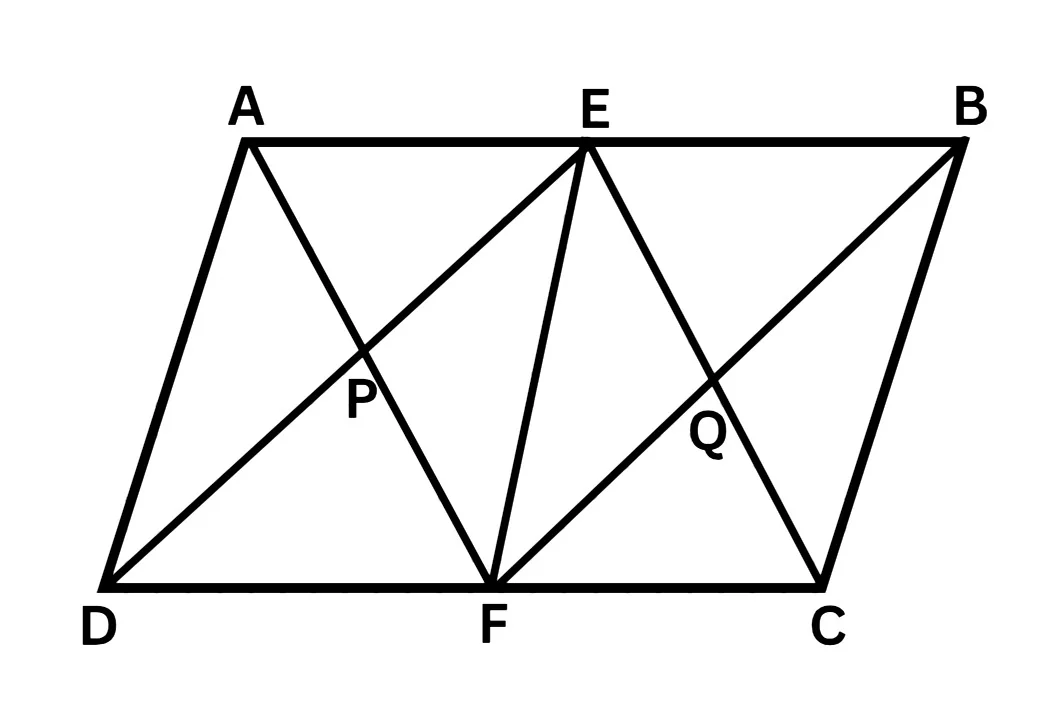
Q95.In the adjoining figure, ABCD is a parallelogram. If E and F are the midpoints of sides AB and CD respectively, how many other triangles are congruent to △APE?
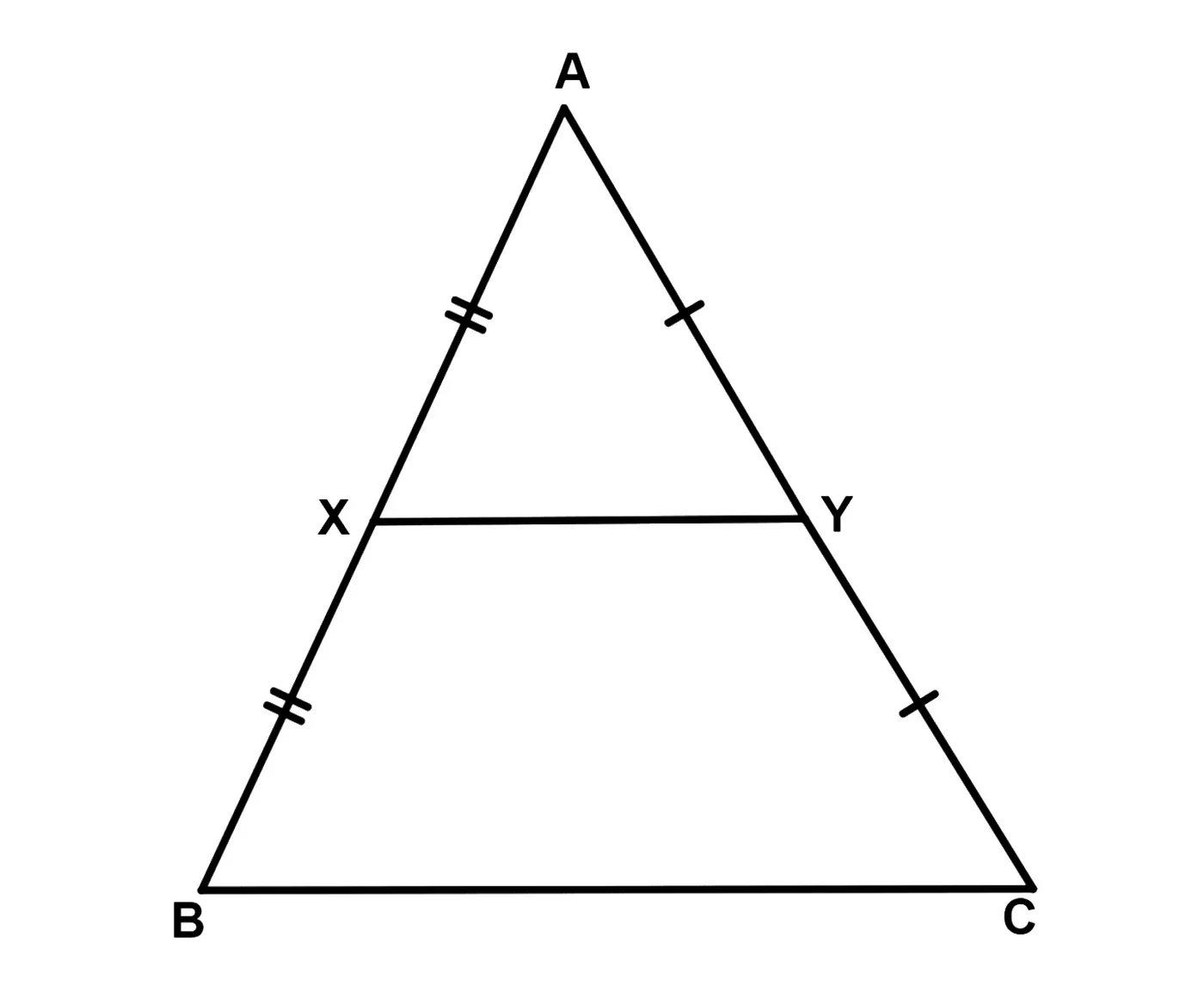
Q97.D and E are the midpoints of sides AB and AC respectively of \(△ABC\). DE is produced to F such that \(CF \parallel AD\). Name the quadrilateral DFCB formed.
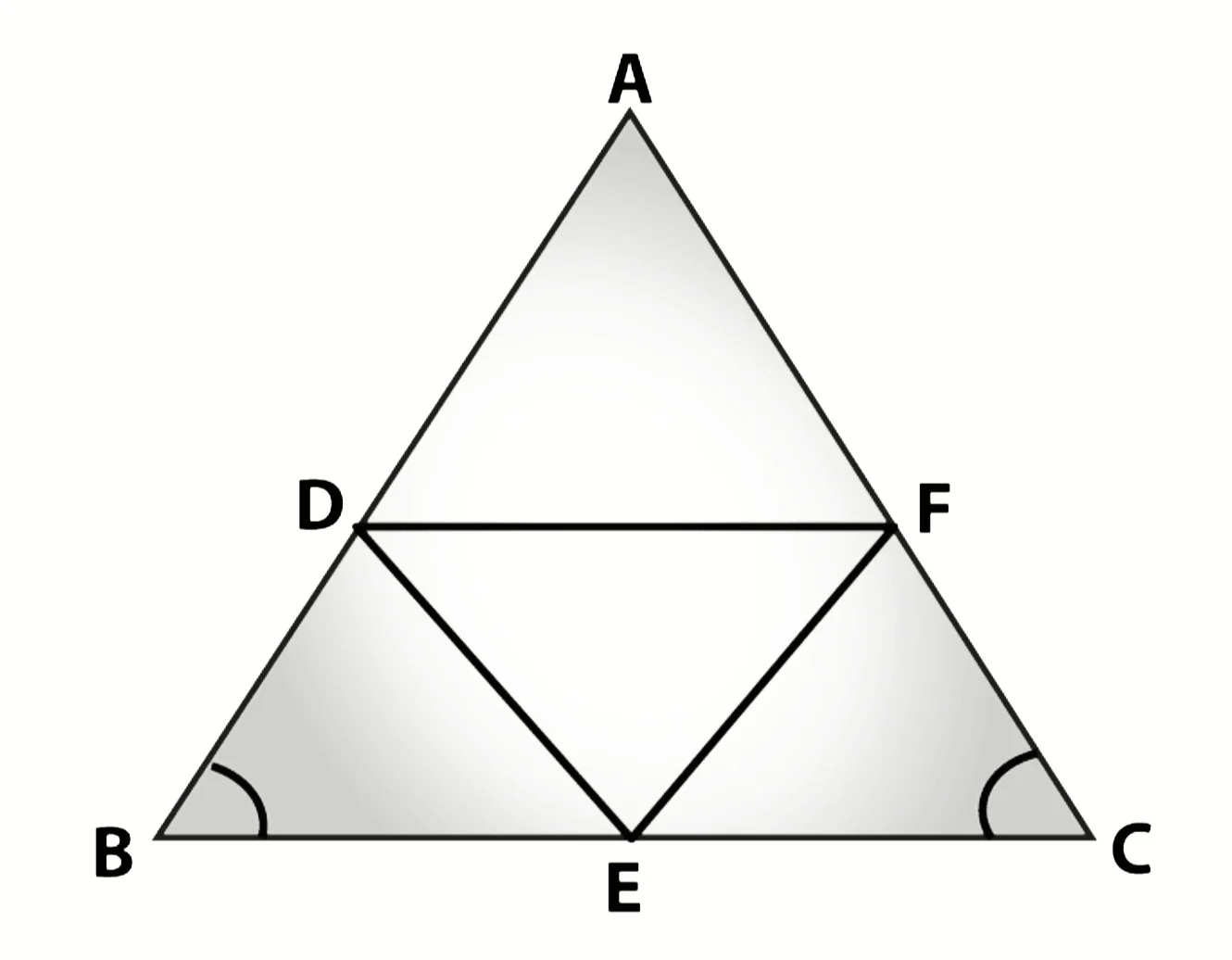
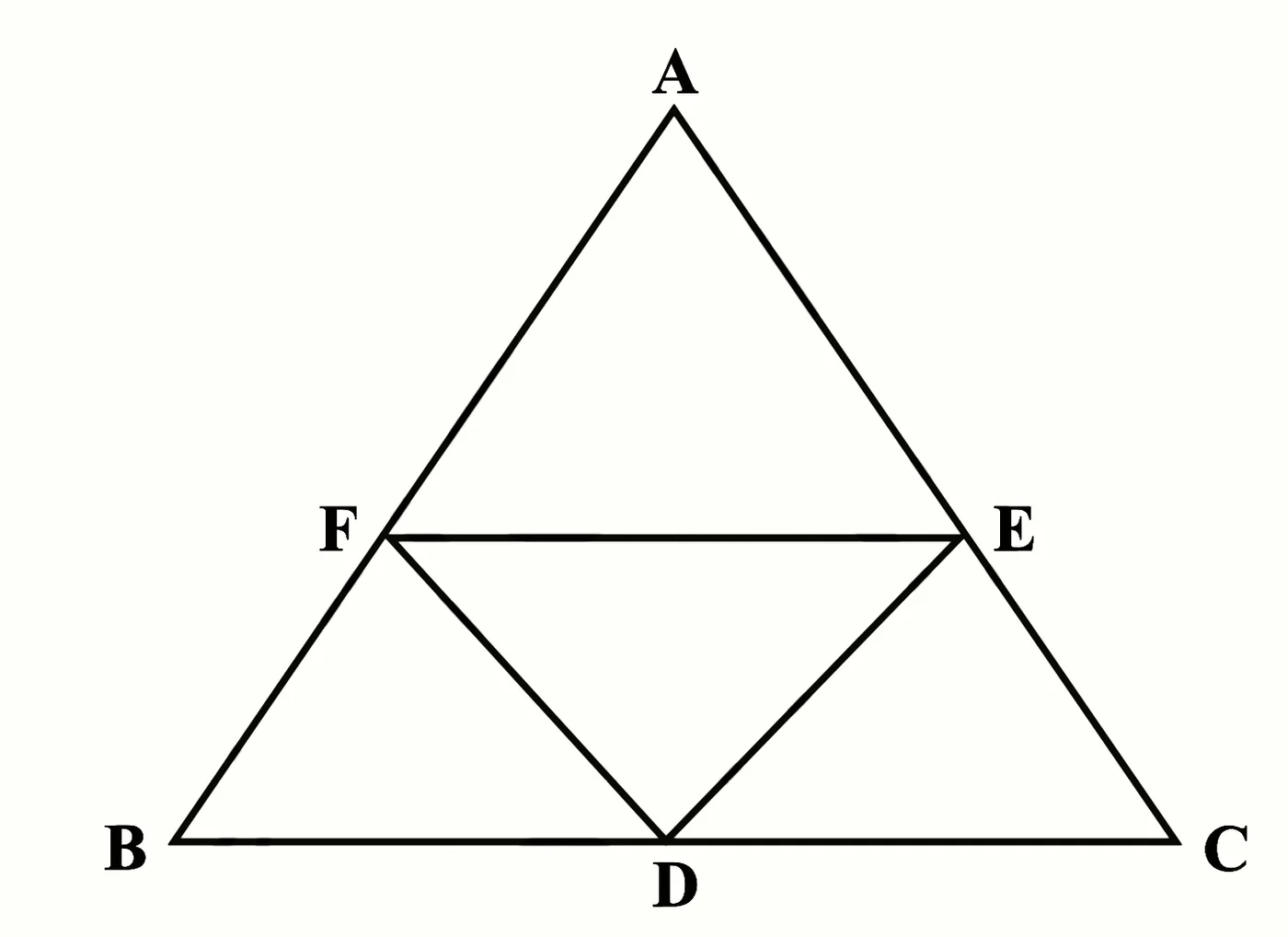
Q98.In \(∆ABC\), AB = 5 cm, BC = 8 cm and CA = 7 cm. If points D, E and F are respectively the mid-points of AB, BC and AC, determine the perimeter of \(∆DEF\).
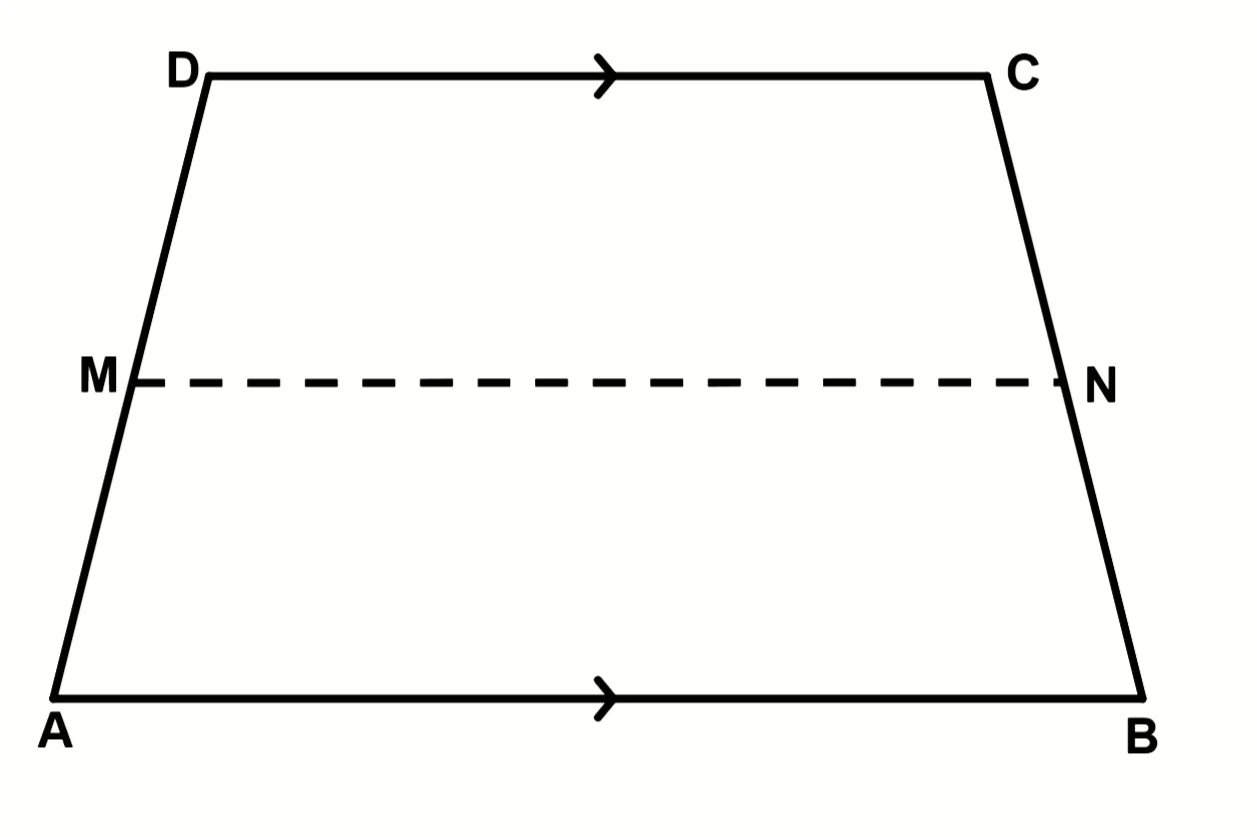
Q102.The figure, given below, shows a trapezium ABCD. M and N are the mid-points of the non-parallel sides AD and BC respectively. Find the length of side DC, if MN = 15 cm and AB = 23 cm.
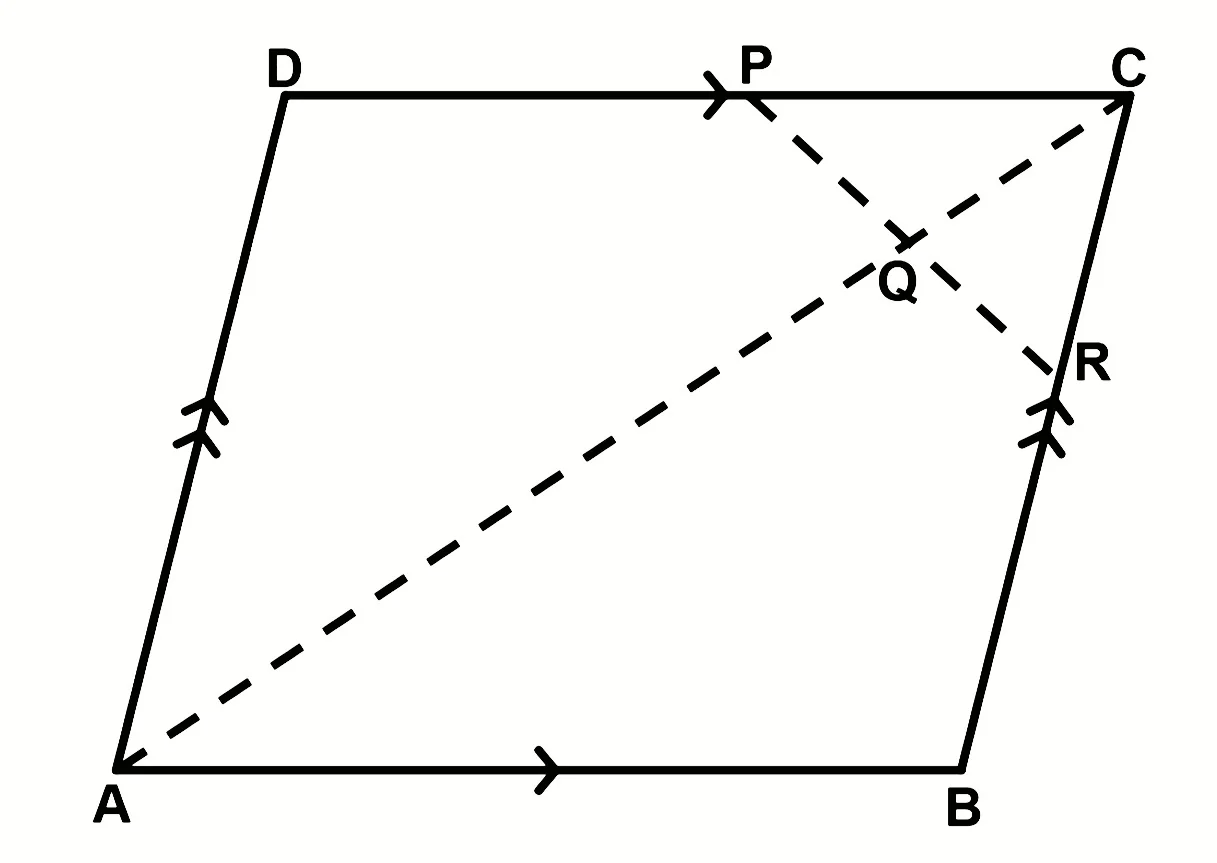
Q103.A parallelogram ABCD has P the mid-point of DC and Q a point of AC such that \(CQ = \frac {1}{4}AC\). PQ produced meets BC at R. What is the relation between PR and BD