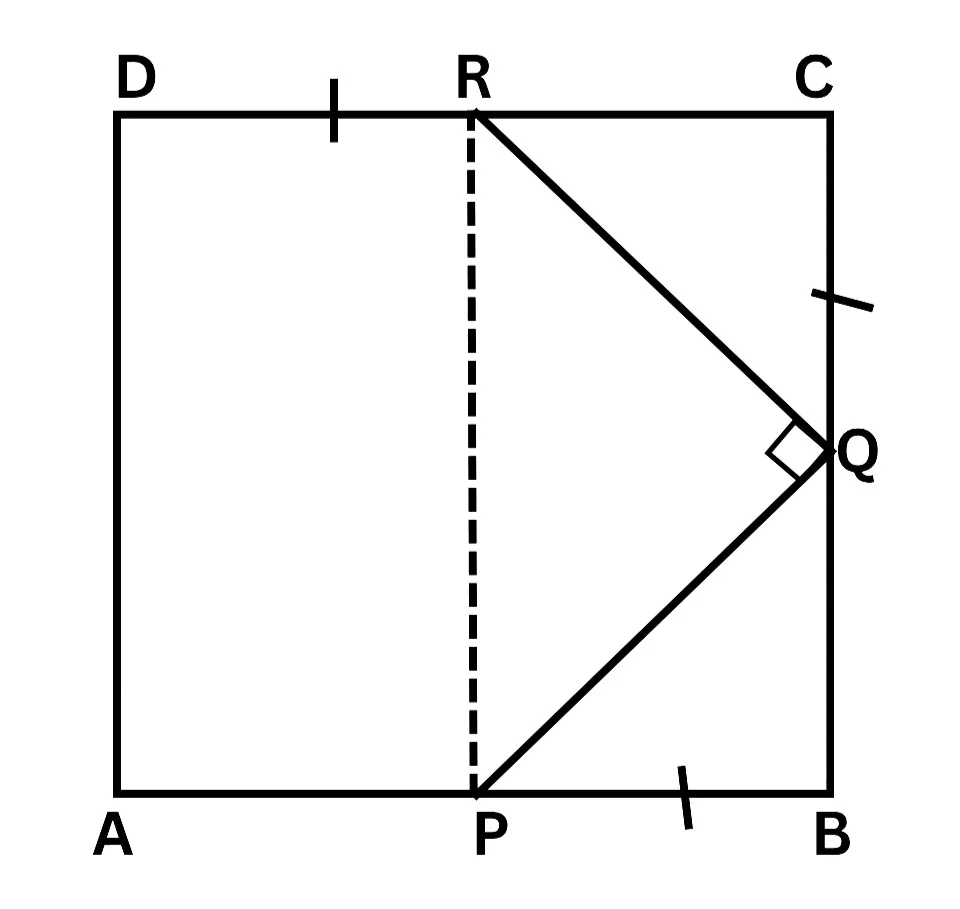
Q1.
The RHS congruence criterion is applicable to which type of triangles?
Q2.
If all three sides of one triangle are equal to the corresponding sides of another triangle, then the triangles are congruent by which criterion?
Q3.
If \( \triangle ABC \cong \triangle DEF\), then the side corresponding to AB is:
Q4.
If \( \triangle ABC \cong \triangle DEF\), then the angle corresponding to \(\angle C\) is:
Q5.
Congruent triangles have equal :
Q6.
If two angles and the included side of one triangle are equal to the corresponding parts of another triangle, then the triangles are :
Q7.
If the corresponding sides of two triangles are proportional but not equal, then the triangles are:
Q8.
If \( \triangle ABC \cong \triangle PRQ\), then the side corresponding to PQ is :
Q9.
If \( \triangle ABC \cong \triangle XYZ\), AB = 6 cm, BC = 8 cm, CA = 10 cm, then the length of side ZX is :
Q10.
If \(\triangle ABC \cong \triangle DFE\), then which pair of sides must be equal?
Q11.
If \(\triangle ABC \cong PQR \text { and } \angle A = 40^\circ, \angle B = 60^\circ\), then the measure of \(\angle R + \angle Q\) is:
Q12.
In \(\triangle ABC\) and \(\triangle PQR\), if AB = QR, BC = RP and CA = PQ, then which of the following holds?
Q13.
What is the minimum number of corresponding parts required to prove two triangles congruent?
3
Show Answer
Q14.
In \(\triangle ABC \text { and } \triangle DEF\), AB = FD and \(\angle A = \angle F\). To prove the triangles congruent by the SAS criterion, which side should be equal to AC?
FE
Show Answer
Q15.
Which of the following is not a congruence criterion for triangles?
Q16.
In \(\triangle ABC\), if AB = AC and \(\angle B = 50^\circ\), find the measure of \(\angle A\).
80
Show Answer
Q17.
In \(\triangle PQR\), if \(\angle R = \angle P\), PR = 5 cm and QR = 4 cm, find the length of the side PQ.
4 cm
Show Answer
Q18.
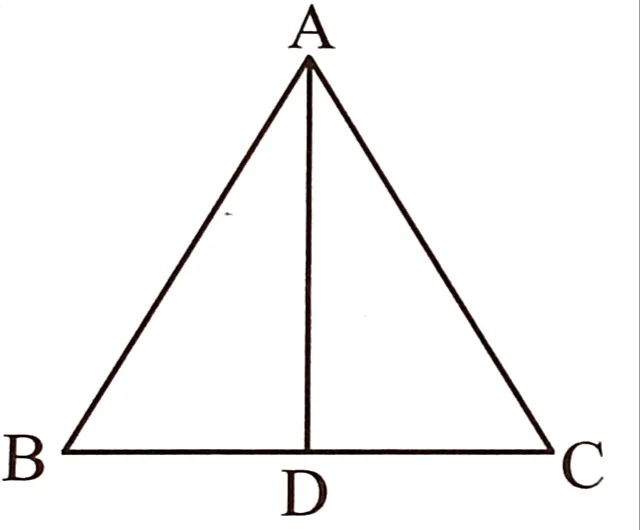
In an isosceles triangle ABC with AB = AC, if AD is the median to BC, what is the measure of \(\angle ADC\)?
90
Show Answer
Q19.
If the bisector of the vertex angle of a triangle also bisects the base, the triangle is:
Q20.
In an equilateral triangle, the medians are:
Q21.
In a \(∆ABC\), if\(\angle A = 120^\circ\) and AB = AC. Find the measure of \(\angle B\).
30
Show Answer
Q22.
What is the point of intersection of the medians of a triangle called?
Centroid
Show Answer
Q23.
If the base of an isosceles triangle is produced on both sides, then the exterior angles so formed are:
Q24.
Which of the following is not necessarily true?
Q25.
What is the measure of each angle of an equilateral triangle?
60
Show Answer
Q26.
If AB = EF and AC = ED, and \( \angle B = \angle F= 90^\circ\), then by which congruence criterion \( \triangle ABC \cong \triangle EFD \)?
Q27.
The vertex angle of an isosceles triangle is 100°. what is the measure of its base angles?
40
Show Answer
Q28.
Which triangle has all its altitudes equal?
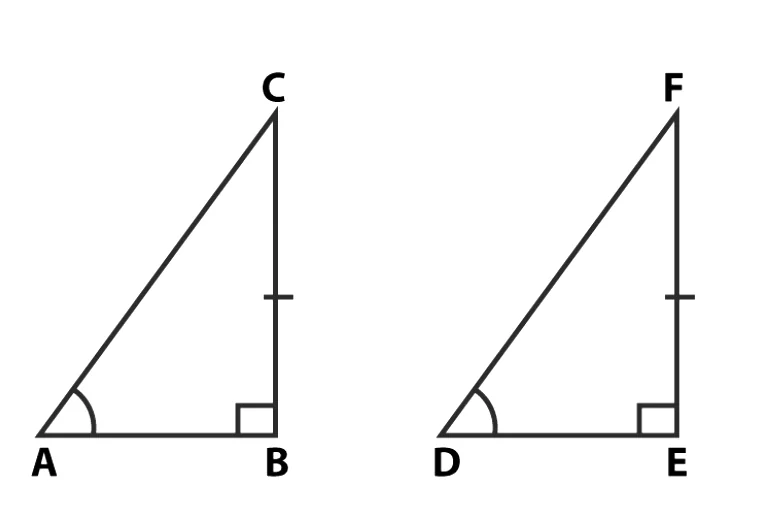
Q29.
Which congruence criterion proves the triangles in the given figure are congruent?
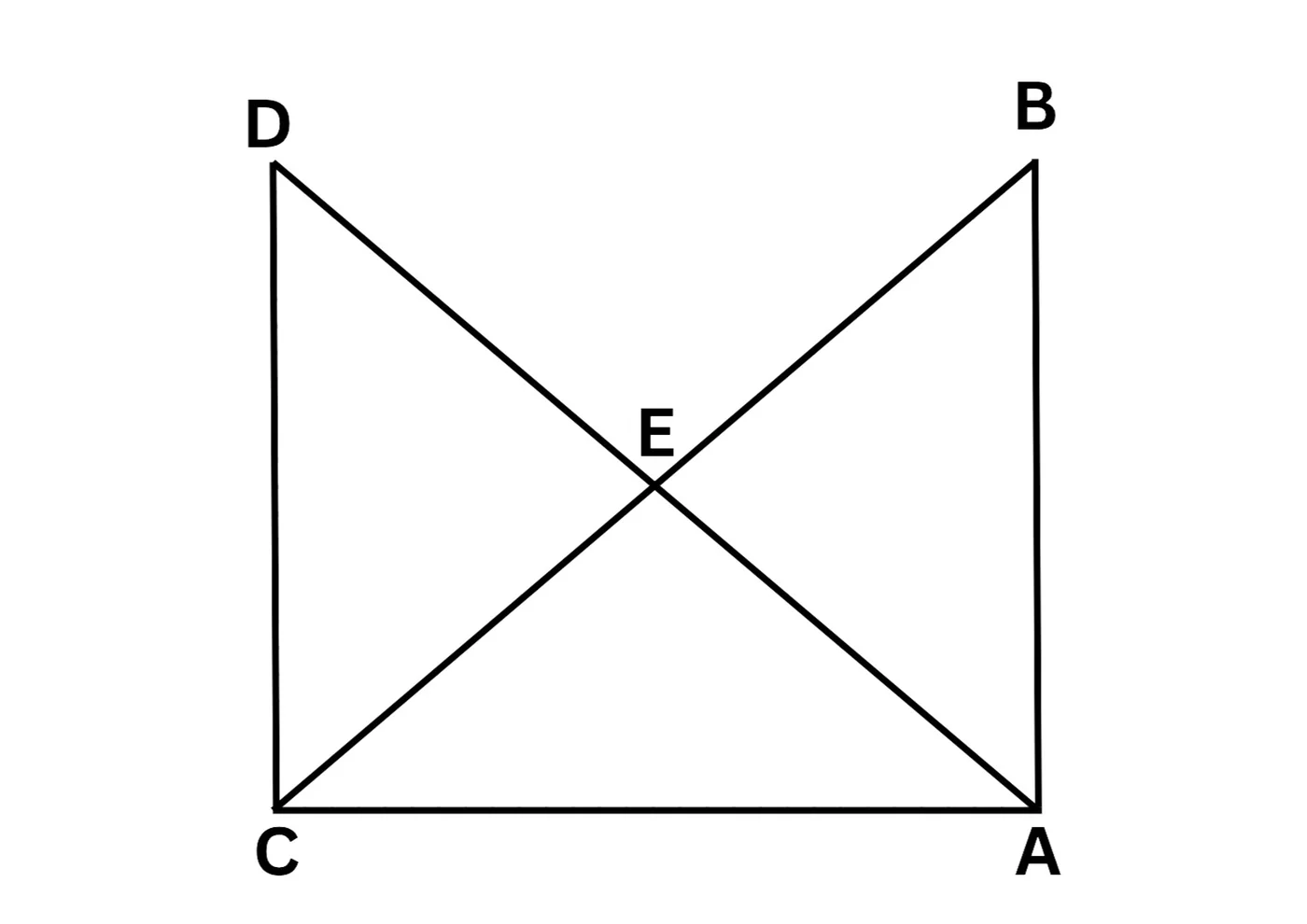
Q30.
In the given figure, AB = CD and CB = AD. Which of the following additional conditions is required to prove that \(ΔADC≅△CBA\)?
Q31.
In a \(\triangle ABC\), if \(\angle A = \angle B + \angle C\), then \(\triangle ABC\) is:
Q32.
Which of the following congruence criterion can be used to prove that \(∆ABC \cong ∆PQR\)?
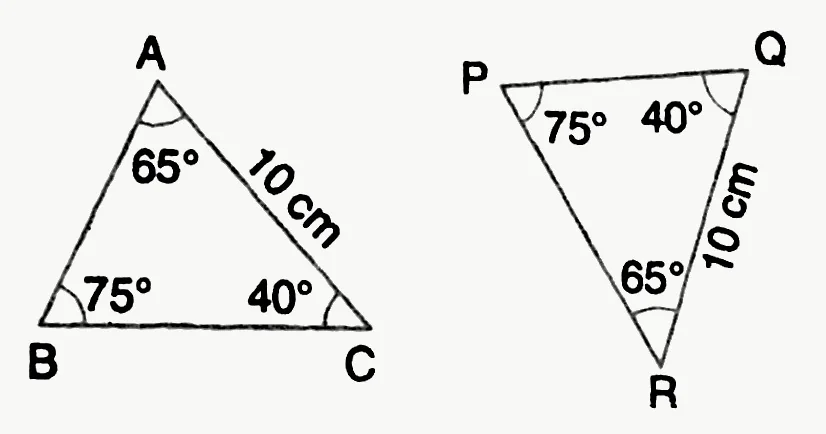
Q33.
By which congruence criterion the following triangles are congruent?
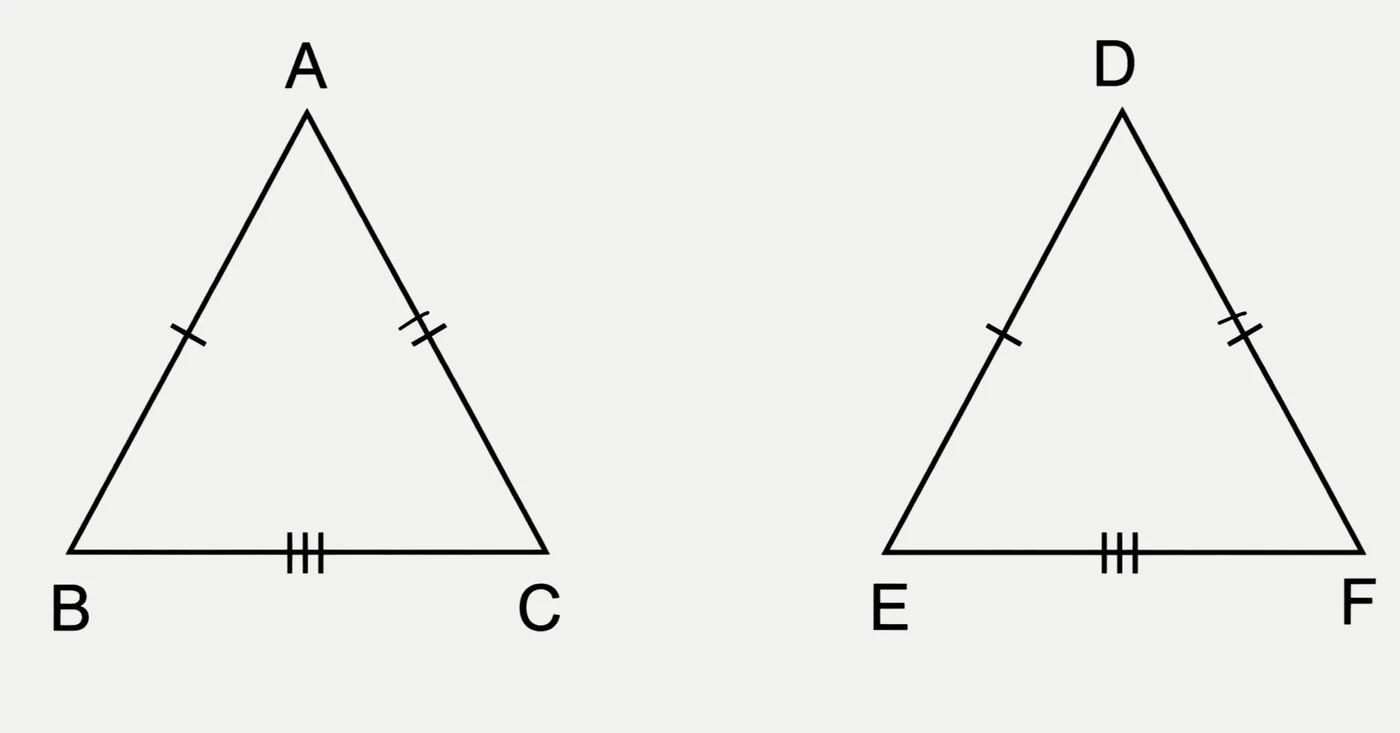
Q34.
In the adjoining figure, by which congruence criterion \(\triangle OAC\cong \triangle OBD\)?
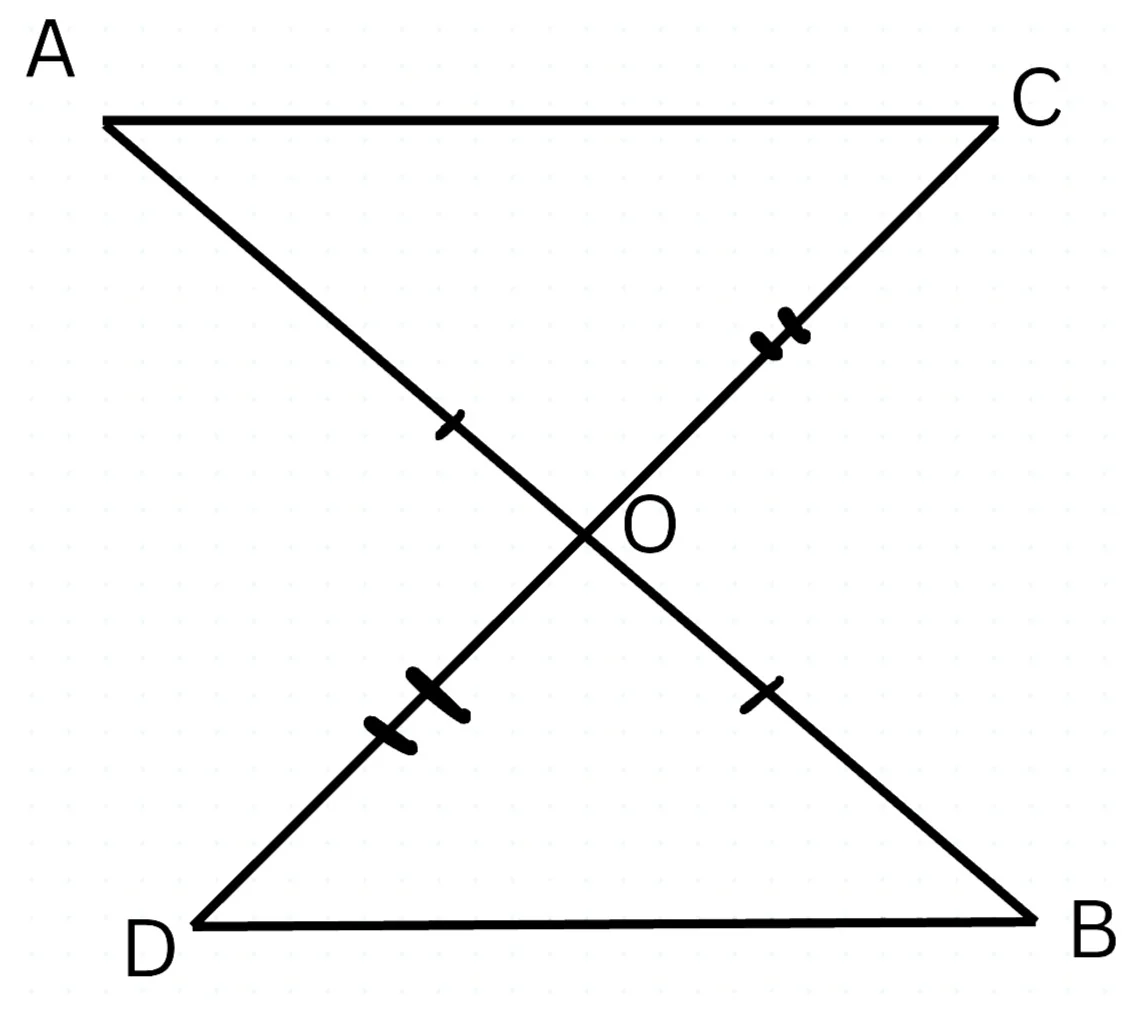
Q35.
ABCD is a quadrilateral in which AD = CB and AB = CD, then \(\angle ACB \) equal to:
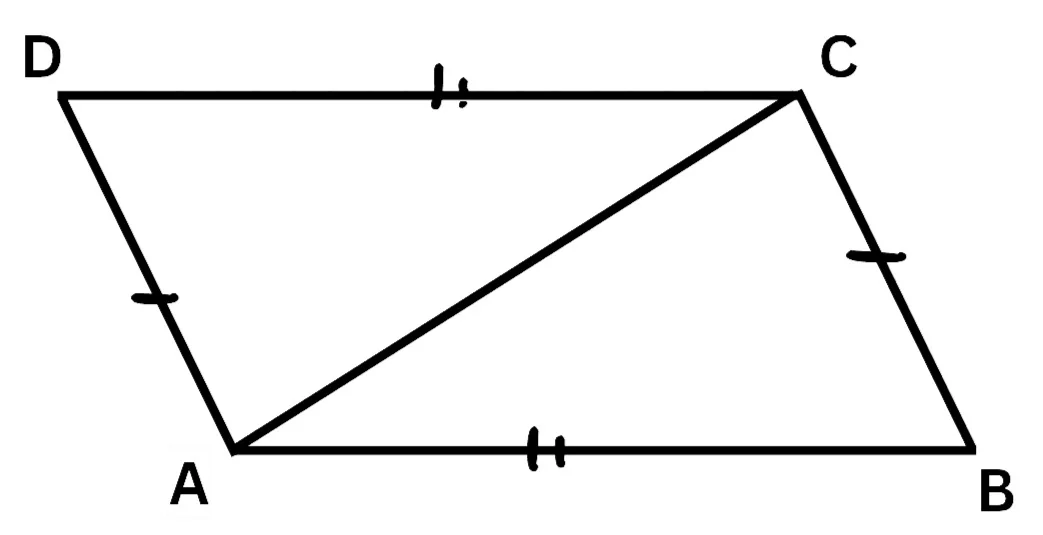
Q36.
What will be the measure of each acute angle, If two acute angles of a right triangle are equal?
45
Show Answer
Q37.
In triangle ABC, \(\angle A = 100^\circ \), AD bisects \(\angle A\) and \(AD ⊥ BC\). Then, the measure of \(\angle B\) is:
Q38.
In \(\triangle PQR, \angle R = \angle P\), \(QS \perp PR \), QR = 5 cm and PR = 6 cm. The length of QS is:
Q39.
In the adjoining figure, the measure of \(\angle DEC\) is:
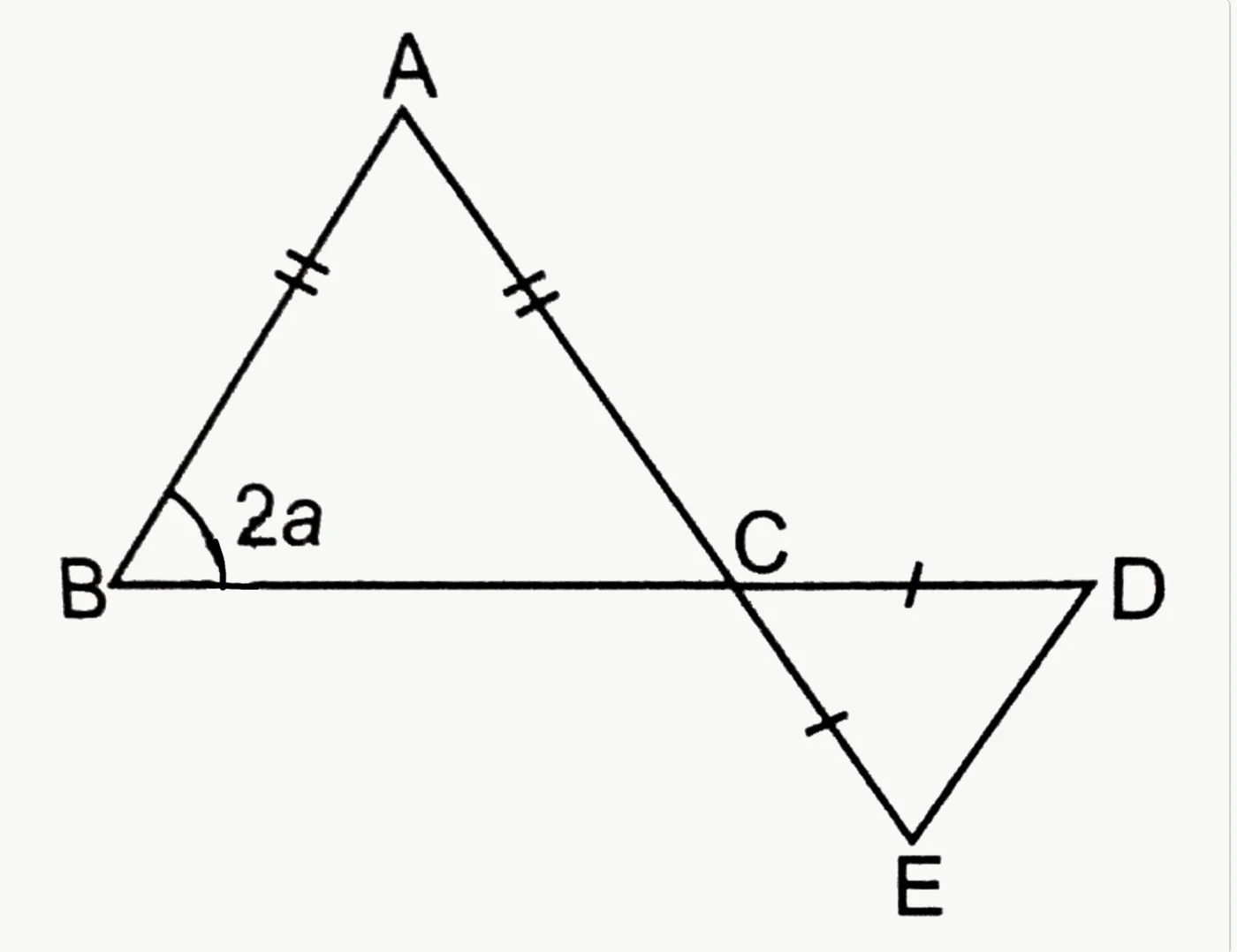
Q40.
Which of the following figures may not be congruent?
Q41.
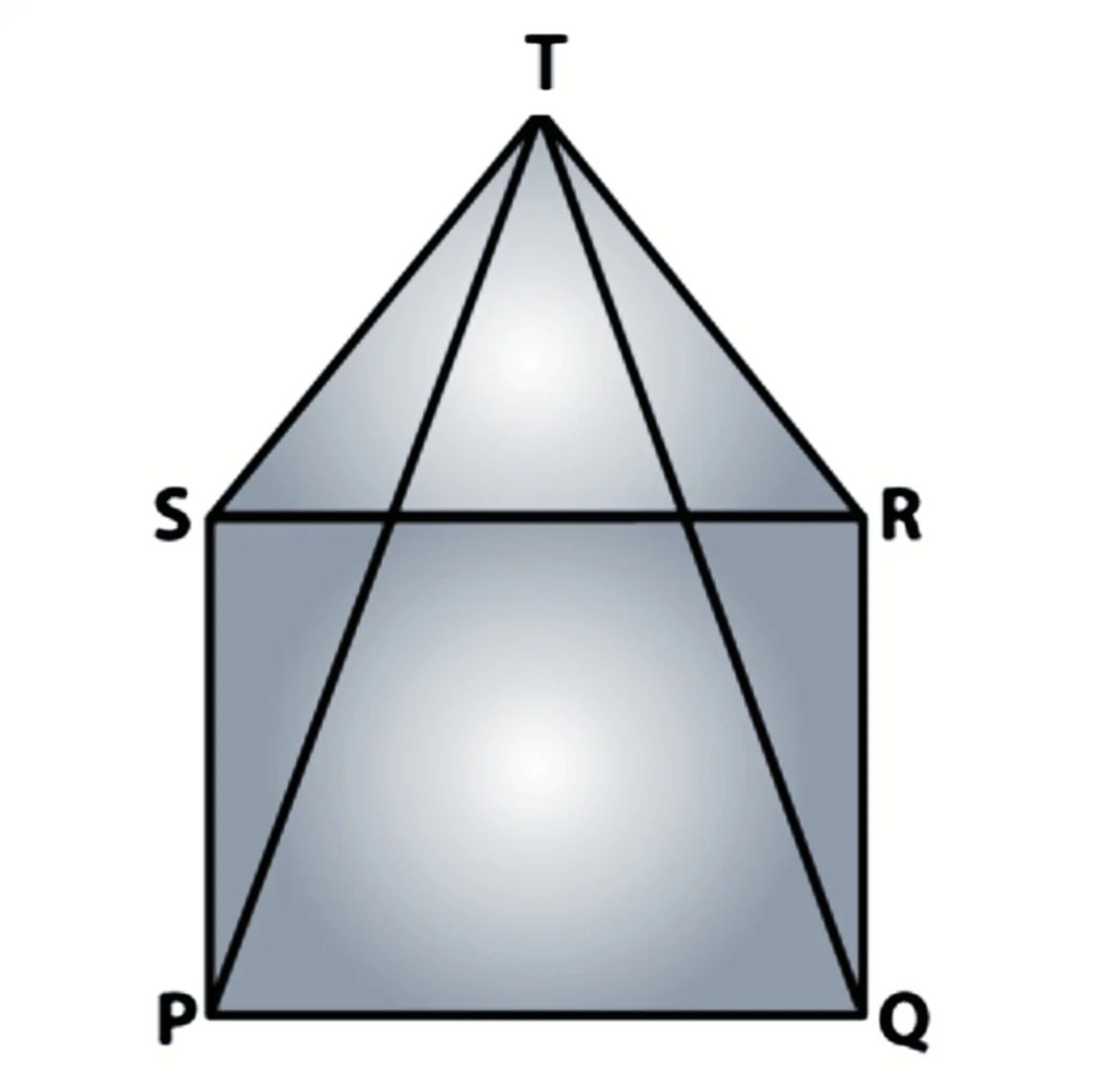
In the figure, PQRS is a square, and SRT is an equilateral triangle. Which of the following is not true?
Q42.
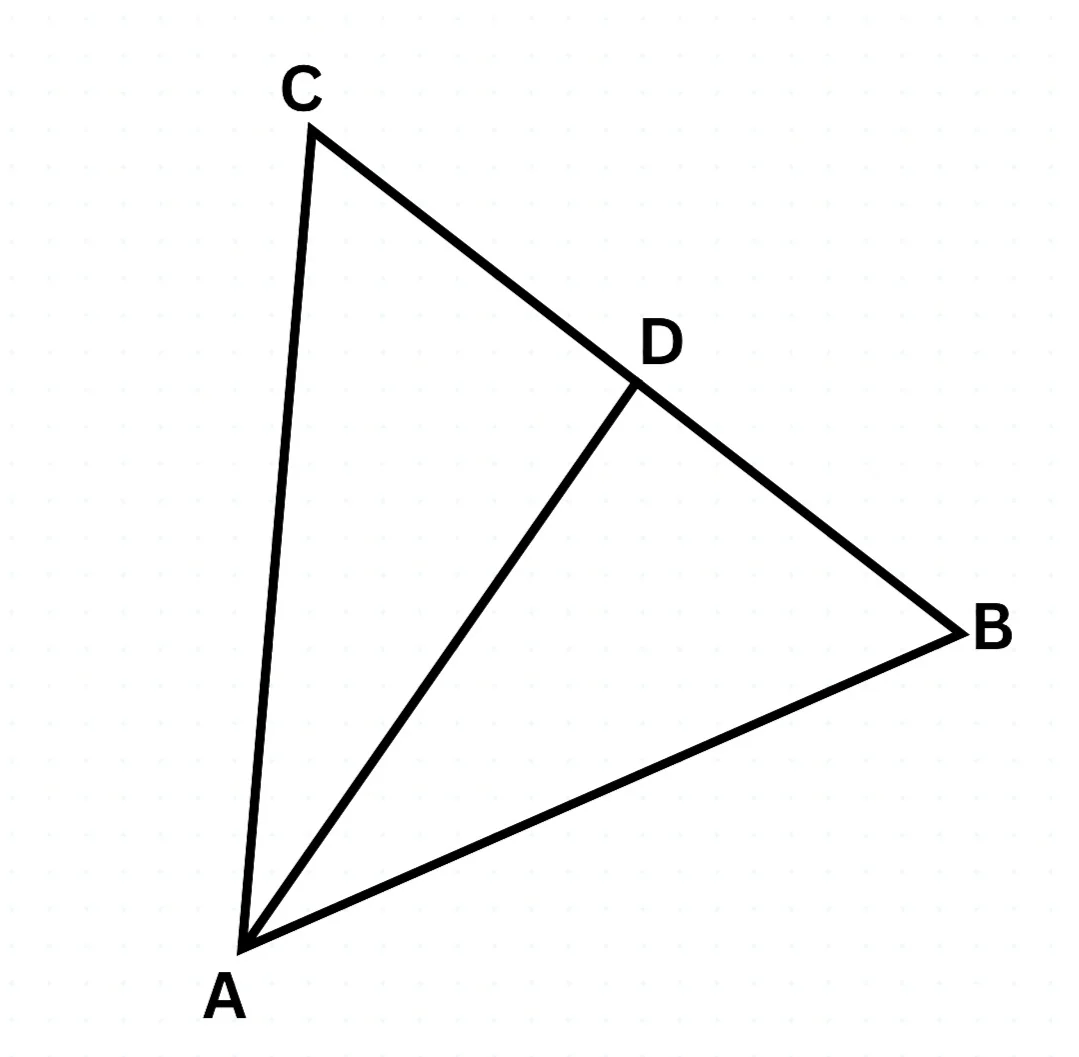
If \( \triangle ABD \) and \( \triangle ACD \) are congruent by SSS rule, then \(\triangle ABC\) is:
Q43.
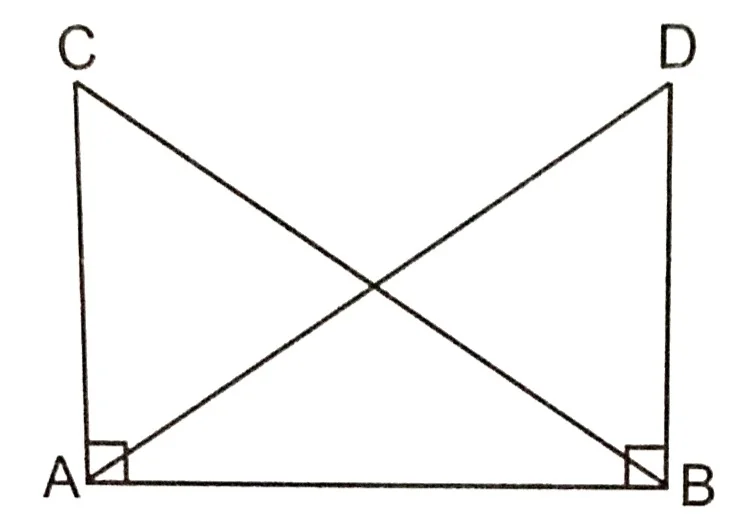
In the adjoining figure, Which additional condition is required to prove \(\triangle ABC \cong \triangle BAD\) by RHS congruence rule if \(\angle A = \angle B= 90°\) and BC = AD?
Q44.
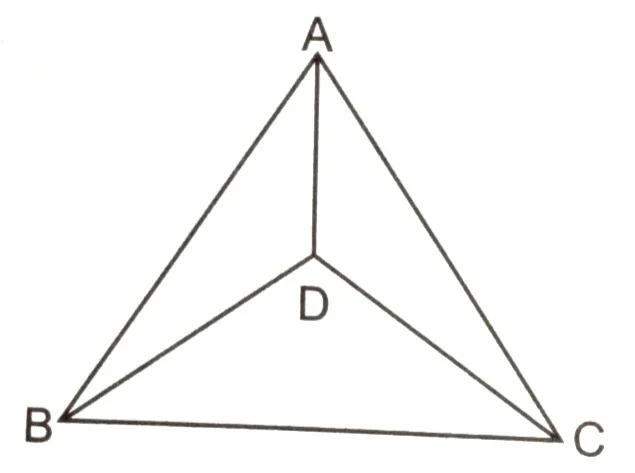
In the adjoining figure, if \( \triangle ABD \) and \( \triangle ACD \) are congruent by SSS congruence rule, then \(\triangle BDC\) is a/an:
Q45.
What are two triangles with the same shape and equal size called?
Congruent triangles
Show Answer
Q46.
What does CPCT stand for in triangle congruence?
Corresponding Parts of Congruent Triangles
Show Answer
Q47.
Perpendicular segment drawn from the opposite vertex to the base of an isosceles triangle is called:
Q48.
What is the shortest segment drawn from a vertex to the opposite side of a triangle called?
Altitude or height
Show Answer
Q49.
The criterion by which \(\triangle ABC \cong \triangle DEF\), if AB = DE, BC = EF, and \( ∠B = ∠E\) is :
Q50.
In the given figure, find the value of (y - x) in degree.
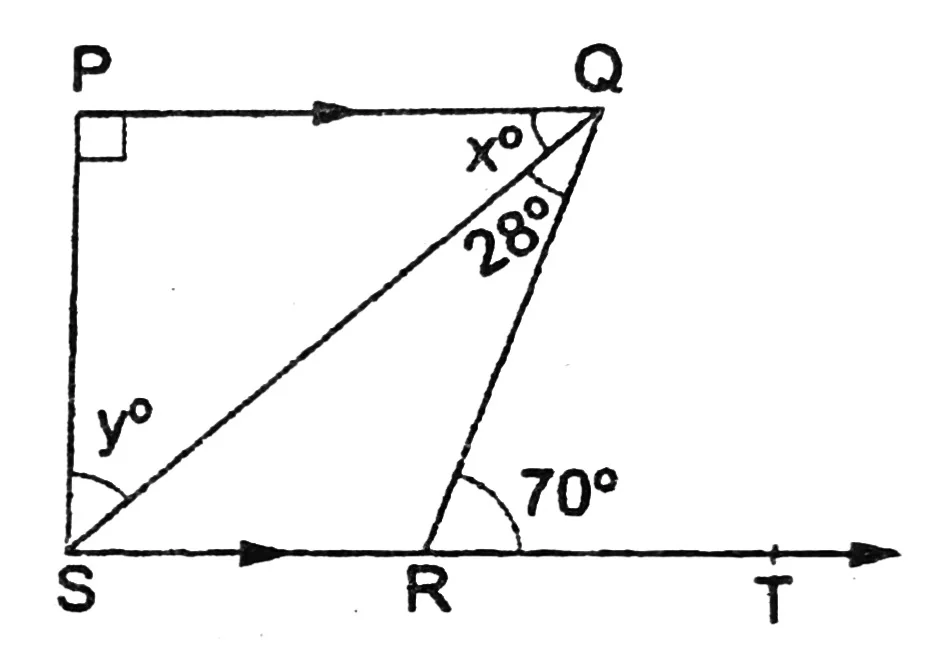
6
Show Answer
Q51.
In the adjoining figure, what is the measure of \( \angle A + \angle B + \angle C + \angle D + \angle E + \angle F\)?
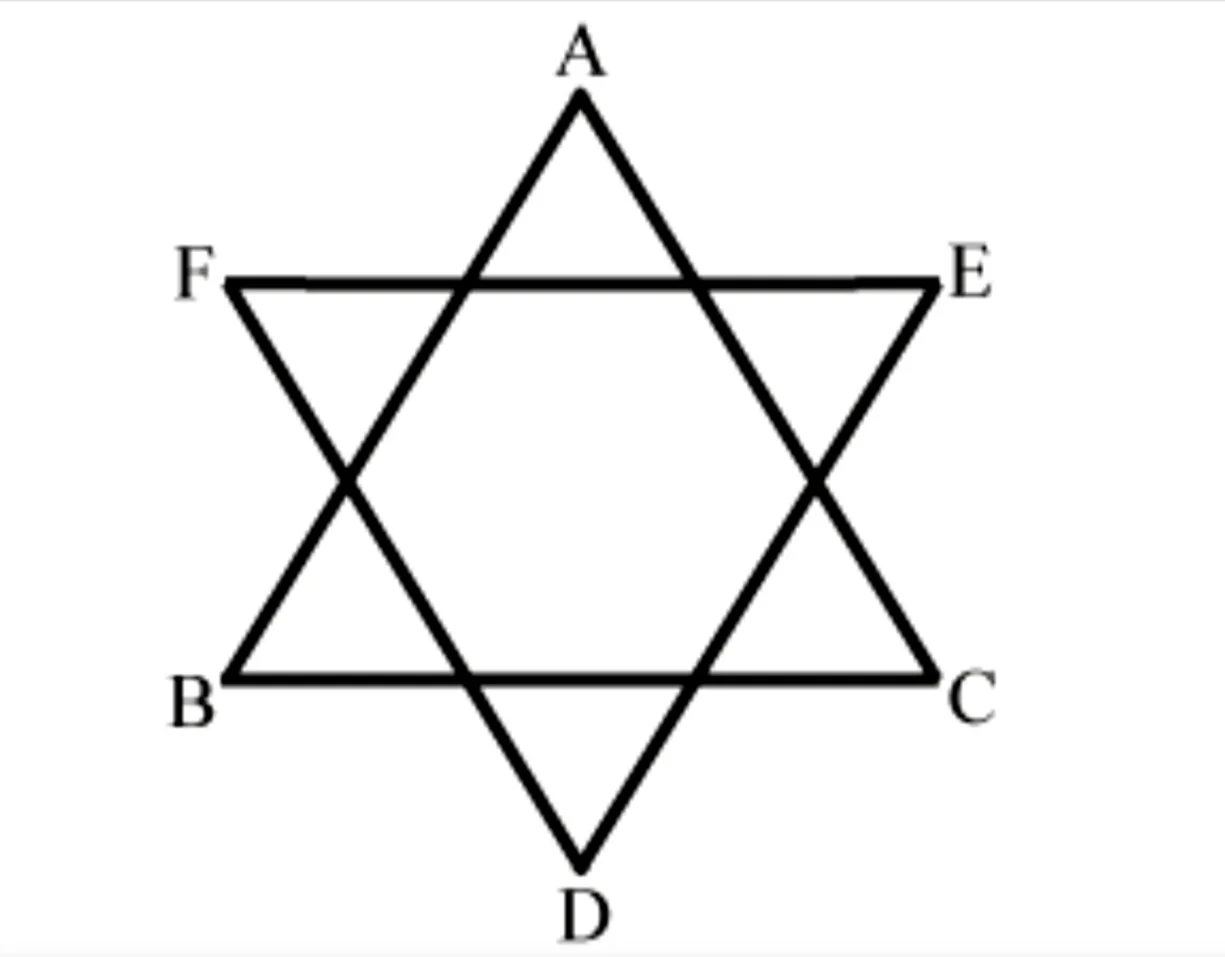
360
Show Answer
Q52.
What is the maximum number of acute angles an isosceles triangle can have?
3
Show Answer
Q53.
In \(\triangle ABC\) and \(\triangle PQR\), \(AB \perp AC\), \(QP \perp RP\), \(\angle C = \angle R\) and AC = PQ. By which congruence rule, \( \triangle ABC\cong \triangle PQR\)?
Q54.
In the given figure, PQ = RQ and PS = RS. Under which congruence rule \(\triangle PSQ \cong \triangle RSQ\)?
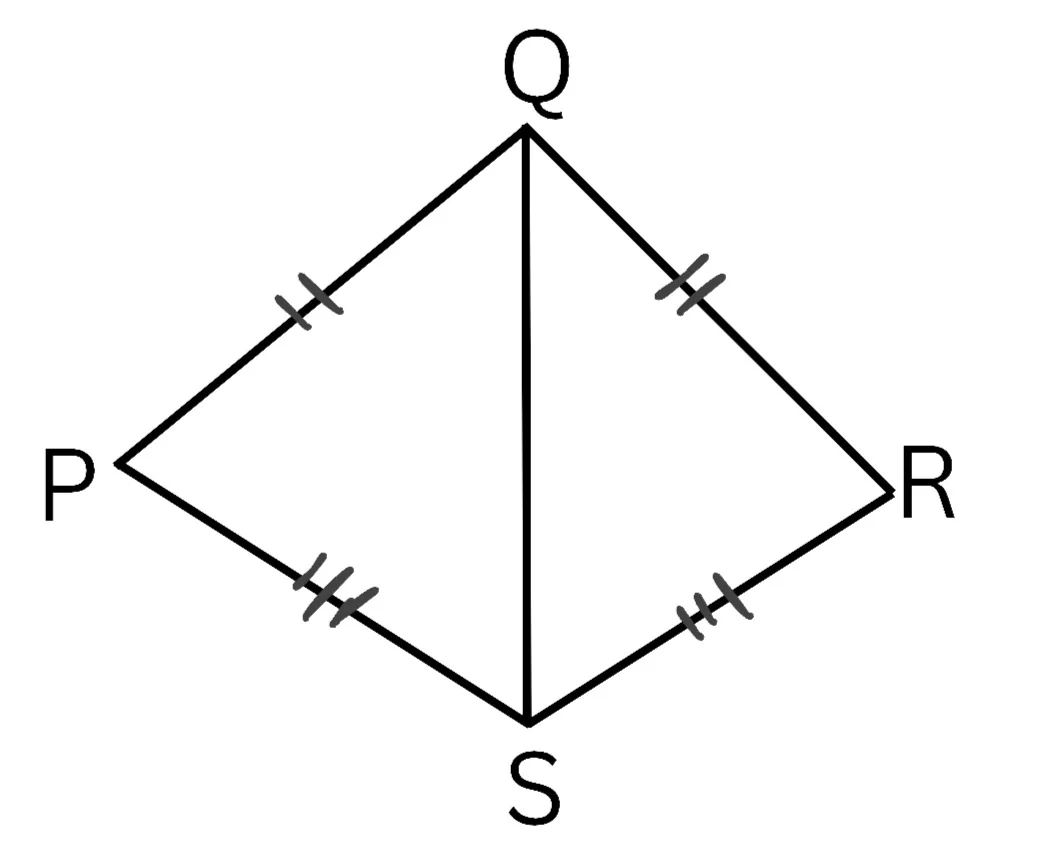
SSS
Show Answer
Q55.
In the given figure, \(\triangle ABC \cong \triangle DEF\). Find the value of x?
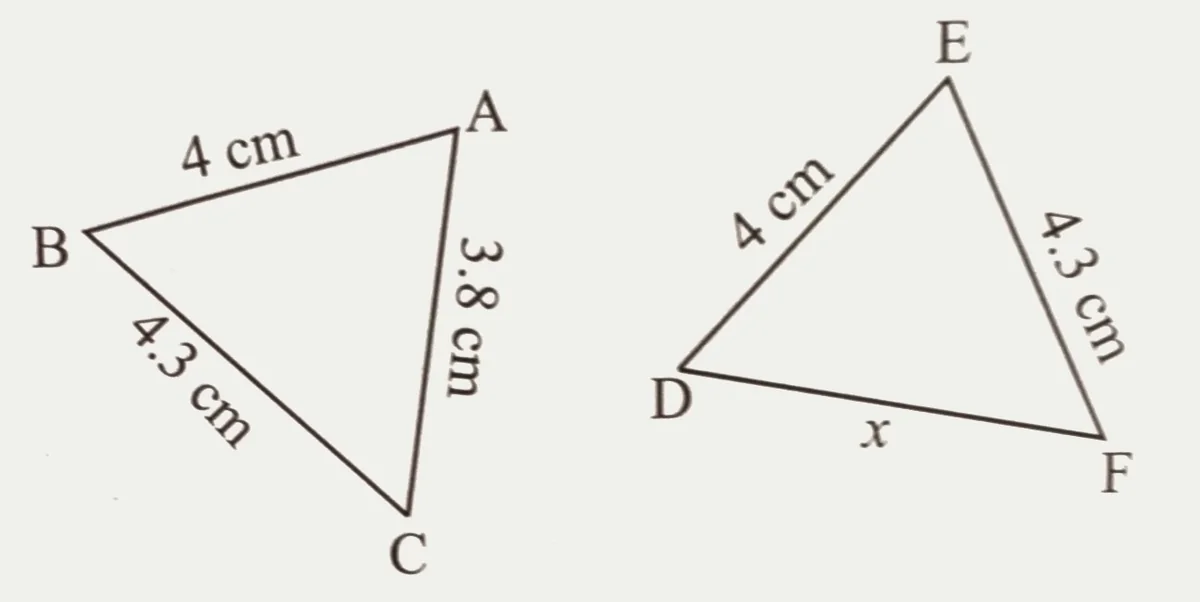
3.8 cm
Show Answer
Q56.
\( \triangle ABC\) is an isosceles triangle where AB = AC, D is the midpoint of BC and \(\angle BAD = 34^\circ\). What is the measure of \(\angle ACD\)?
56
Show Answer
Q57.
If \(\triangle ABC \cong \triangle PQR \) and \(\angle A = 40^\circ\), \(\angle B = 60^\circ\). Find the value of \(\frac{1}{2}(\angle R +\angle P)\).
60
Show Answer
Q58.
If \( \triangle ABC \cong \triangle FED\), then:
Q59.
In \(\triangle ABC \cong \triangle FED\), AB = FE and \(\angle A = \angle F\). Which angle is corresponding to \(\angle C\)?
D
Show Answer
Q60.
Name the common side of \(ΔADC \text { and }△CBA\)?
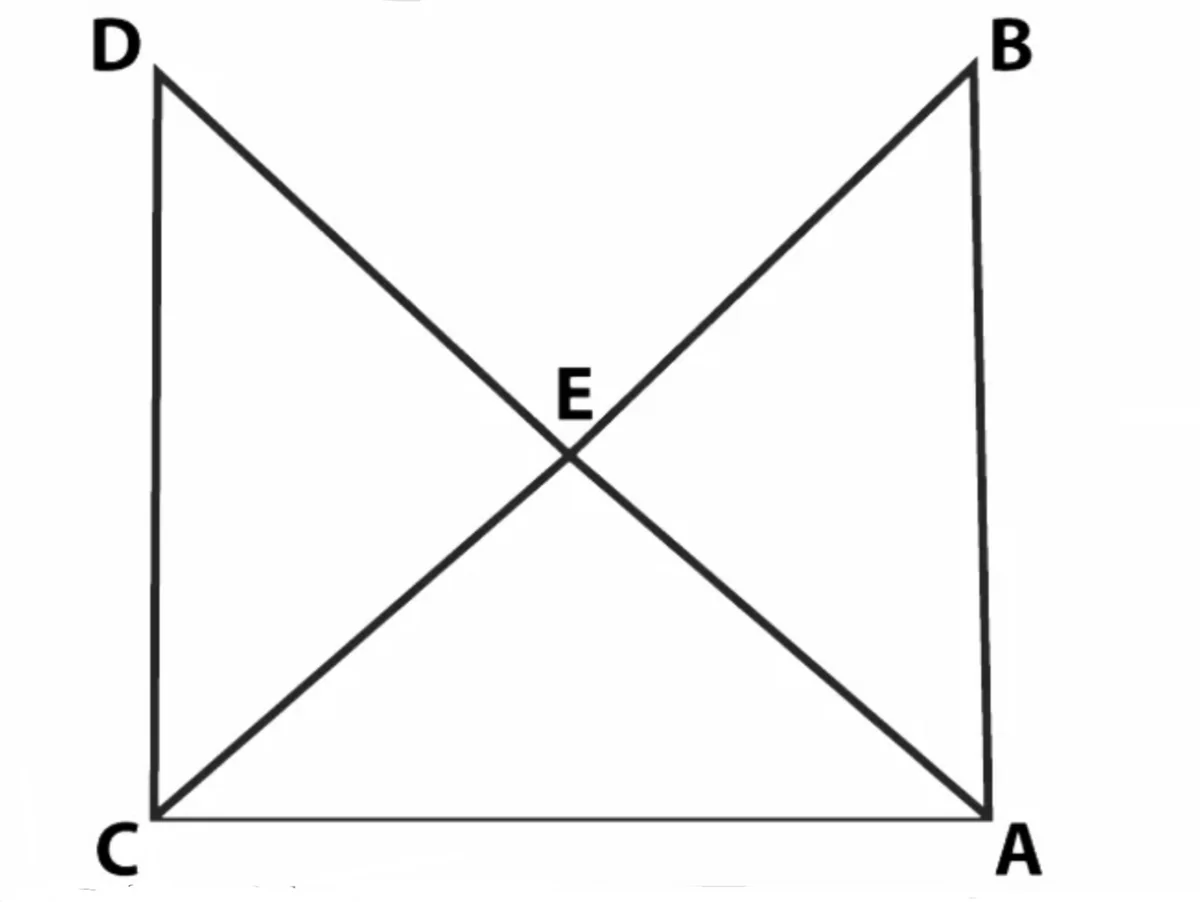
AC
Show Answer
Q61.
ABC is an isosceles triangle in which AB = AC. \(\angle B = \frac {1}{4}\angle A \) . The measure of \(\angle B\) is:
Q62.
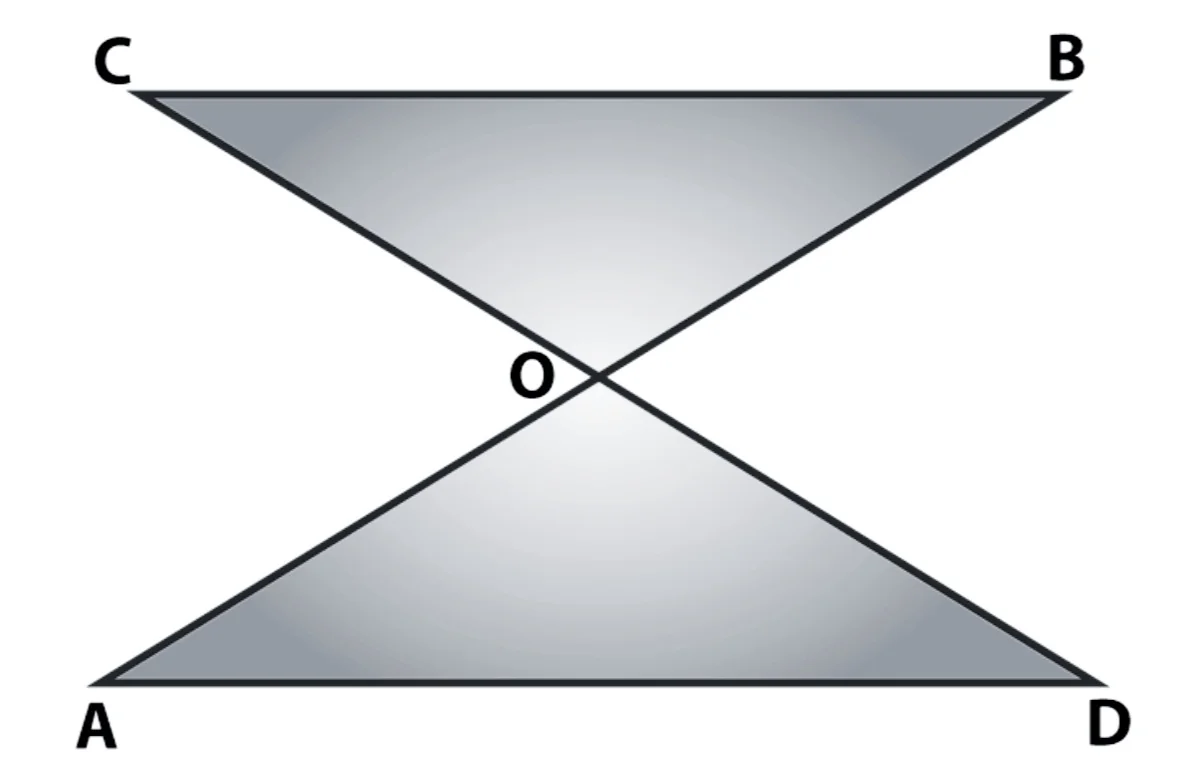
In the given figure, if AB and CD bisect each other at O, which congruence criterion best proves \(\triangle AOD \cong \triangle BOC \):
Q63.
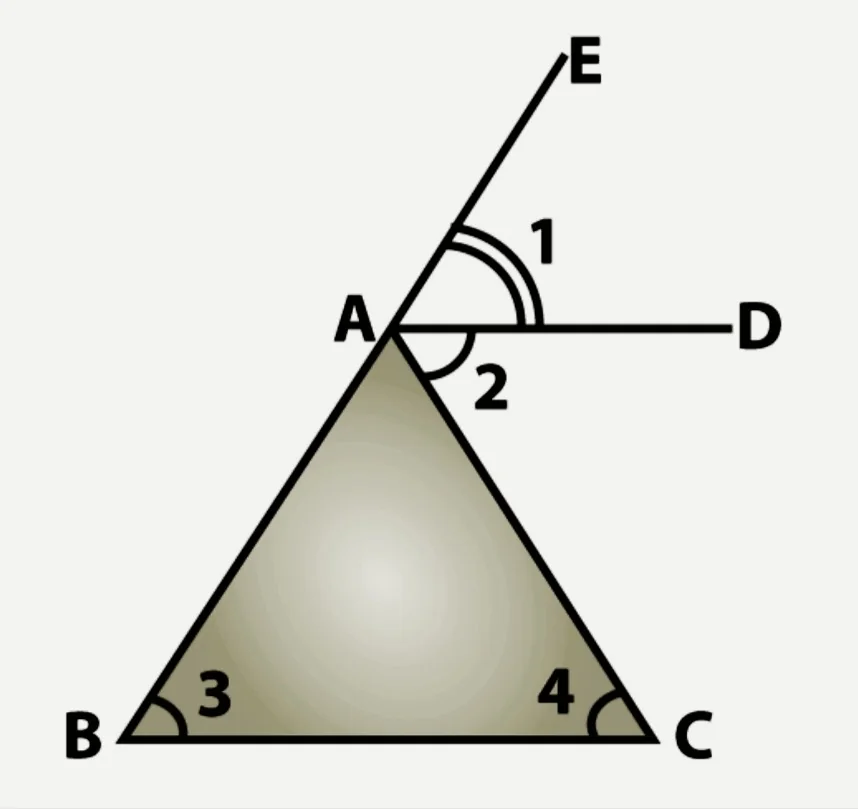
In the given figure, If the bisector of the exterior vertical angle of a triangle is parallel to the base, then the triangle is:
Q64.
In \(∆PQR\), if \(\angle QPR = 80^\circ\) and PQ = PR, then \(\angle R\) and \(\angle Q\) are:
Q65.
If BE and CF are two equal altitudes of a triangle ABC, then the triangle \(∆ABC\) necessarily is:
Q66.
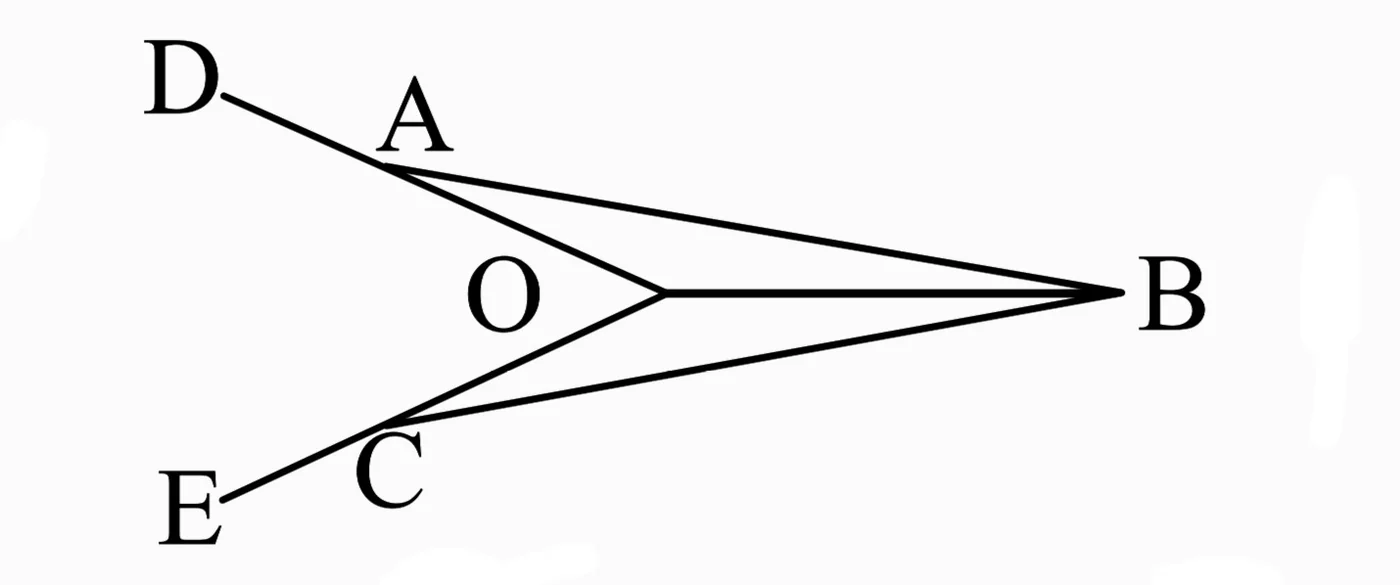
In the adjoining figure, if AB = BC and \(\angle ABO = \angle CBO\), to prove that \(\angle DAB = \angle ECB\), which of the following properties will be used?
Q67.
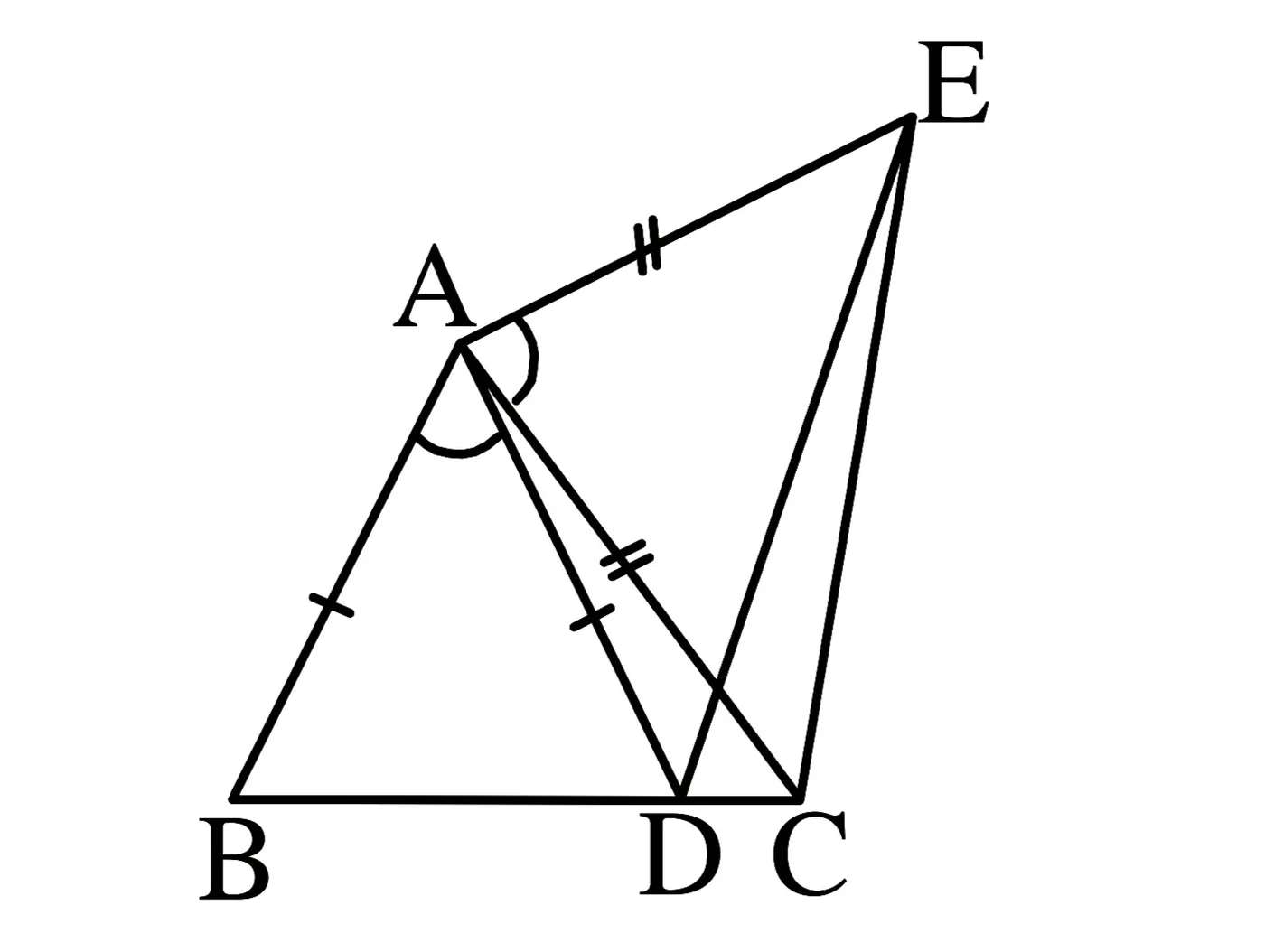
In the adjoining figure, AC = AE, AB = AD and \(\angle BAD = \angle EAC\). Identify the pair of congruent triangles required to show BC = DE. Also state the congruency criteria used.
Q68.
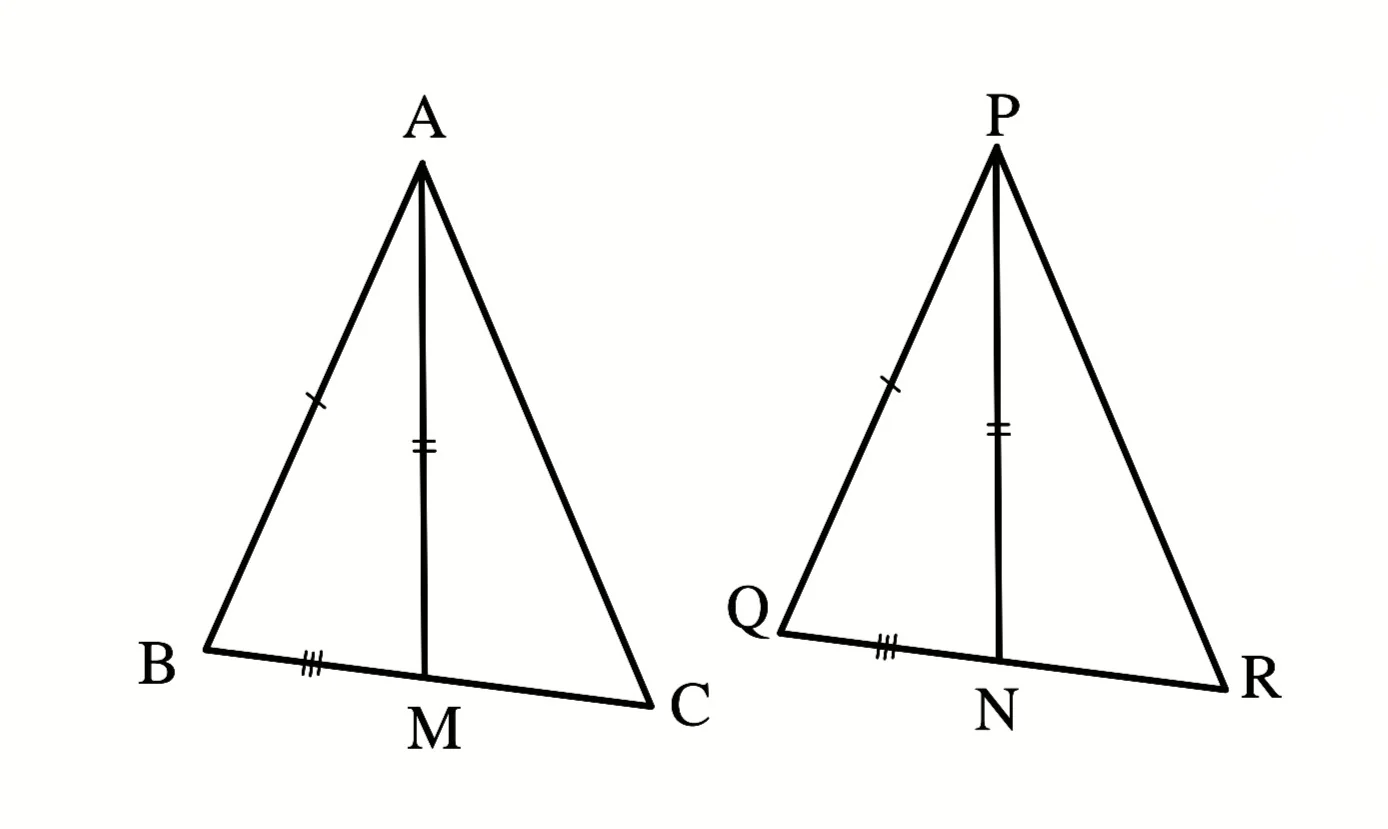
In the adjoining figure, two sides AB and BC and median AM of one triangle ABC are respectively equal to sides PQ and QR and median PN of triangle PQR. Which additional corresponding parts of the triangles must be proven equal to show that \(∆ABC \cong ∆PQR\)?
Q69.
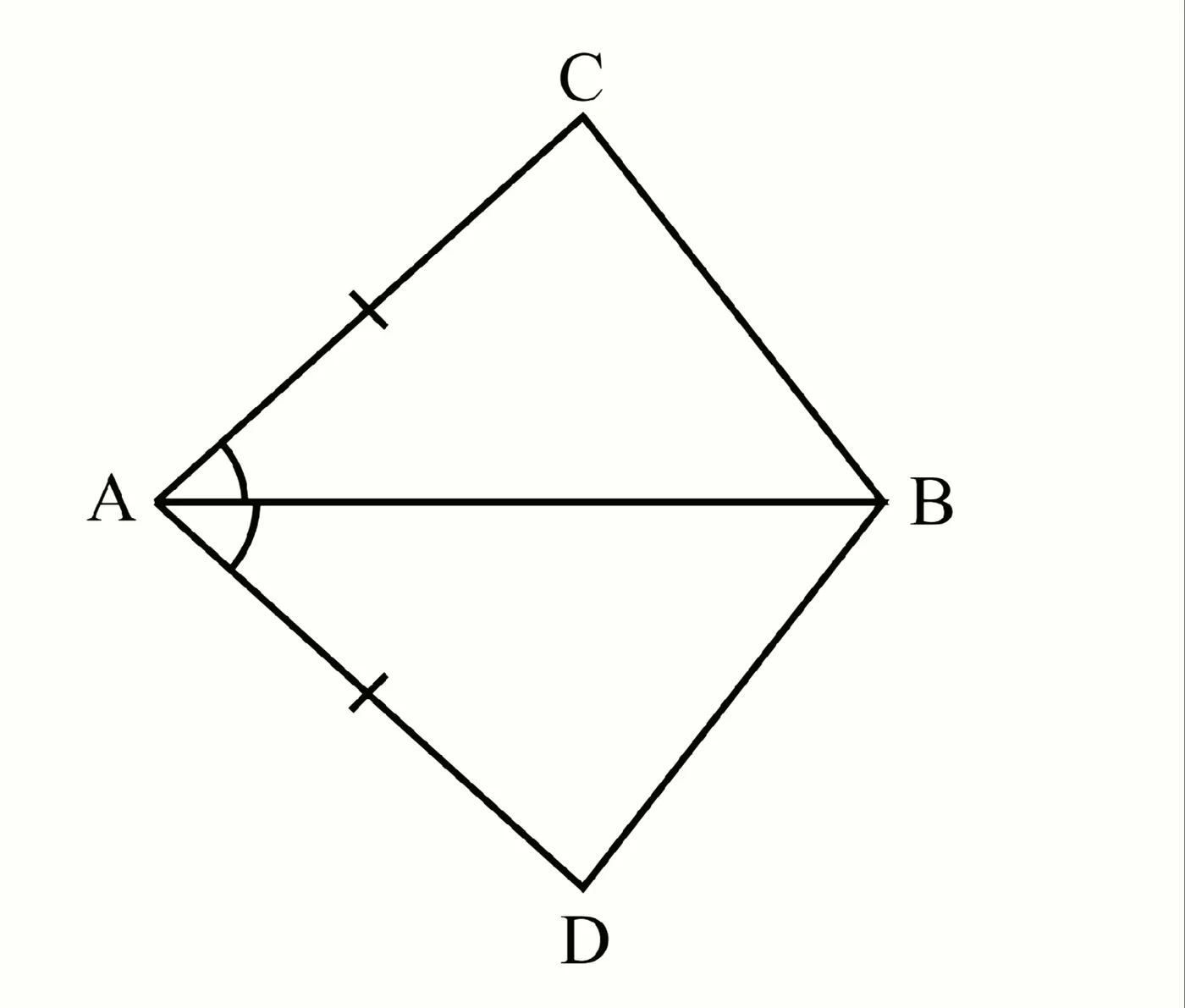
In quadrilateral ACBD, AC = AD and AB bisects \(\angle A\). What can you say about BC and BD?
Q70.
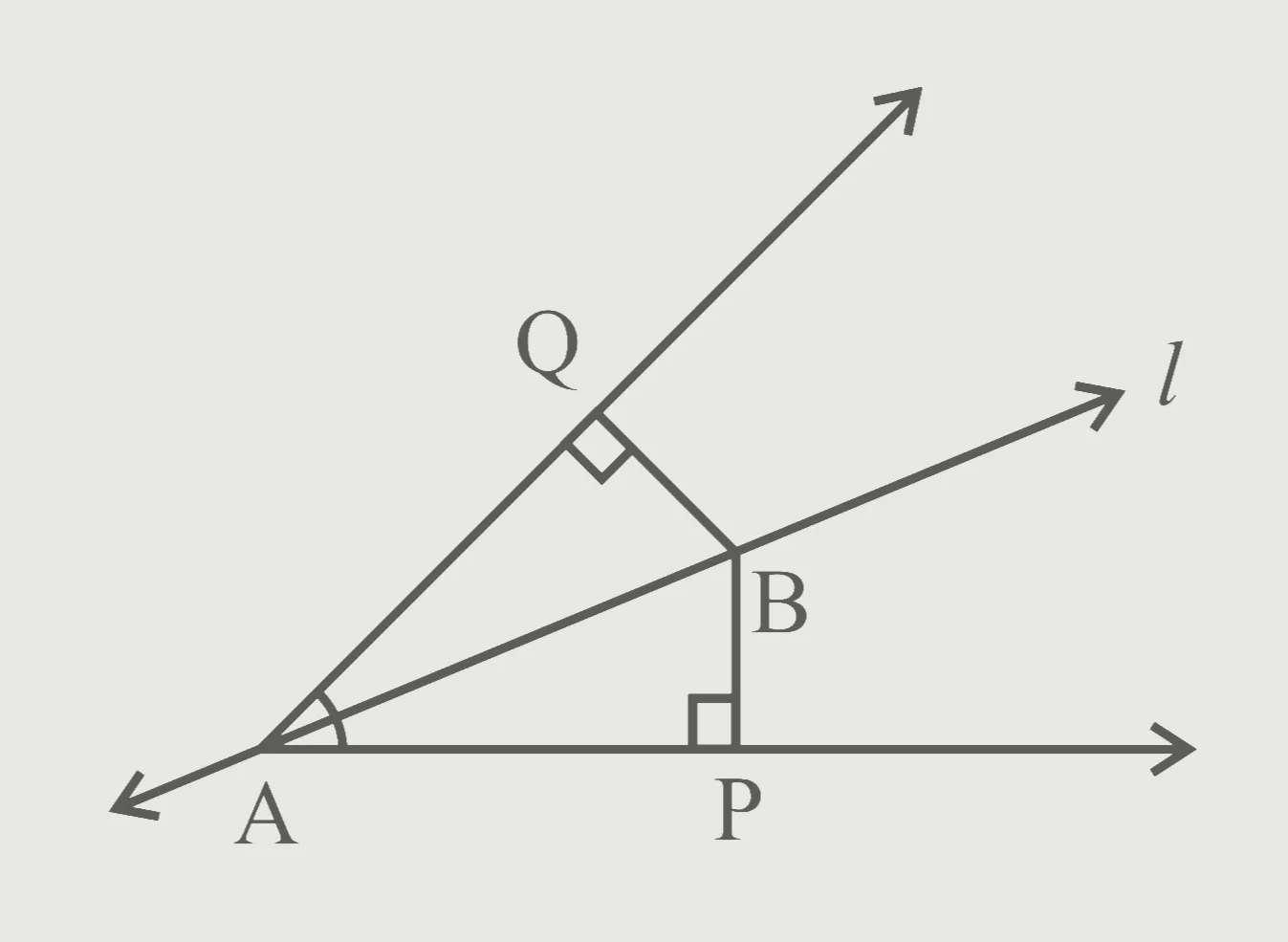
In the adjoining figure, line l is the bisector of an angle \(∠ A\) and B is any point on l. BP and BQ are perpendiculars from B to the arms of \(∠ A\) . Then which of the following is inappropriate?
Q71.
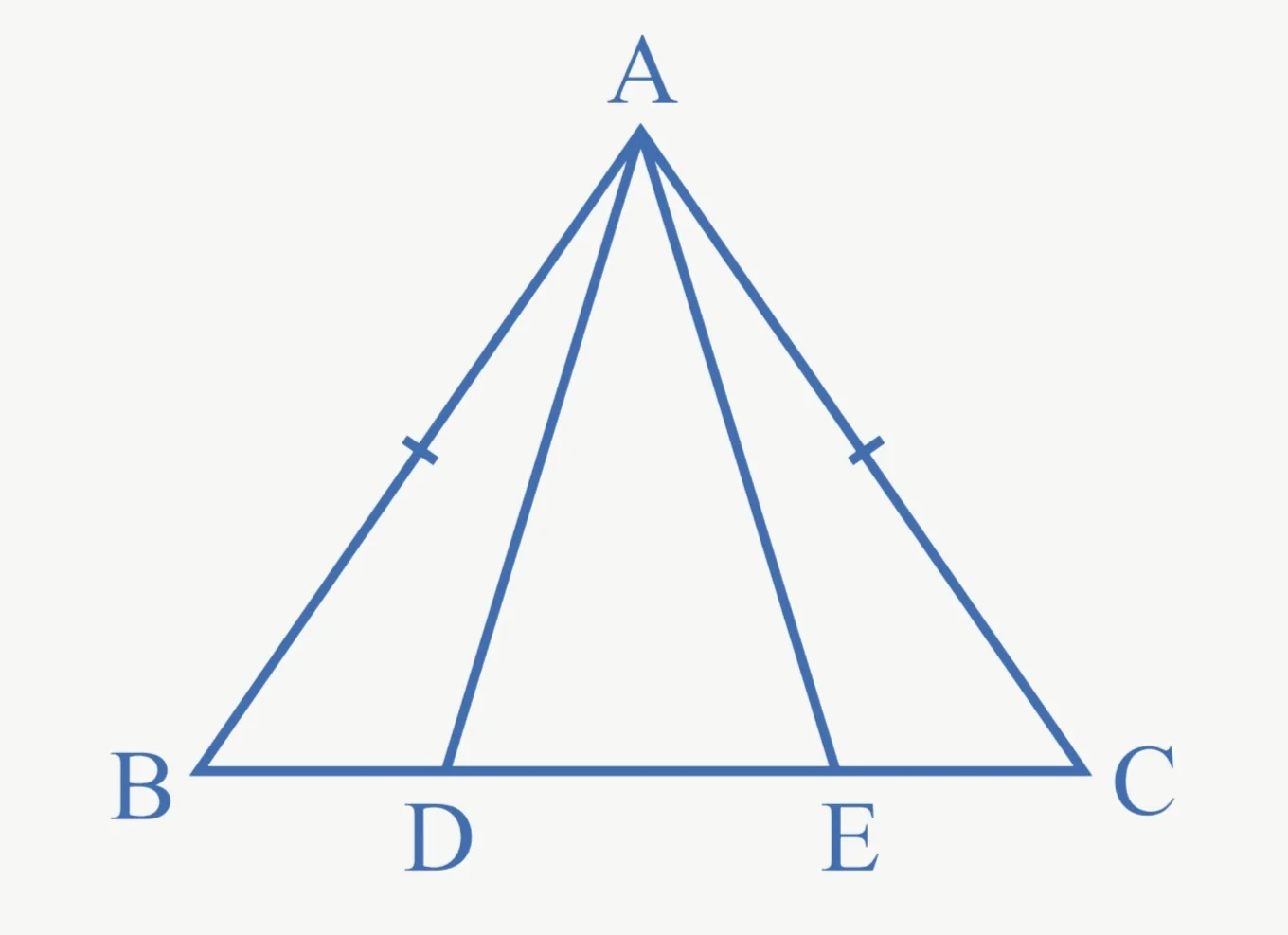
In an isosceles triangle ABC with AB = AC, D and E are points on BC. Then:
Q72.
What is the measure of the sum of the exterior angles of a triangle?
360
Show Answer
Q73.
Two line segments are congruent if and only if their _____ are equal.
Lengths
Show Answer
Q74.
Two squares are congruent if they have same _____.
Size or side length
Show Answer
Q75.
In an isosceles triangle, if the vertex angle is twice the sum of the base angle. What is the measure of the vertex angle.
120
Show Answer
Q76.
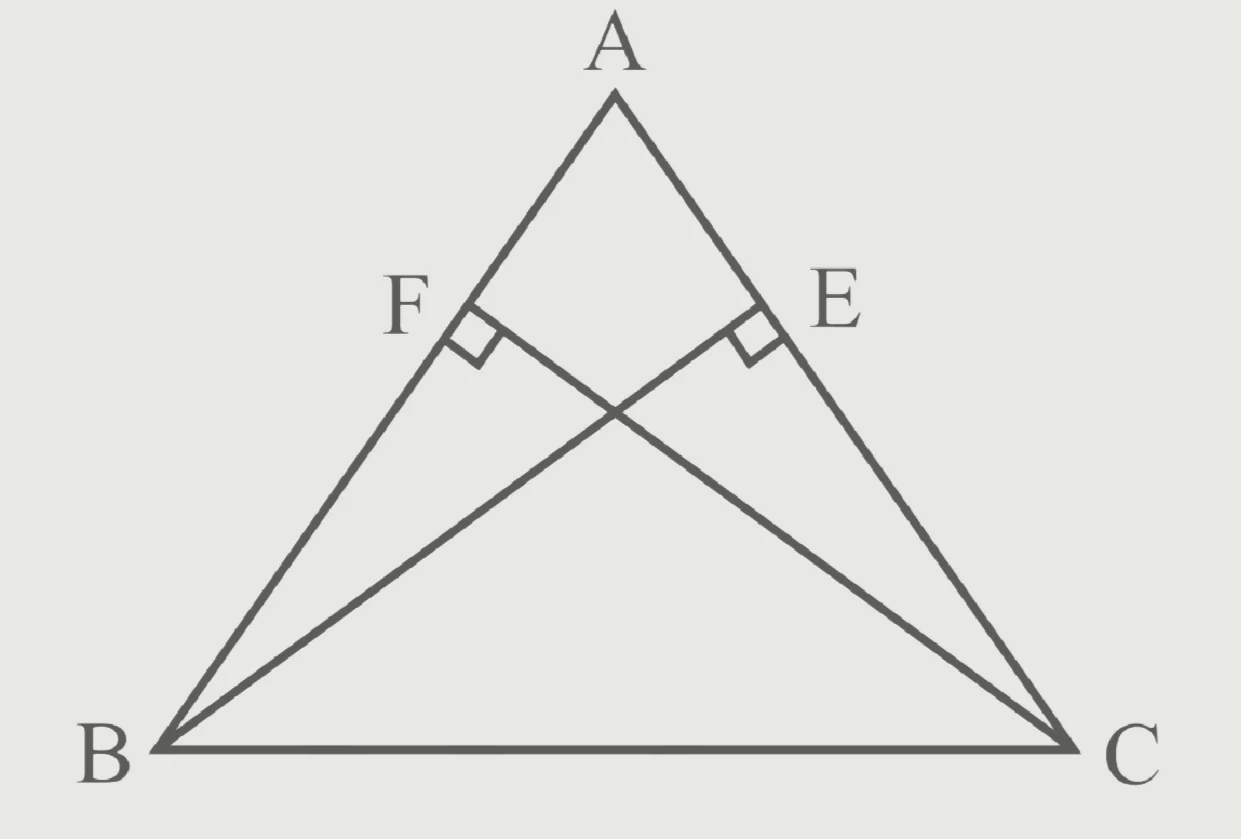
ABC is a triangle in which altitudes BE and CF to sides AC and AB are equal. What type of triangle is ABC?
Isosceles triangle
Show Answer
Q77.
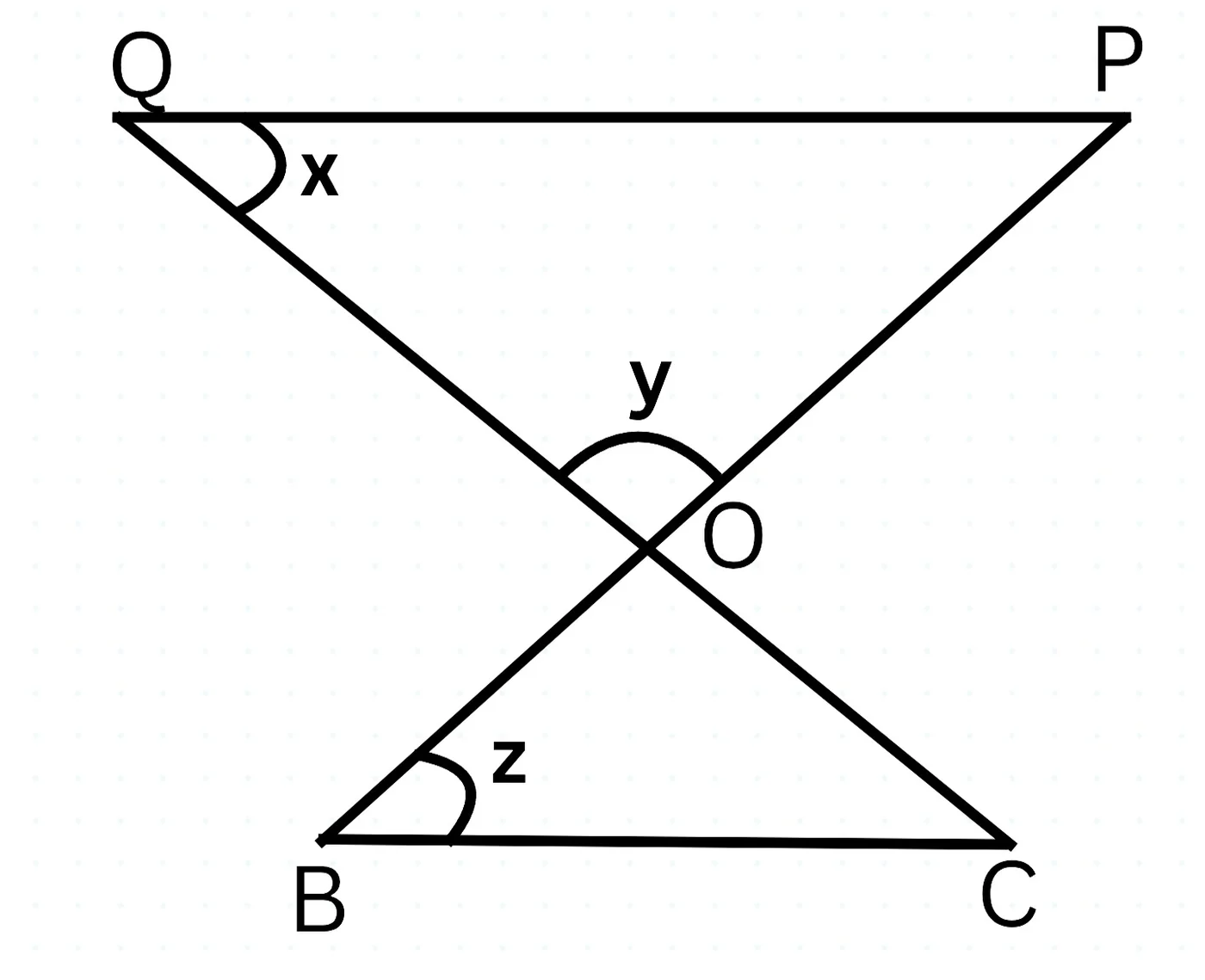
In the adjoining figure, \(BC \parallel QP\), BP and CQ intersect at O. What is the value of (x + y + z) in degree?
180
Show Answer
Q78.
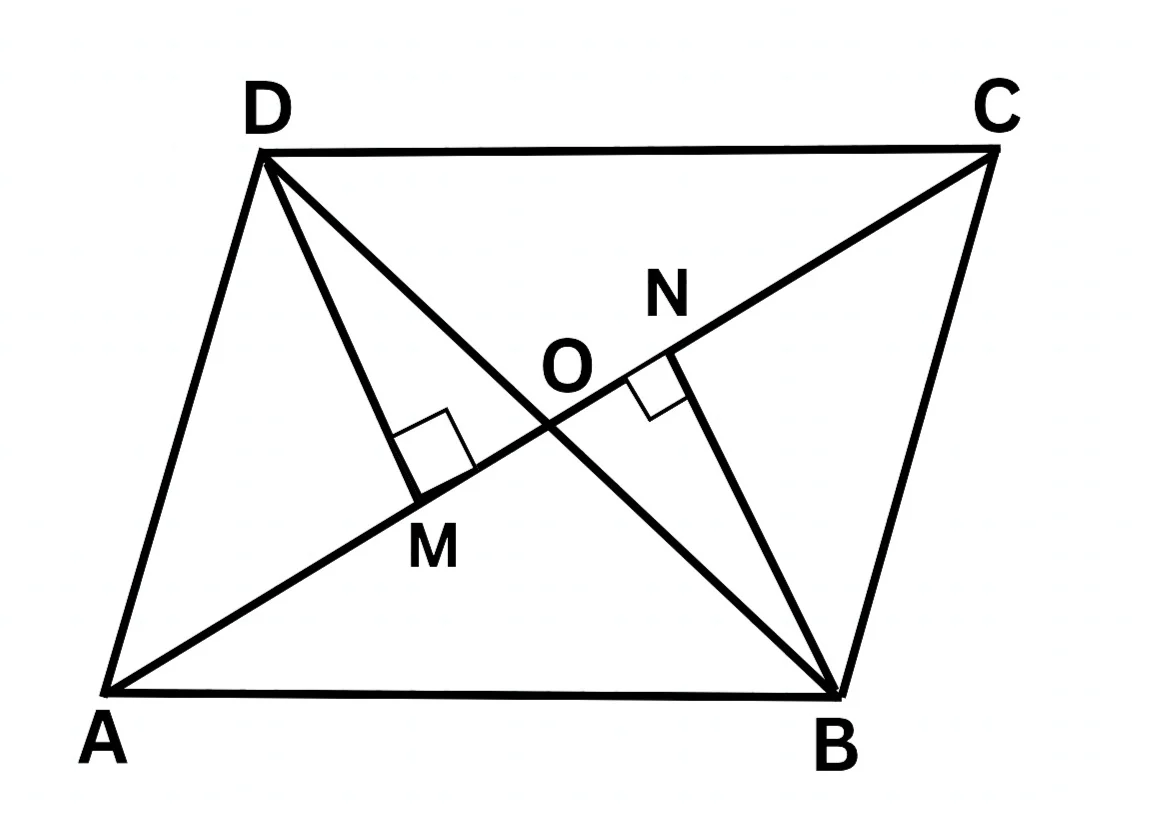
In adjoining figure, ABCD is a quadrilateral in which BN and DM are perpendicular to diagonal AC such that BN = DM. By which congruence rule \(∆ DMO \cong ∆ BNO\)?
AAS
Show Answer
Q79.
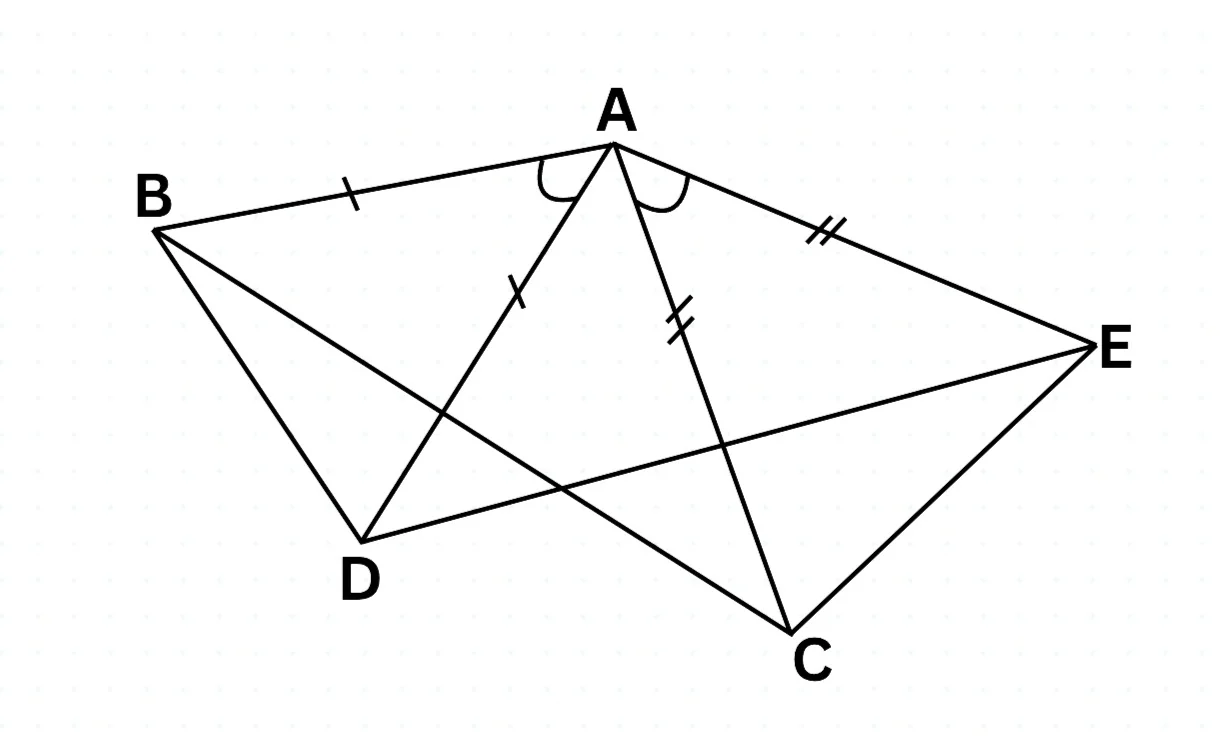
In the given figure, if \(∆ABC \cong ∆ADE\), state the corresponding pairs of sides that are equal by the CPCT (Corresponding Parts of Congruent Triangles) rule.
BC = DE
Show Answer
Q80.
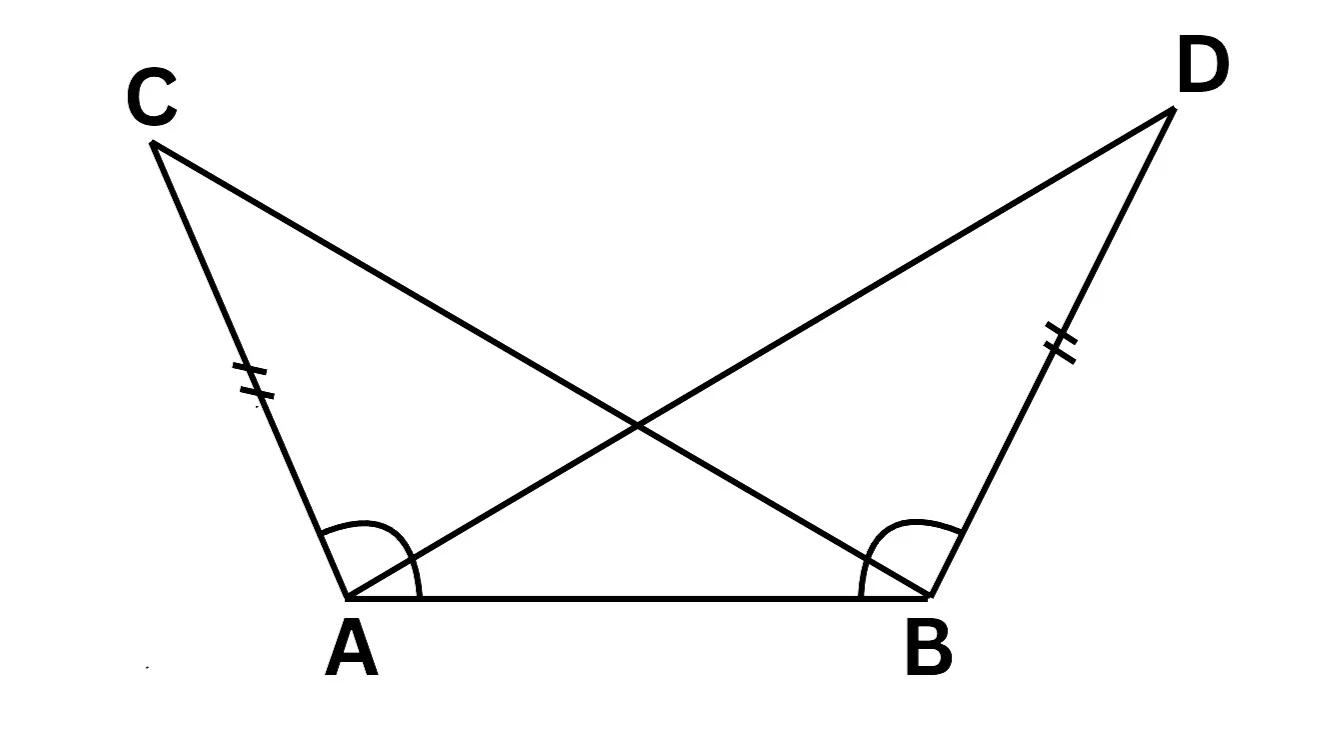
In The adjoining figure, if AC = BD and \( \angle CAB = \angle DBA\), by which congruence rule \(∆ ABC \cong ∆ BAD\)?
SAS
Show Answer
Q81.
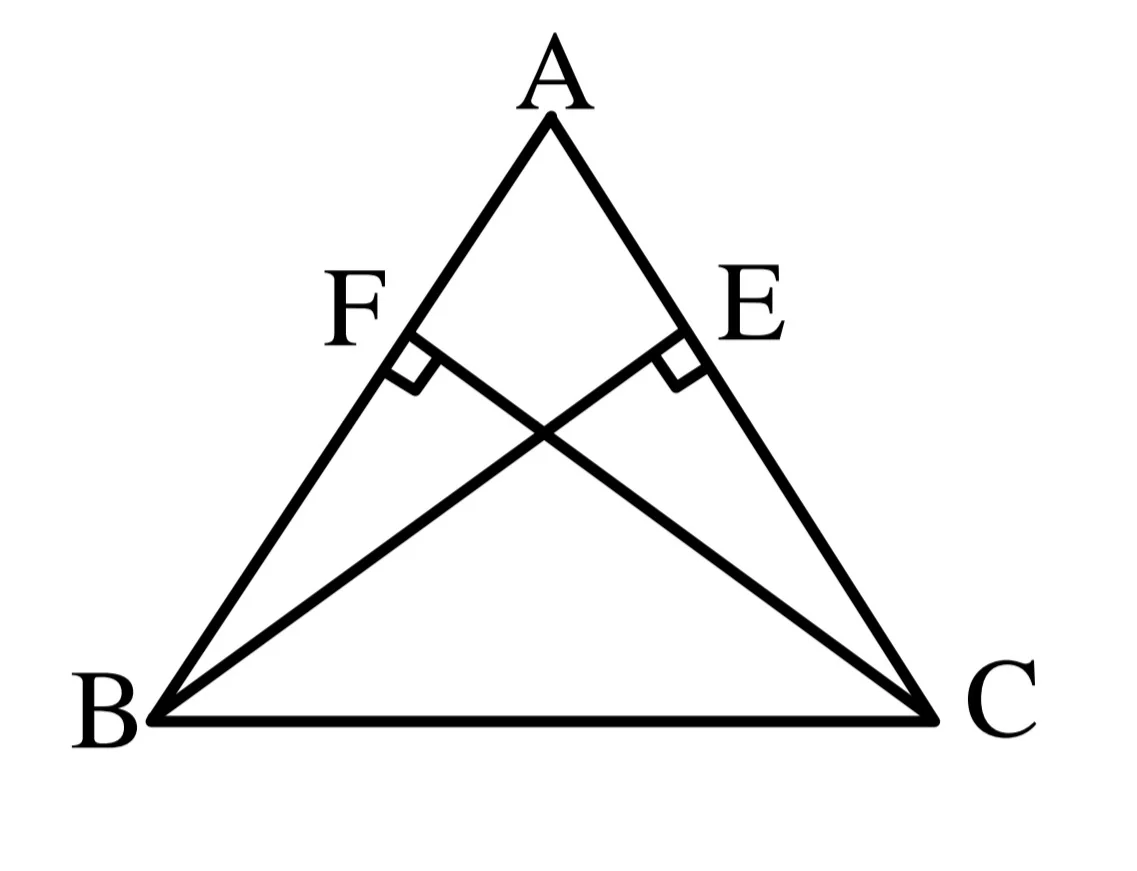
In the adjoining figure, BE and CF are equal altitudes of \(∆ ABC\) on sides AC and AB respectively. If \(\angle ECB = 55^\circ\). Find the measure of \(\angle FCB\).
35
Show Answer
Q82.
In the adjoining figure, AB is a line segment and P is its mid-point. D and E are points on the same side of AB such that: \(\angle BAD = \angle ABE\) and \(\angle EPA = \angle DPB\). Which side of \(∆DAP\) is corresponding to side PE of \(∆ EBP\)?
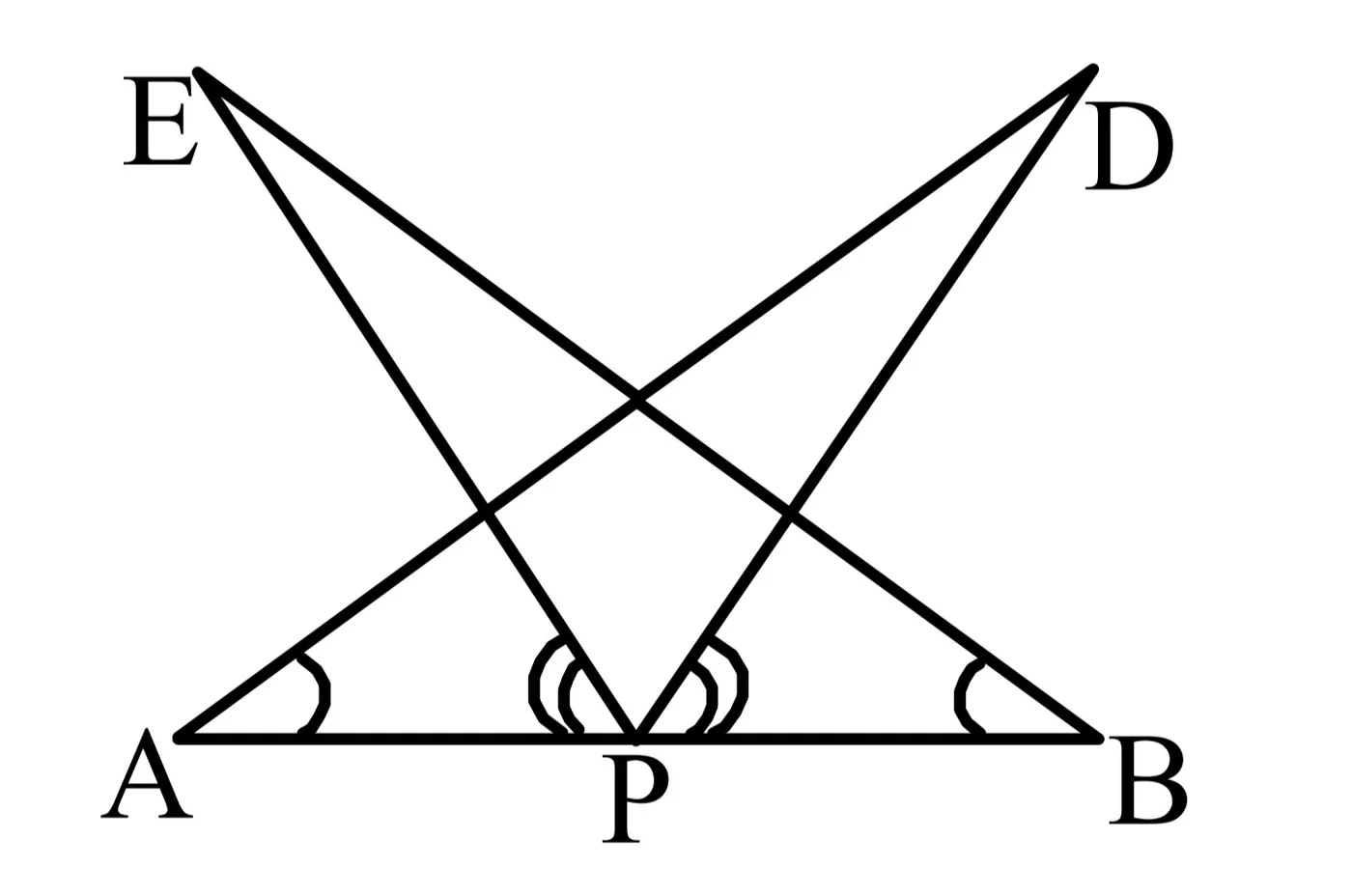
PD
Show Answer
Q83.
In the adjoining figure, In right triangle ABC, right angled at C, M is the mid-point of hypotenuse AB. C is joined to M and produced to a point D such that DM = CM. Point D is joined to point B. Which triangle is congruent to \(∆ AMC\)?
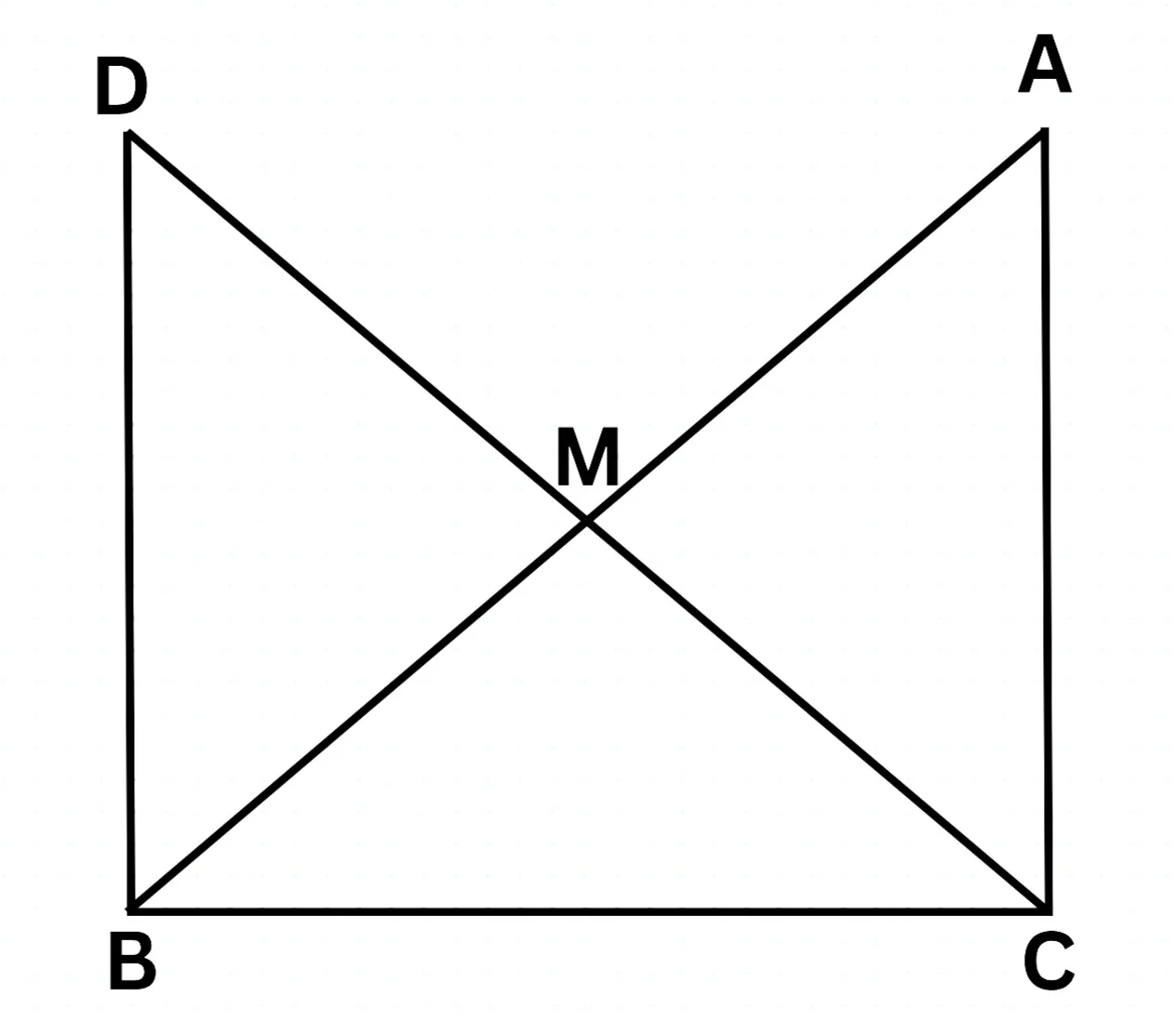
Triangle BMD
Show Answer
Q84.
In the adjoining figure, l and m are two parallel lines intersected by another pair of parallel lines p and q. Which congruence criterion can not be used to prove that \(∆ ABC ≅ ∆ CDA\)?
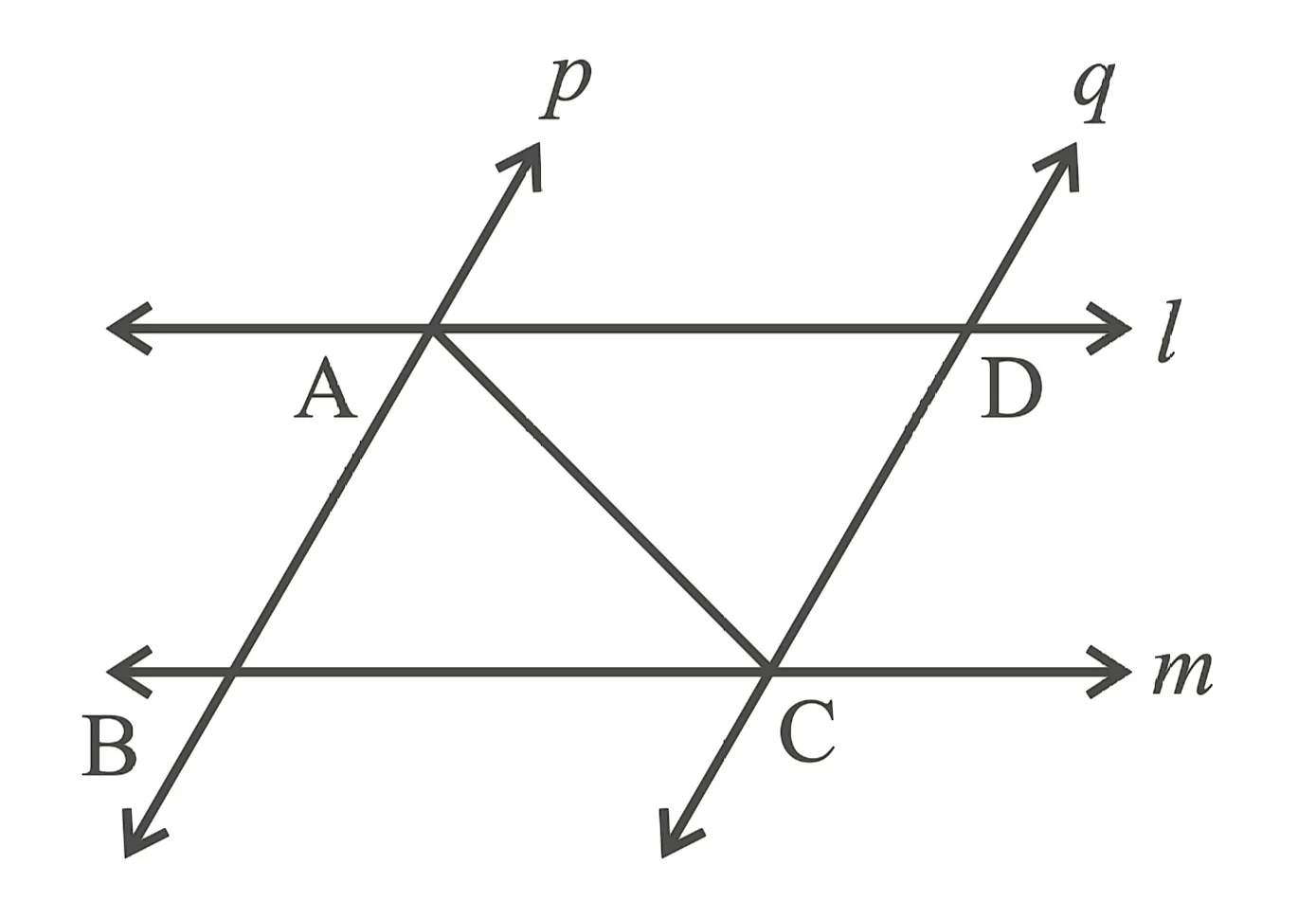
RHS
Show Answer
Q85.
AB is a line-segment. P and Q are points on opposite sides of AB such that each of them is equidistant from the points A and B. If \(∠PAB=35^\circ\), determine the angle between PA and PB.
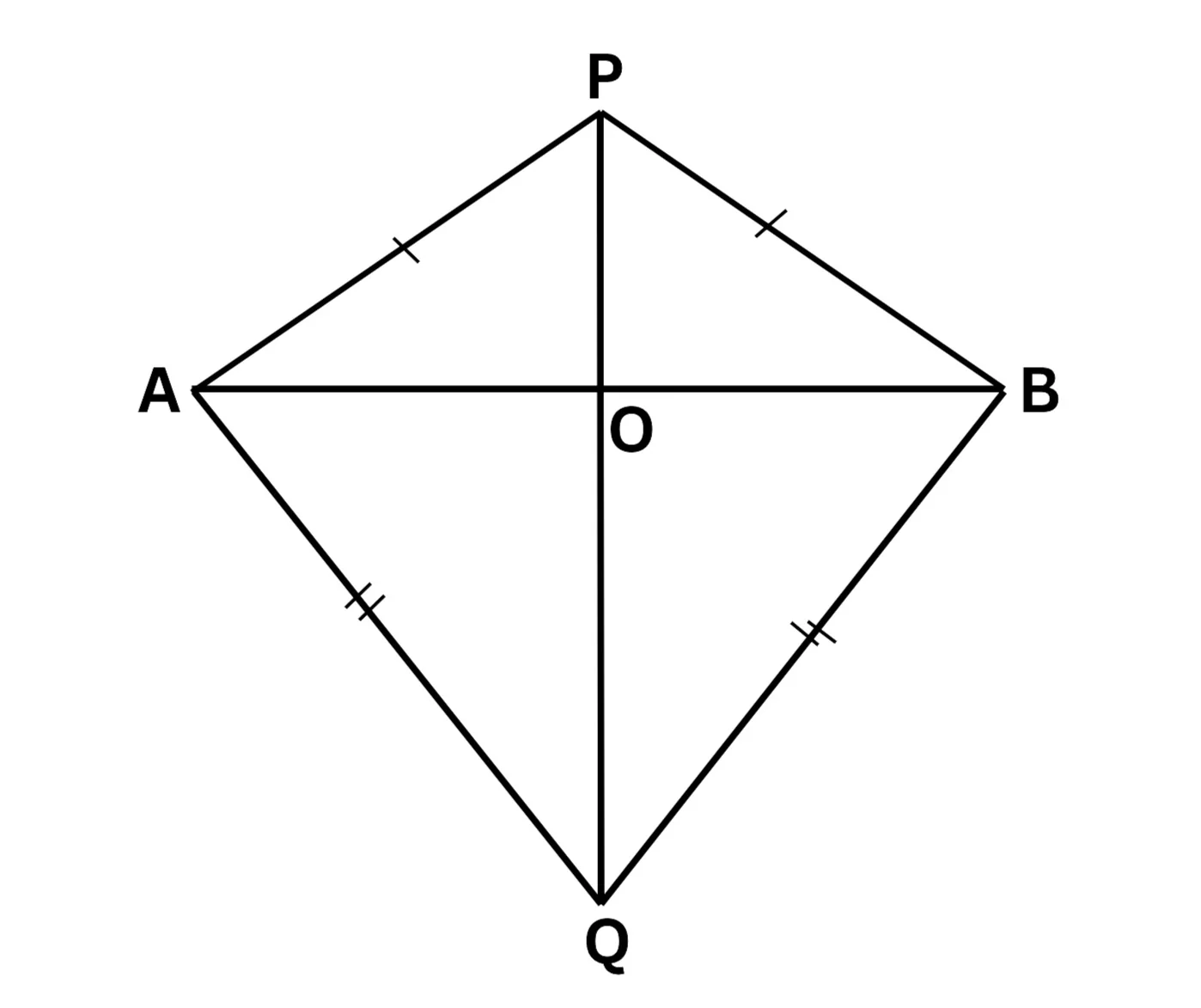
110
Show Answer
Q86.
In the adjoining figure, AB = AC, what is the measure of \(\angle C\)?
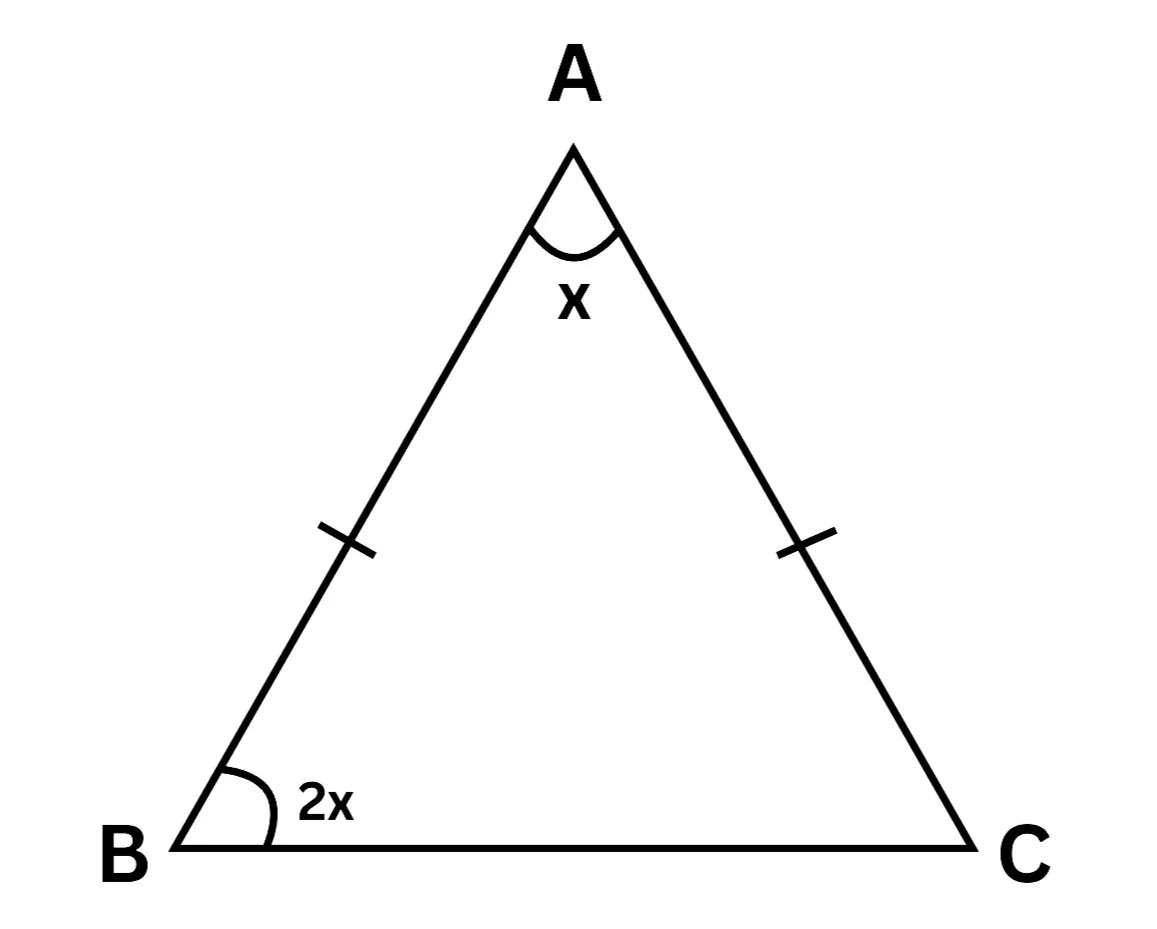
72
Show Answer
Q87.
In the given figures, PQ = PR, and QS = RT, name the triangle congruent to \(∆ PQT\). What type of triangle is \(∆PST\)?
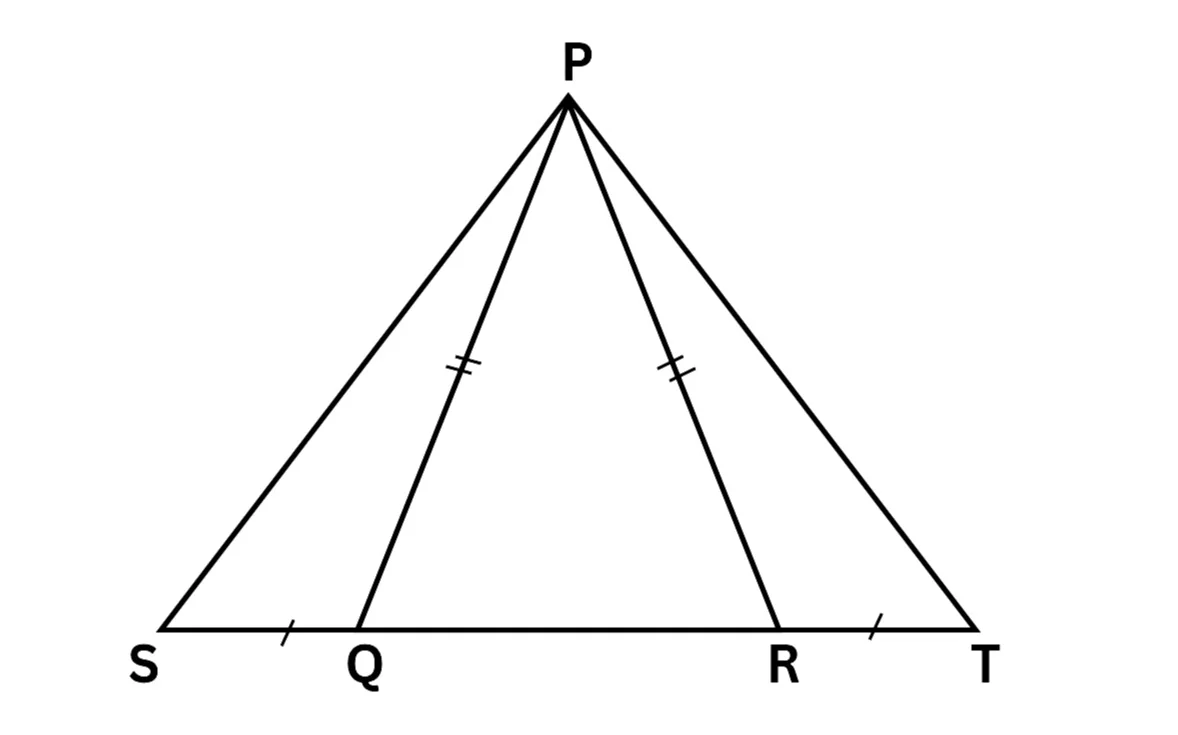
Triangle PRS, isosceles triangle
Show Answer
Q88.
In the given figure, AB = AC, \(\angle ABD = \angle ACD\) \(\angle D = 40^\circ\) and \(\angle A = 110\). Find the measure of \(\angle ABD\).
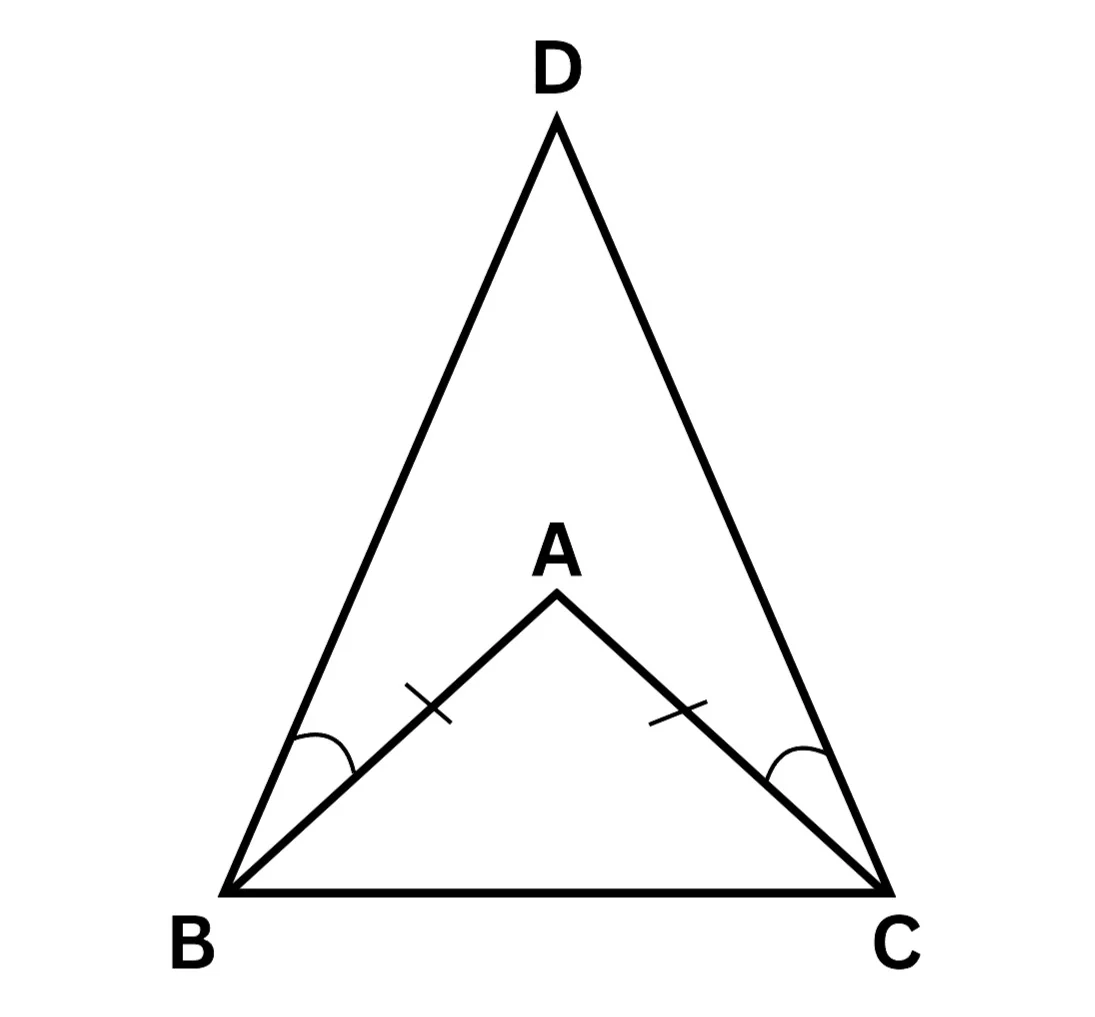
35
Show Answer
Q89.
if \(∆ABC \cong ∆RQP\), which side of \(\triangle PQR\) corresponds to BC?
QP
Show Answer
Q90.
In right triangles ABC and PQR, hypotenuse AC = PR and side AB = PQ. Which congruence rule proves \(\triangle ABC \cong \triangle PQR\)?
RHS
Show Answer
Q91.
How many elements does a triangle have?
6
Show Answer
Q92.
\(∆ABC\) is an isosceles triangle in which AB = AC. Side BA is produced to D such that AD = AB, then what is the measure of \(\angle BCD\)?
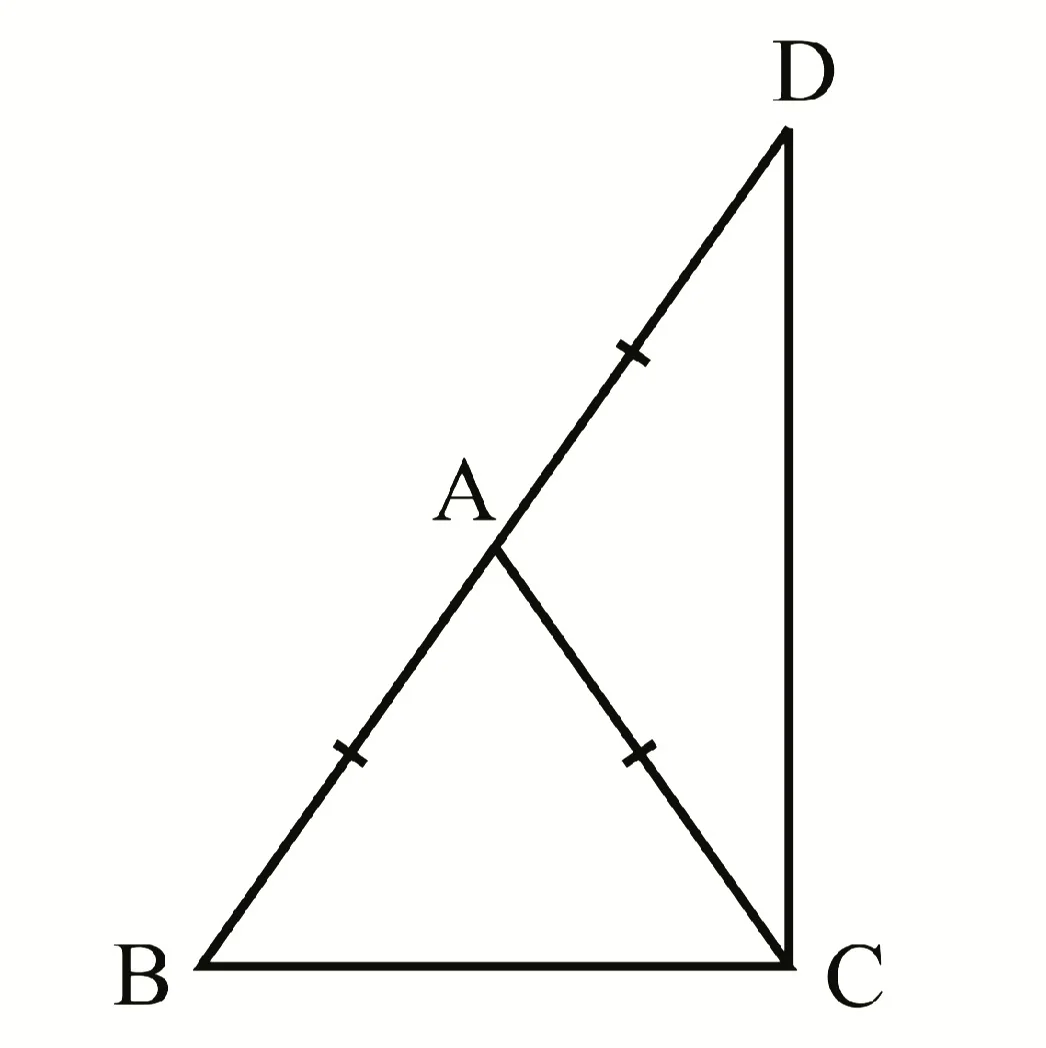
90
Show Answer
Q93.
In the given figure, ABCD is a quadrilateral in which AD = BC and \(\angle DAB = \angle CBA\). What is the angle corresponding to \(\angle ABD\)
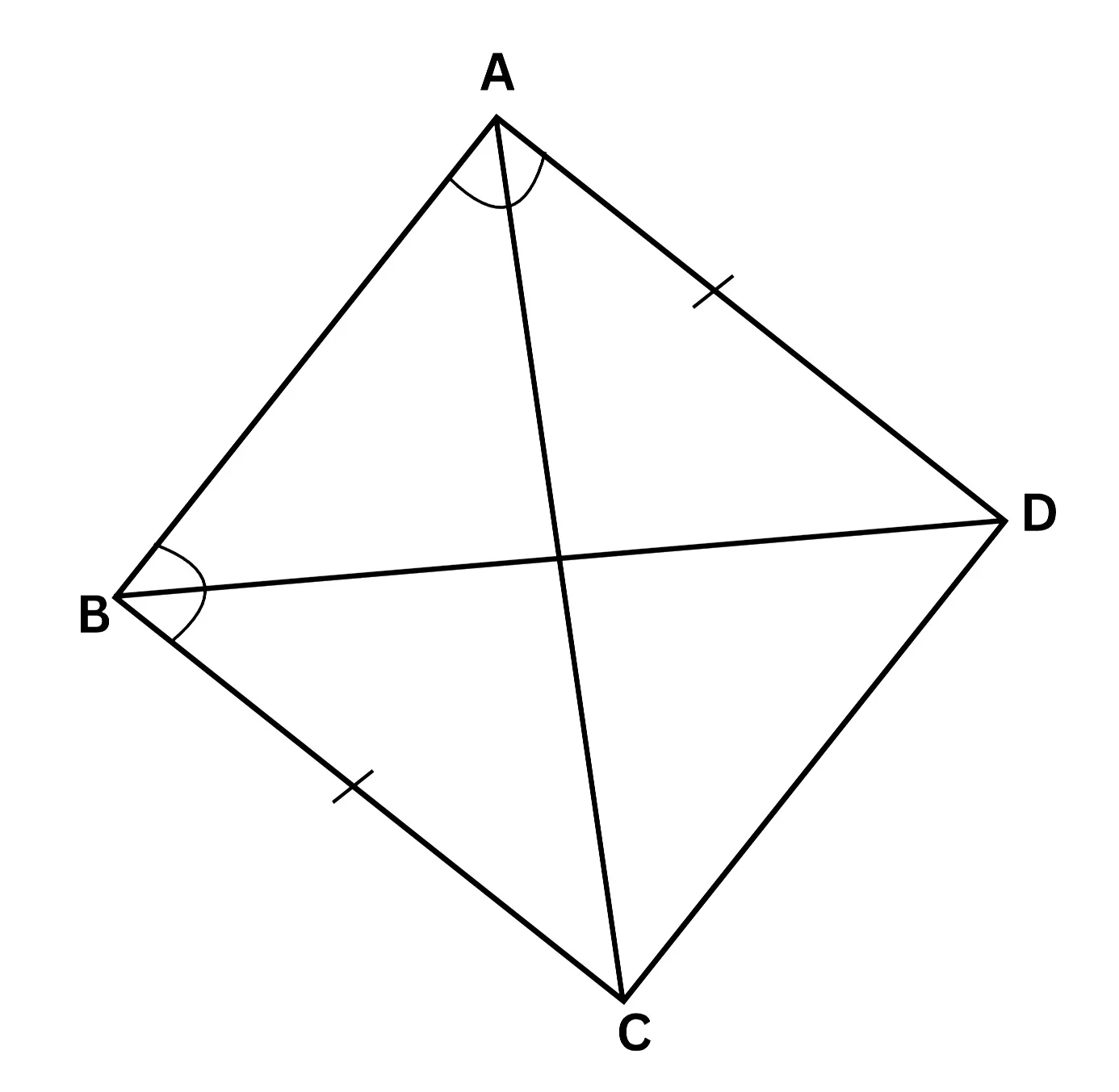
Angle BAC
Show Answer
Q94.
If \(\triangle PQR \cong \triangle STU\), and the perimeter of \(\triangle PQR\) is 30 units with PQ = 8 units and QR = 10 units, what is the length of side SU?
12 units
Show Answer
Q95.
Two triangles PQR and STU have PQ=ST, \(\angle R= \angle U\), and \(\angle Q= \angle T\). Which congruence rule is used to prove that \(\triangle PQR \cong \triangle STU\)?
AAS
Show Answer
Q96.
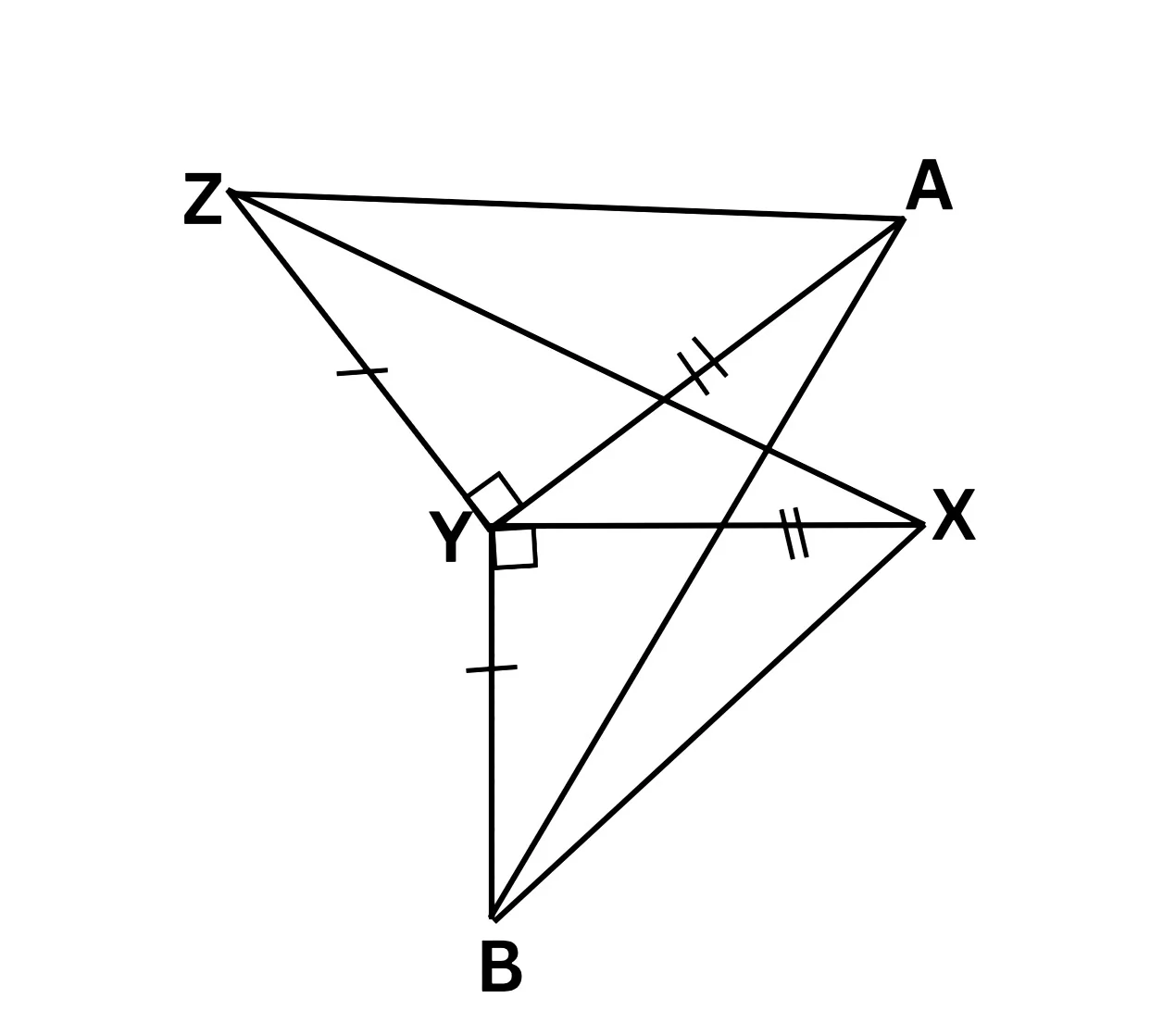
In the adjoining figure, which triangle is congruent to \(∆XYZ\):
Q97.
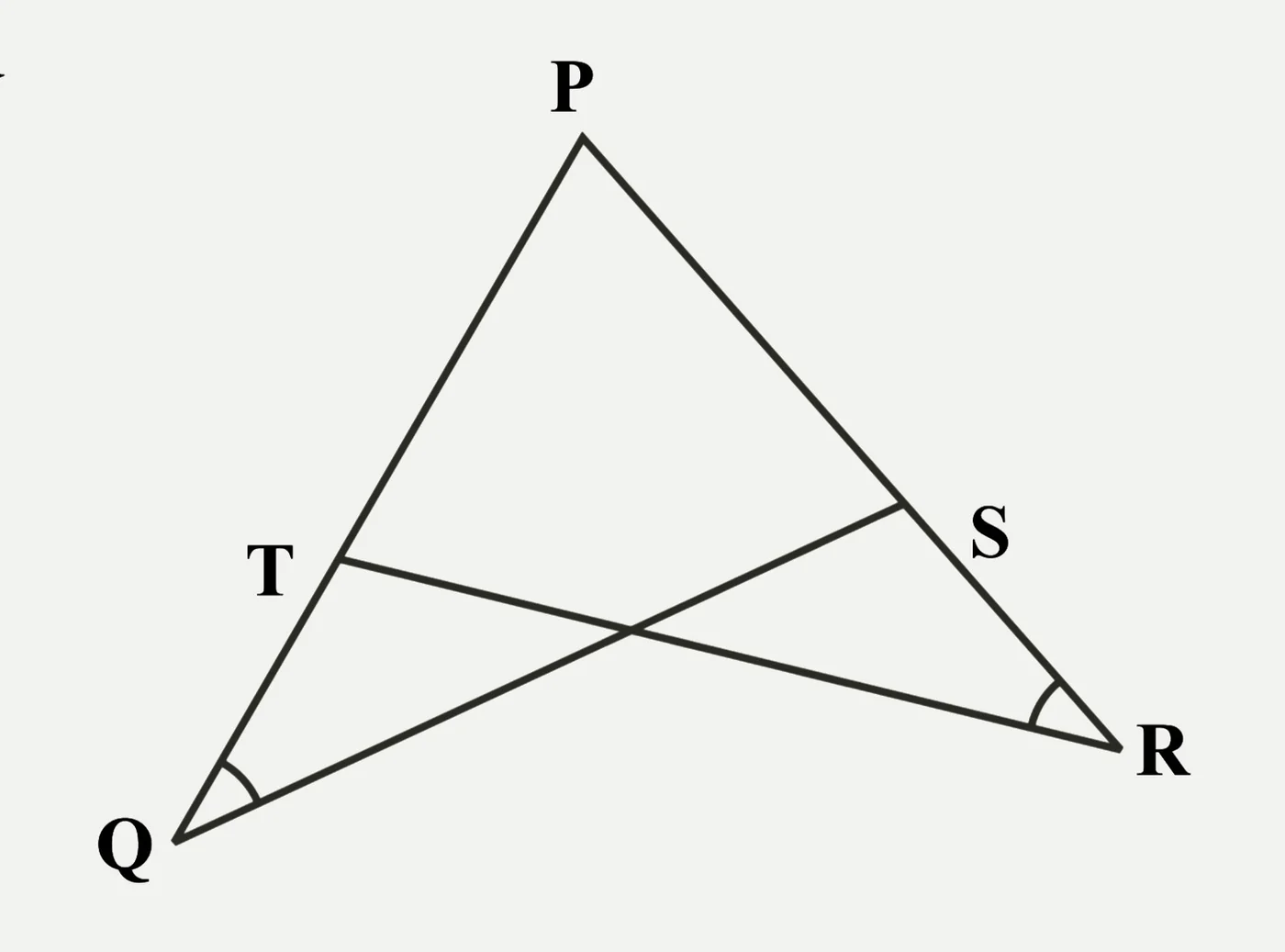
In the given figure, PS= PT and \(\angle Q = \angle R\). Which congruence criterion best proves that \(∆ PQS ≅ ∆ PRT\)?
AAS
Show Answer
Q98.
Which of the following statements is always true for any triangle?
Q99.
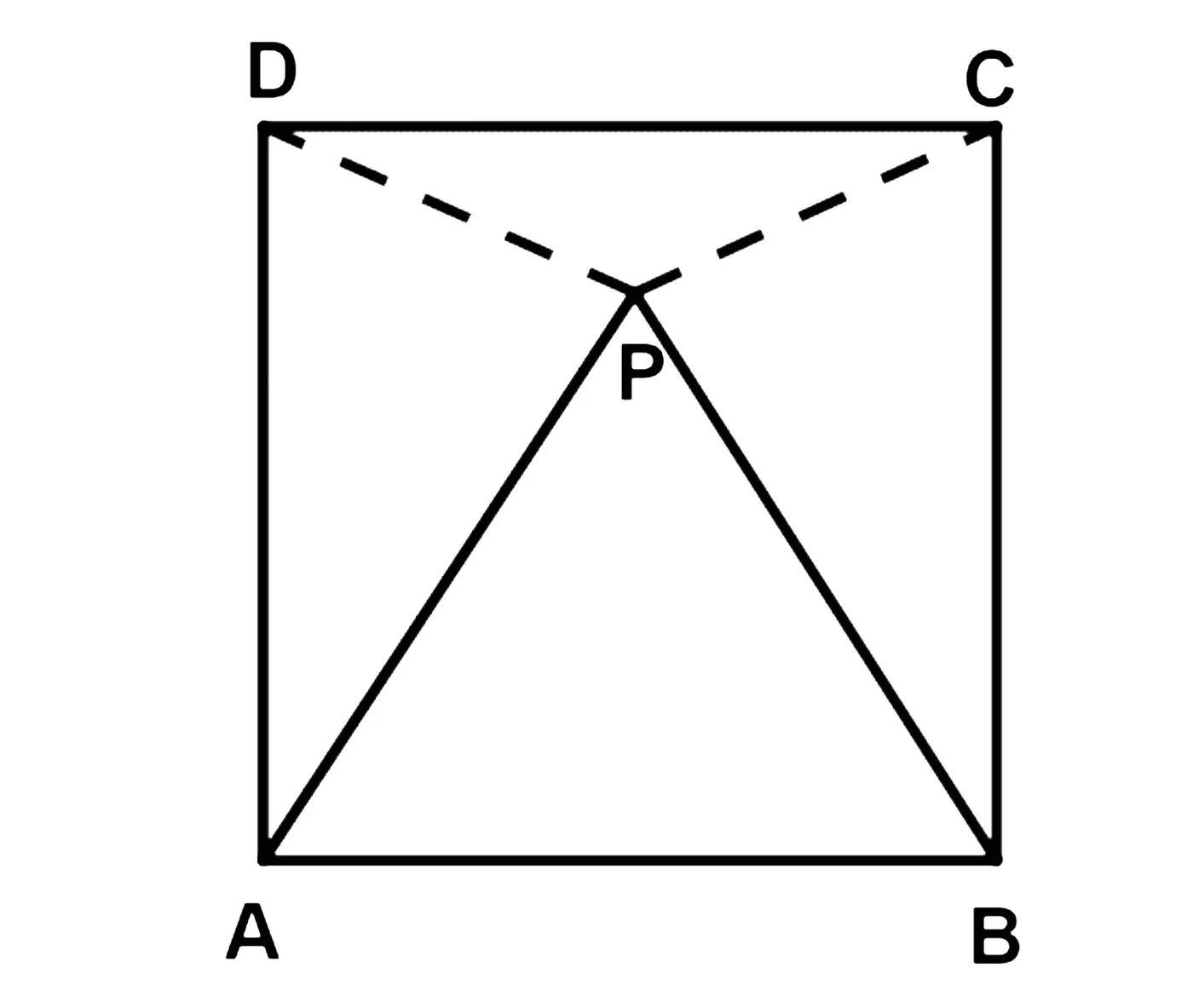
In the following diagrams, ABCD is a square and APB is an equilateral triangle. Find the measure of \(\angle DPC\).
150
Show Answer
Q100.
In the given figure, ABC is an equilateral triangle in which QP is parallel to AC. Side AC is produced up to point R so that CR = BP. What is the relation between QR and PC?
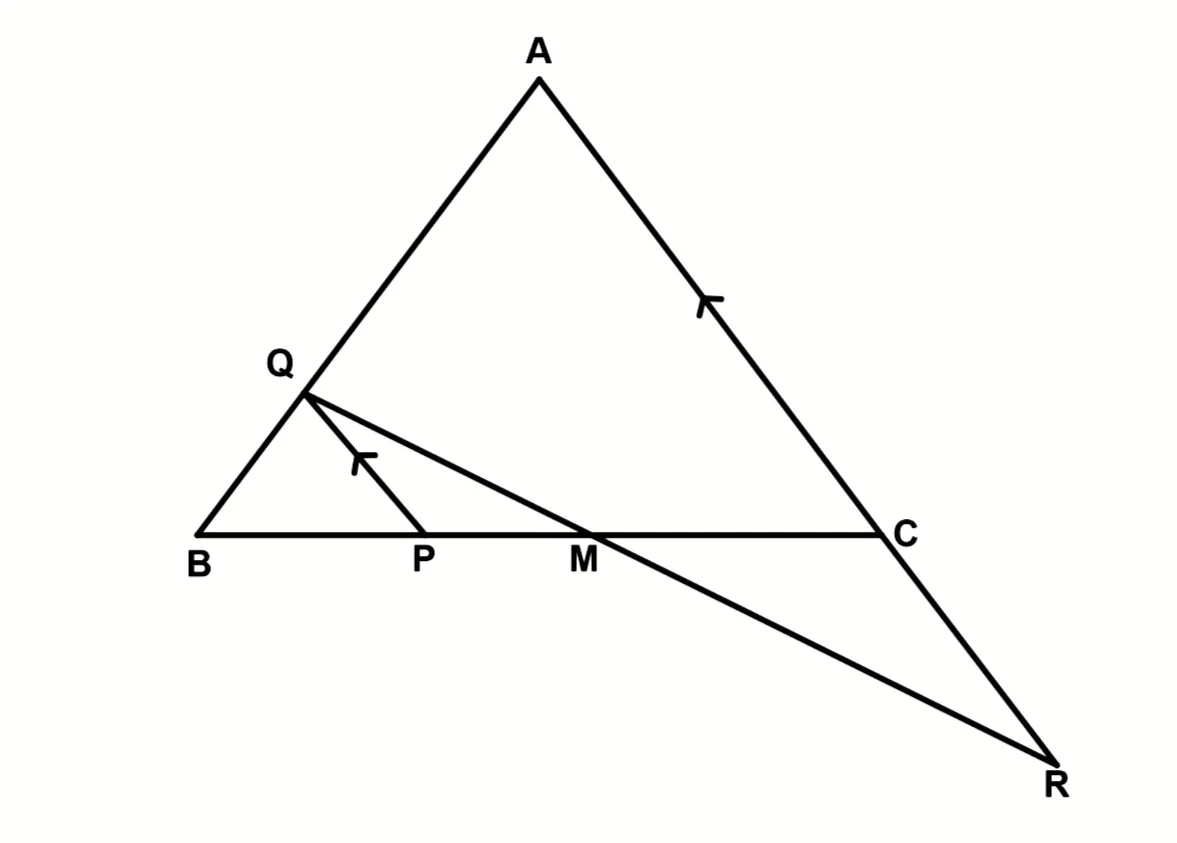
QR and PC bisect each other at M.
Show Answer
Q101.
In the adjoining figure, ABCD and LMNO are squares. Express the measure of \(\angle MDC\) in terms of x ?
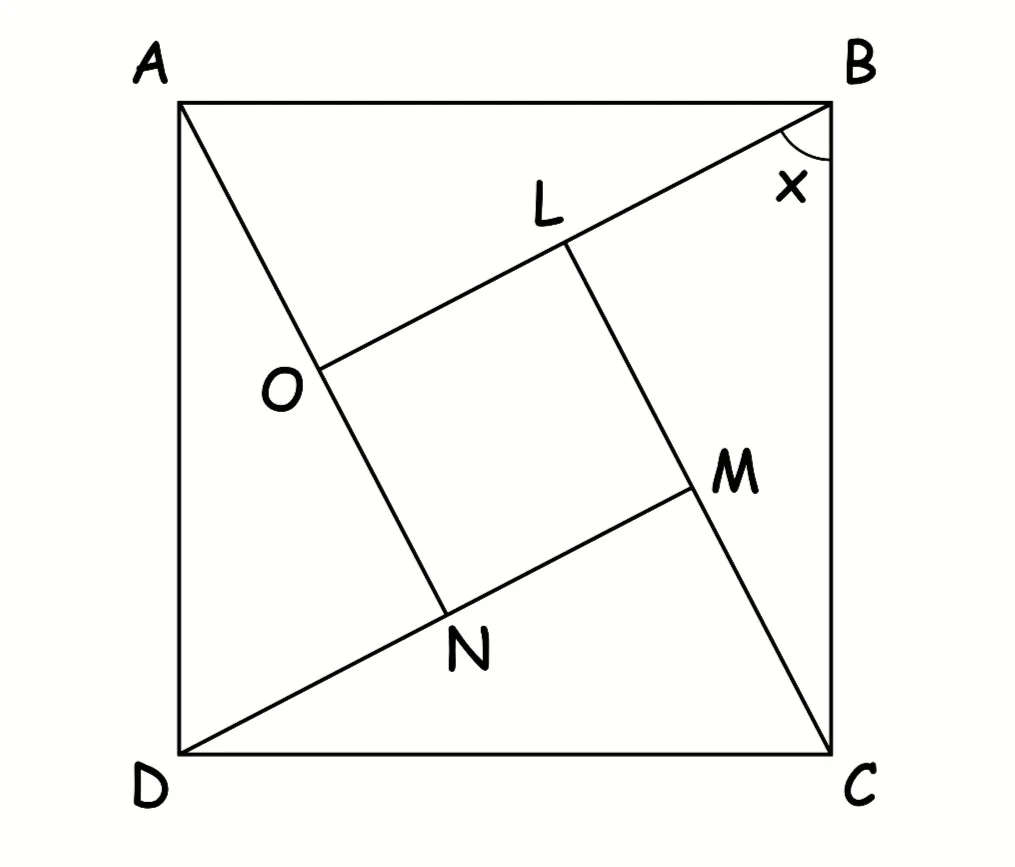
90 - x
Show Answer
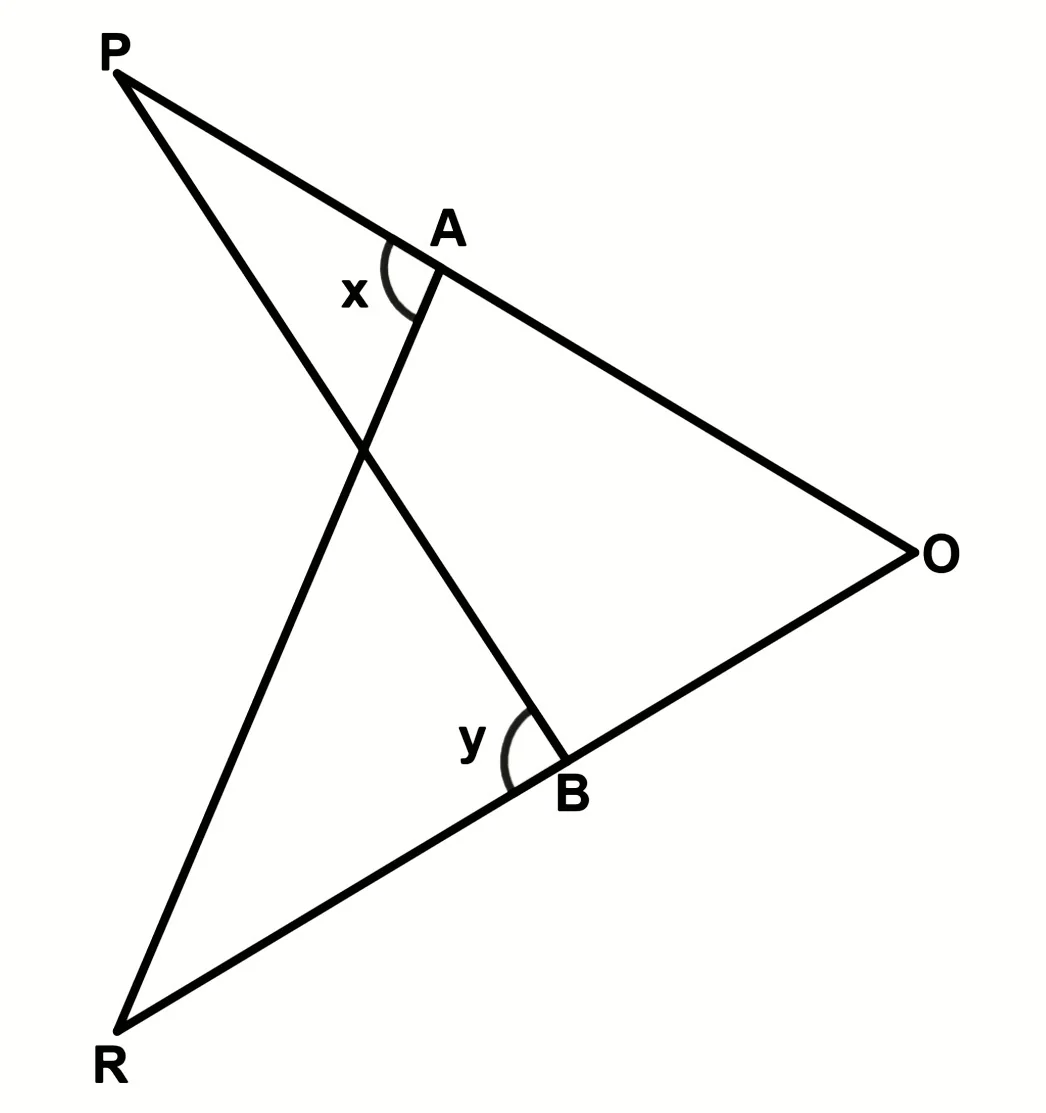
Q102.
In the given figure, if \(∠x = ∠y \) and PO = RO, then:
Q103.
In the given figure, DG and BC are parallel. if AB = AC and \(\angle BAC = 50^\circ\), then what is the measure of \(\angle AED\)?
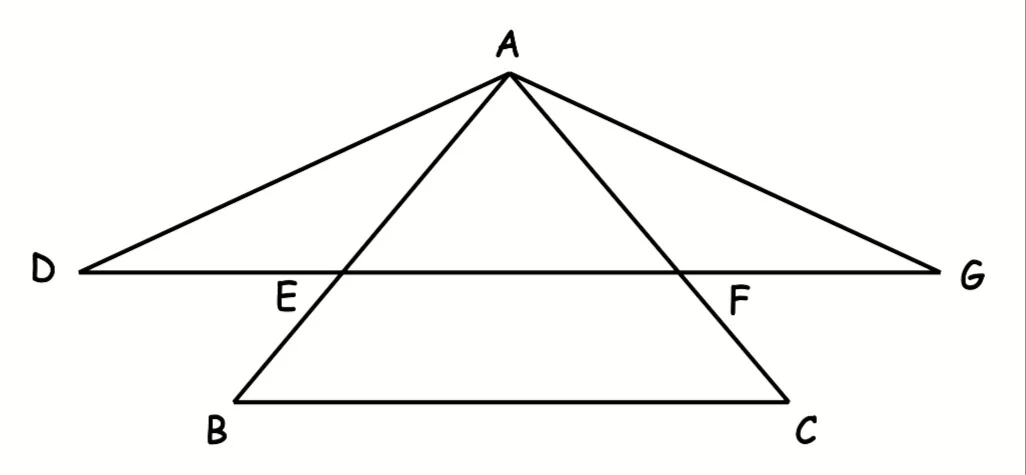
115
Show Answer
Q104.
In \(\triangle ADE \cong \triangle AFG\), if \(DE = (3x - 5)\) units and \(FG = (x + 7)\) units, find the value of x.
6 units
Show Answer
Q105.
In the given figure, ABCD is a square and \(∠PQR=90^\circ \). If PB = QC = DR, then which of the following is invalid?